Attic Insulation
Blown-in fiberglass attic insulation, added to the depth your home needs, to even out hot and cold rooms and cut wasted heating and cooling.
Summer in Fayetteville means a long run of 90-degree afternoons, and a thin attic sends that heat straight down into the house. We do attic insulation, attic insulation removal and air sealing for Fayetteville homes, from 1960s ranches to the neighborhoods the city took in on its west side. Insulation Pros serves homes across North Carolina, and we can price most attics free, from the size alone.
Fayetteville has about 92,000 housing units spread over about 148 square miles, by the Census Bureau's figures. The 1970s were the busiest decade for the housing standing today, at about 19 percent of it, and roughly two thirds went up between 1960 and 1999. Only about 2 percent dates from before 1940.
Summer sets the pace. NOAA's 1991 to 2020 normals for the Fayetteville PWC station average a July high of about 91 degrees and about 53 days a year at 90 or above, against about 63 nights at or below freezing. Both climate maps, the state code's and the newer national one, put Cumberland County in zone 3.
If you're looking for an insulation company in Fayetteville, here's what to expect from us. You give us the square footage of your attic, or your address so we can work out the size, and we price the job. Most attics don't need a home visit for that. If yours needs a closer look, we make a special visit. You'll get a price for what the attic needs, and we won't pad it. We're a family business. This page covers adding attic insulation, taking out insulation that's failed, the city's houses from the 1960s on, and air and duct sealing.
More for Fayetteville homeowners: Attic insulation in Fayetteville.

Monday to Friday 8:00 am to 5:00 pm. Saturday by appointment. Sunday closed.
Fayetteville, the Cumberland County seat at the head of navigation on the Cape Fear River, took its present name in 1783. Its houses run from Haymount homes of the early 1800s and the bungalows of the 1920s to the brick ranches that spread as Fort Bragg grew after 1940.
Haymount climbs the slope about a mile west of Market Square, and its lower streets only came inside the city limits around 1910. The district's National Register nomination, written in 1983, counted forty-one houses built between about 1817 and 1950. Most went up between 1900 and 1930, in styles from Federal and Greek Revival to Colonial Revival. In a Haymount house, look at the wiring before the insulation. Ceilings of that era may still hide porcelain knobs and tubes, and ENERGY STAR treats that pre-1930 wiring as a fire hazard where loose fill would bury it. An electrician sorts out which runs are still live, and those stay uncovered.
Bungalows caught on in Fayetteville in the late 1910s and above all in the 1920s. Whole neighborhoods of them, Pershing Heights along General Lee Avenue and Haymount Heights among them, grew northwest of the old city in the 1920s and 1930s. The 1983 National Register study of the city's historic resources describes a typical local bungalow as a story and a half, with several front gables, wide eaves and exposed rafters. In that half story the bedrooms tuck under the slope of the roof, and short knee walls close off a low space at each side. ENERGY STAR puts the hollows behind knee walls, and the floor cavities beneath them, on its list of attic leak spots. So those side attics get sealed and insulated too, along with the space overhead.
Army personnel at Fort Bragg went from about 5,000 to 93,000 between early 1940 and the fall of 1942. The 2009 survey of Fayetteville's modern buildings found brick ranch houses filling the subdivisions of the 1950s and 1960s. It found brick ranches and split-levels in Van Story Hills, and plain brick ranches in Bonnie Doone and south of Raeford Road around Bingham Drive. Owens mixes ranches with Minimal Traditional houses. A ranch's low roof leaves very little height above the outside walls, and ENERGY STAR notes that the eaves are sometimes where insulation runs thin. The soffit vents at those edges stay open, with baffles holding the insulation back. In a split-level, the upper and lower wings may each sit under a roof of their own, and both of those attics get looked at.
Attic insulation, removal, air sealing and more. Open one to see how the work goes.
Blown-in fiberglass attic insulation, added to the depth your home needs, to even out hot and cold rooms and cut wasted heating and cooling.
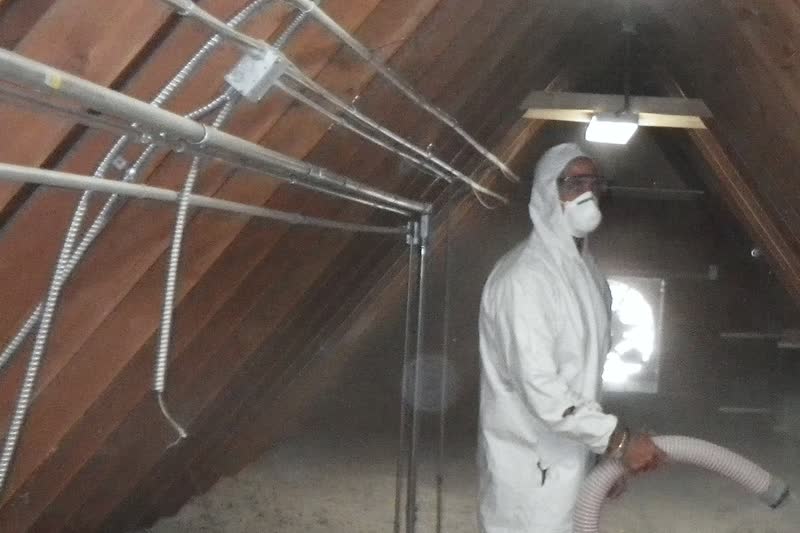
Old, wet, matted or animal-soiled attic insulation vacuumed out, so new insulation can go in on a clean, sealed attic floor.
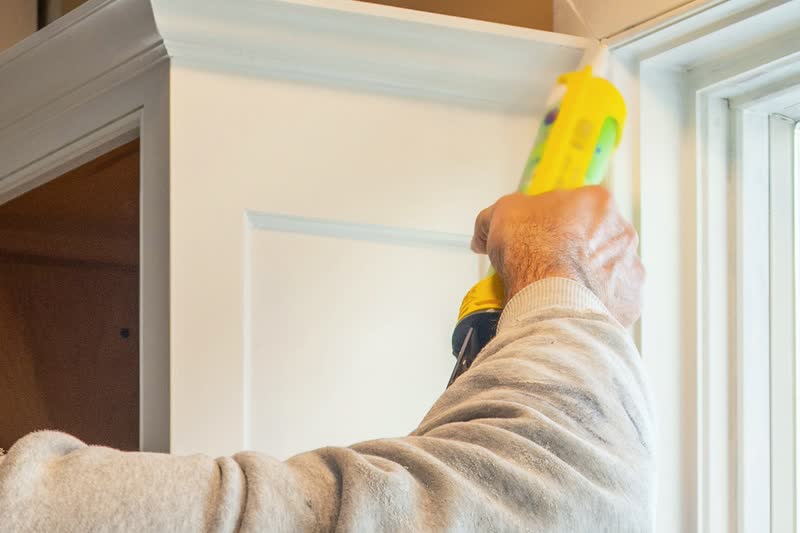
Sealing the gaps between your rooms and the attic, and leaky ductwork, so the air you pay to heat and cool stays inside.
Insulation blown into the closed walls of an existing house, batts in open walls for additions, remodels and new builds, and garage walls and ceilings.
Insulation for the garage ceiling under a bonus room, the wall shared with the house and the garage attic, with air leaks sealed first.
Floor insulation under the house: wet or fallen insulation pulled out, new batts between the floor joists, plastic over the dirt and the floor leaks sealed.
Most of the attic insulation we put into Fayetteville houses goes on top of an existing layer. After the ceiling's air leaks are sealed and baffles are set at the eaves to keep the soffit vents clear, blown-in fiberglass gets spread over the dry old insulation until the whole floor is one even depth.
In zone 3, ENERGY STAR's target is R-49 for a bare attic, and R-38 on top where an attic already has 3 to 4 inches. New houses only have to meet R-38 under North Carolina's energy code, so even one built to code may fall short of ENERGY STAR's figure. See attic insulation in Fayetteville for how deep each material has to be and what moves the price.
Fayetteville's center sits about 100 feet above sea level, 1 mile from NOAA's Fayetteville PWC station, the best match for Fayetteville. The station's 1991 to 2020 normals average about 2,970 heating and 1,890 cooling degree days a year, so at Fayetteville's station, heating needs outweigh cooling.
Only a failed layer comes out. ENERGY STAR's guide to hiring an attic insulation contractor says new insulation can go on top of old unless the old has gotten wet or moldy, picked up an odor, or been soiled by animals. The cause gets fixed first: a roof leak by a roofer, and animals out of the attic with their way in closed.
Then the attic insulation removal itself is done with a vacuum. The spoiled material gets pulled out, the bare ceiling is sealed while every hole is easy to see, and in most homes a new layer is blown in to the target depth. If you'd rather have the old insulation taken out and nothing put back, just say so.
One old fill is off limits: vermiculite, which looks like small gray-brown or silver-gold pebbles. The EPA's advice is to treat it as if it contains asbestos, leave it in place and call in a professional asbestos contractor before any work would disturb it. Finding it ends our part of the job until that's done.
About 49 percent of Fayetteville's housing units were built in the 1960s, 1970s and 1980s. The 2024 scoping report for the county's architectural survey describes the county growing more urban in the decades after 1940, as new subdivisions and mobile home parks spread over former fields and forests. It notes that by 1980 more than 80 percent of Cumberland County's residents lived in urban areas.
Many of those houses were started before January 1, 1978. For a house begun on or after that date, North Carolina law has required a certificate that it meets the state's minimum insulation standards before anyone moves in, wherever the county or city enforces them. About 44 percent of the city's housing predates 1980, so a good share of it went up before the 1978 insulation rule or just after it.
In these attics the first job is finding out how much is there. Stand at the hatch and look across the floor. By ENERGY STAR's test, joists that show at or above the top of the insulation mean the attic needs more, and joists lost under an even blanket mean it probably has enough. ENERGY STAR adds that the middle of an attic can be well filled while the eaves hold very little, so check out at the edges too. Tell us what you see when you ask for a price.
About 29 percent of the city's housing dates from the 1990s and 2000s, and about 10 percent from 2010 or later. Part of today's city was built outside its limits and joined later. The city's Phase 5 annexation, carried out under a state method that applies only to areas already developed, made those areas part of Fayetteville on September 30, 2005. The Fayetteville Observer put it at 27 square miles of western Cumberland County and about 46,000 people.
Houses from these decades were insulated to the code of their day. What we want to know is whether the layer has settled, whether it reaches the eaves, and what happened to it when the air handler, ducts or recessed lights went in. Where the ceiling has can lights, ENERGY STAR says to keep insulation 3 inches away unless the fixture is rated IC, for insulated ceiling.
ENERGY STAR's hiring guide is blunt about the order. Ask for the attic's holes and gaps to be sealed before any insulation is added, and if a contractor won't agree to seal first, call another one. Loose fill slows heat but not air. We close the openings where walls meet the attic floor, the dropped soffits over cabinets, the chases around flues and ducts, the plumbing vent and the wiring holes. Then the hatch gets weatherstripped and insulated.
Ductwork in the attic is one of ENERGY STAR's signs of poorly performing ducts, and it puts the typical house's loss at 20 to 30 percent of the air that moves through the system. On a 90-degree afternoon, that's cooled air you paid for. We seal the joints and the boots behind the ceiling registers with mastic or metal tape, never ordinary duct tape. Ducts that are crushed, kinked or apart go to an HVAC contractor.
Fayetteville runs its own electric system. For gas, Fayetteville is in the Cumberland County franchise of Piedmont Natural Gas, and 23 percent of Fayetteville homes heat with piped gas.
Rebate to check in Fayetteville: Insulation Incentive Program (PWC). Before a Fayetteville job, check its current terms; the Cumberland County page lists every program.
Each page has local notes on the homes and attics in that town.
Cumberland County, 7 miles north
Median home built 1990, 6 years newer than Fayetteville's
Attic insulation in Spring LakeCumberland County, 8 miles south
Median home built 1995, 11 years newer than Fayetteville's
Attic insulation in Hope MillsCumberland County, 11 miles east
Median home built 1986, 2 years newer than Fayetteville's
Attic insulation in EastoverCumberland County, 16 miles east
Median home built 2003, 19 years newer than Fayetteville's
Attic insulation in StedmanHoke County, 16 miles southwest
Median home built 1975, 9 years older than Fayetteville's
Attic insulation in RaefordAlso in Cumberland County: Falcon, Godwin, Linden, and Wade. Every town in Cumberland County. See all service areas.
Local service pages: Attic Insulation in Asheville, Attic Insulation in Charlotte, Attic Insulation in Durham, Attic Insulation in Fayetteville, Attic Insulation in Greensboro, Attic Insulation in Greenville, Attic Insulation in High Point, Attic Insulation in Lexington, Attic Insulation in Raleigh, Attic Insulation in Thomasville, Attic Insulation in Wilmington, Attic Insulation in Winston-Salem.
Look for one that prices only what your attic needs and agrees to seal before it insulates. ENERGY STAR's hiring guide tells homeowners to call another contractor if one won't. The estimate should name the target R-value, include baffles at the eaves and say whether any old insulation comes out. ENERGY STAR also suggests comparing estimates from more than one contractor. At the end of the job, the FTC's R-value Rule requires a receipt showing what was installed, including the R-value and, for blown-in insulation, the number of bags.
Often it's part of the answer. ENERGY STAR lists hot or cold rooms and uneven temperatures among the signs that an attic needs insulation and air sealing. On a hot afternoon the roof heats the attic, and that heat comes down through a thin layer and through gaps in the ceiling. Sealing, bringing the layer up to depth and sealing attic ducts usually come first. Where ducts run through the attic, a radiant barrier can help too, since the Building America Solution Center says it keeps attic ductwork cooler in summer.
Yes. All of North Carolina is our service area, so Hope Mills, Spring Lake and the other towns of Cumberland County are covered, and so is Raeford over the Hoke County line. Each of the nearby towns above has its own page. The price works the same there too, usually from the square footage.
It can be, but we'll tell you if it isn't. Start with ENERGY STAR's check: if the joists are buried under an even layer, adding more may not be cost-effective. If the attic is thin, or the insulation is wet or fouled, fixing it is a plain repair a buyer's inspector may note. Your price shows what the attic needs, if anything, and the decision is yours.
Attic insulation, insulation removal and air sealing are the main work. Beyond the attic, we blow insulation into the closed outside walls of existing houses, insulate garage ceilings, the wall a garage shares with the house and garage attics, and insulate the floors over crawl spaces. Commercial buildings get attic and ceiling insulation too. A home energy audit is a paid service of its own.
The size first. Send the attic's square footage, or an address and we'll work the size out ourselves. It helps to know about when the house was built, whether the air handler is in the attic, whether gas heats the house or the water, and which rooms are hardest to keep comfortable. If you've seen water stains on a ceiling, tell us that too, since it may mean a special visit first. Before install day, clear the way to the attic opening, whether that's a hatch in a closet or pull-down stairs in a hallway or garage.
No. Insulation and air sealing are inside work. Fayetteville's Historic Resources Commission rules on exterior changes in the city's two local historic districts, and the state statute behind it leaves interior arrangement outside any commission's reach. New vents in the roof or soffits are exterior work, though, so get the commission's answer before that step. Haymount's place on the National Register, by itself, limits nothing an owner pays for privately.
Brown rings on a ceiling, and insulation that feels damp or has slumped into clumps. Florence dropped about 10 inches of rain at Fayetteville Regional Airport and 18 to 20 inches in places south of the city, the state's 2024 county survey report notes. Rain that lasts for days can find small gaps in a roof. ENERGY STAR lists damp insulation among the problems to fix before insulating, because it points to the roof. The roofer goes first. After that, we vacuum out what got soaked and blow in new.
Yours, as the owner. A gap between leases is the easiest moment, with the room under the attic hatch empty and nothing to move. If the house is occupied, settle on a day with your tenant well ahead. Nearly all of our work happens up in the attic and right at the hatch, so the living space below is barely disturbed. Leaks in the ceiling are sealed first, and the new insulation goes on after that.
Attic Insulation
Start with the free checks, then work up through the attic: insulation depth, air leaks, ducts and roof heat. Each step says plainly whether it is a job for an HVAC technician or an insulation contractor.
Air Sealing
Powered attic fans, solar attic fans and whole-house fans do three different jobs. Here is what the studies measured, how North Carolina's humid summers limit them, and what to fix in the attic before buying one.
Census Bureau figures for Fayetteville, NOAA normals for the Fayetteville PWC station, NOAA monthly normals for the Fayetteville PWC station, Fayetteville Public Works Commission (PWC), Annexation (City of Fayetteville), The size and shape of Fayetteville has changed over the years (The Fayetteville Observer, 2023), Cumberland County Architectural Survey Update, Phase I Scoping Report (NC HPO), N.C. Gen. Stat. 143-139.2, enforcement of insulation requirements, How to Hire an Attic Insulation Contractor (ENERGY STAR), Adding Attic Insulation (ENERGY STAR), Recommended Home Insulation R-Values (ENERGY STAR), Attic Insulation Project (ENERGY STAR), Duct Sealing (ENERGY STAR), Asbestos-contaminated vermiculite insulation (EPA), Attic Radiant Barriers (Building America Solution Center), FTC R-value Rule (16 CFR 460.17), North Carolina codes in force (Office of State Fire Marshal) (October 2026). Compiled by Insulation Pros. How the town pages are made.
Sources for the Fayetteville notes and questions (read October 20, 2026):
Fayetteville, NC
Open in Google Maps (opens in a new tab)Insulation Pros is an insulation contractor serving North Carolina, Fayetteville and Cumberland County included. A free price on a Fayetteville attic usually takes just its size.
Not sure what's over the ceilings of your Fayetteville house? Call or text, or send the attic's size or your address, and a free price comes back in writing. If the attic needs nothing, that's what we'll tell you.
What You Can Count On
We serve homes across North Carolina. These are the largest towns we work in.
Alamance County
Buncombe County
Cabarrus County
Cumberland County
Durham County
Forsyth County
Gaston County
Guilford County
Mecklenburg County
New Hanover County
Onslow County
Orange County
Pitt County
Wake County