Attic Insulation
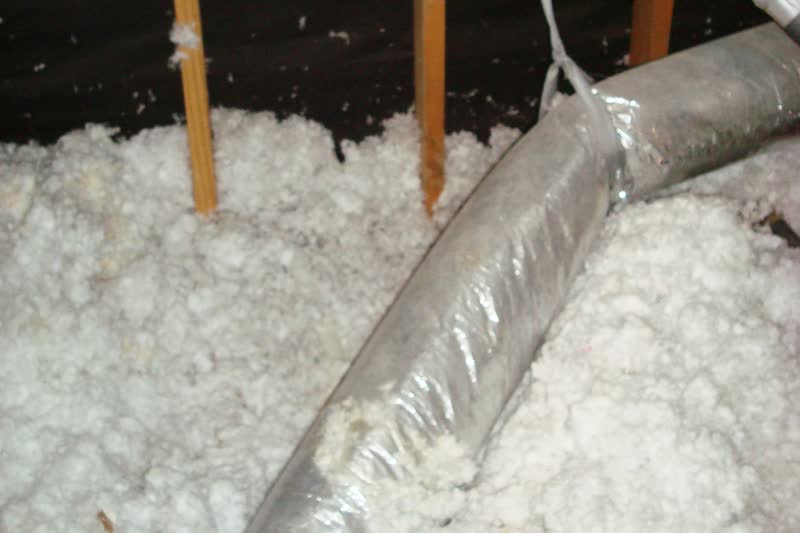
Blown-in fiberglass attic insulation, added to the depth your home needs, to even out hot and cold rooms and cut wasted heating and cooling.
About 37 days a year in Salisbury hit 90 degrees, and on every one a thin attic sends heat into the rooms below. We add blown-in attic insulation, vacuum out worn-out layers and seal the ceiling's leaks, in houses old and new. Free estimates.
Salisbury is the Rowan County seat, and the City counts ten National Register historic districts within its limits. Census Bureau estimates date about one in seven of the city's housing units to 1939 or earlier and more than half to before 1980, and the same estimates put a little over a third at 1990 or later. So no single rule fits every Salisbury attic.
Insulation Pros is family owned and operated, and all of Salisbury lies inside the area we cover. In a Salisbury house the attic comes first: the insulation already there, whether any of it calls for attic insulation removal, and where the ceiling needs air sealing. We do most estimates from the attic's area, so for a lot of houses you can get a price with nobody stopping by.

Monday to Friday 8:00 am to 5:00 pm. Saturday by appointment. Sunday closed.
Salisbury dates to 1755, but much of its housing ring grew after 1896, when the Southern Railway put its big repair shops at nearby Spencer. The city doubled in size within a decade, and boarding houses, rentals and family homes from that boom now carry attics more than a century old.
Southeast of downtown, Brooklyn-South Square mixed merchants' houses with the smaller homes of railroad workers, salesmen and clerks. Its National Register nomination dates the largest group of houses to 1890 through 1915. The inventory also shows how often they grew afterward: a rear ell added about 1900, an upper story and rear ells about 1905, a rear ell in 1935. An addition like that can sit under its own roof. Behind it may be a separate attic reached by its own little hatch, holding more or less insulation than the main one, or a pocket nobody has opened. We trace each roof section and fill every one to the same level, so no thin patch is left behind.
The city's 2023 survey update of the Salisbury Historic District also walked about 15 blocks just south of it. East of Fulton Street the older houses cluster. West of Fulton building came later, with far more houses from the 1950s and 1960s, Ranch houses among them, and the survey suggested carrying the district's period of significance forward to 1975. Kitchens of those decades sometimes have a dropped soffit, a boxed-in space above the wall cabinets. ENERGY STAR lists these among common attic leaks, because many are open on top. From the attic, the insulation over one is pulled back, the opening is covered and sealed, and the insulation is put back.
Attic insulation, removal, air sealing and more. Open one to see how the work goes.
Blown-in fiberglass attic insulation, added to the depth your home needs, to even out hot and cold rooms and cut wasted heating and cooling.
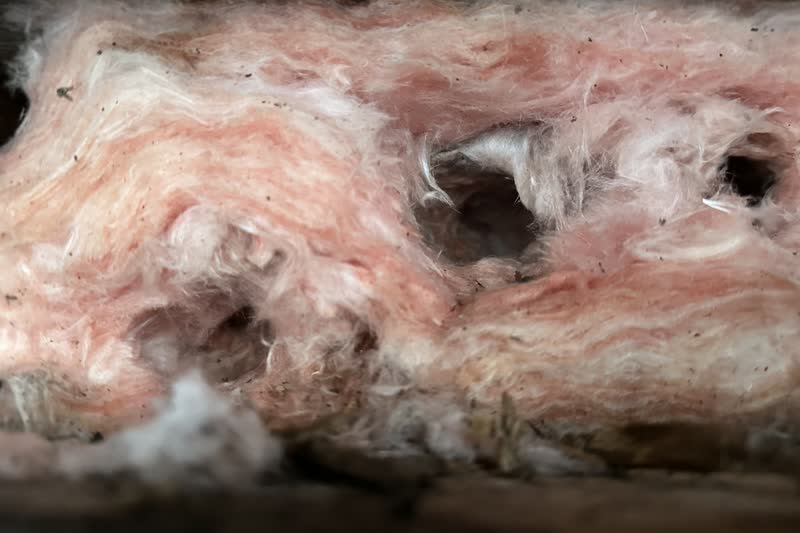
Old, wet, matted or animal-soiled attic insulation vacuumed out, so new insulation can go in on a clean, sealed attic floor.
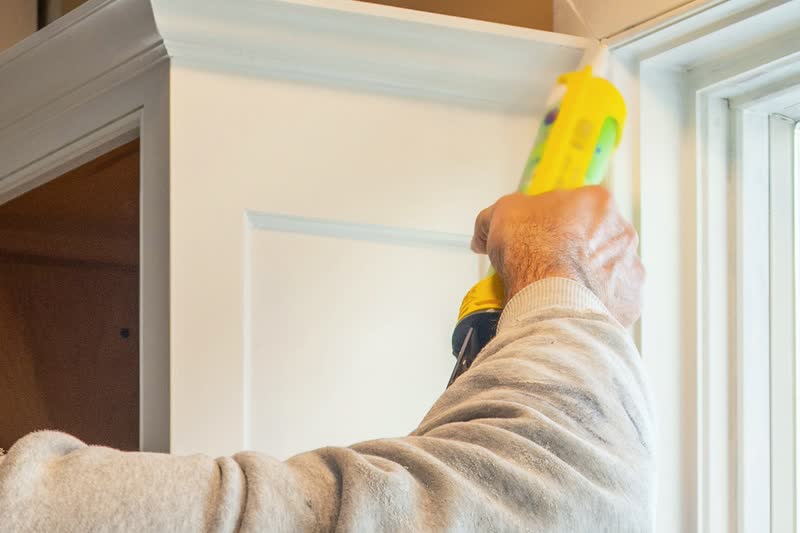
Sealing the gaps between your rooms and the attic, and leaky ductwork, so the air you pay to heat and cool stays inside.
Insulation blown into the closed walls of an existing house, batts in open walls for additions, remodels and new builds, and garage walls and ceilings.
Insulation for the garage ceiling under a bonus room, the wall shared with the house and the garage attic, with air leaks sealed first.
Floor insulation under the house: wet or fallen insulation pulled out, new batts between the floor joists, plastic over the dirt and the floor leaks sealed.
Attic insulation in Salisbury starts from a clear target. North Carolina's energy code puts Rowan County in climate zone 3, and the newer national map agrees. So one line of ENERGY STAR's chart applies: add R-49 to an attic that has none, or bring one that already holds 3 to 4 inches up to R-38.
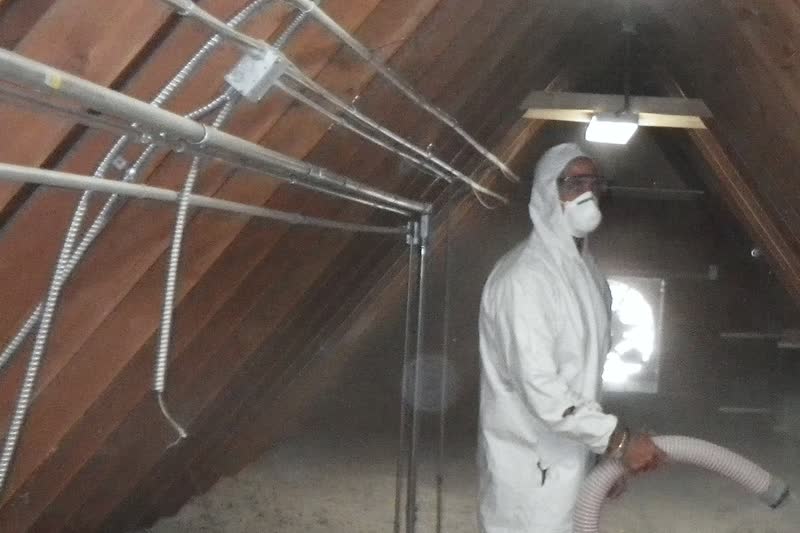
Our attic work is blown-in, loose-fill insulation. The crew measures what's there, seals the ceiling's air leaks, and blows new material to one even depth, with baffles holding it back from the soffit vents. Clean, dry insulation stays and gets covered. Your price gives the target as an R-value, with the depth in inches beside it.
Salisbury's center sits about 770 feet above sea level, 1 mile from NOAA's Salisbury station, the best match for Salisbury. The station's 1991 to 2020 normals average about 3,530 heating and 1,480 cooling degree days a year, so at Salisbury's station, heating needs outweigh cooling.
Clean, dry insulation is worth keeping, but some old layers would only hide a problem under a new one. Those come out: insulation soaked or stained by a roof leak, insulation that rodents or other animals have nested in, and insulation packed down so hard it won't fluff back up.
Whatever spoiled it gets stopped first, by a roofer for a leak or a wildlife company for animals, and then the old layer is vacuumed out of the attic. With the attic floor bare, its gaps get sealed and, in most homes, fresh insulation is blown in. If you're after removal alone, we do that job as well.
Vermiculite is the exception. This loose fill, which looks like small gray-brown or silver-gold pebbles, should be treated as containing asbestos and left undisturbed, according to EPA. We don't vacuum it out; a professional asbestos contractor has to handle it.
NOAA's 1991 to 2020 normals count about 37 days a year in Salisbury that reach 90 degrees, and on those afternoons a sun-baked roof deck sends its heat down into the attic. A radiant barrier, in the words of the Department of Energy's Building America Solution Center, is typically a layer of reflective aluminum foil placed in the attic next to an air space. Where the ductwork runs through the attic, the same source says, a radiant barrier keeps it cooler during the summer.
It works alongside the insulation on the attic floor, not in place of it, and the Solution Center adds that its advantages shrink where an attic picks up little summer heat. Insulation and air sealing come first, and that's where we'd put your money.
Salisbury's older neighborhoods are well recorded. The National Register nomination for North Main Street describes houses from 1900 to 1930. Among them are the cottages and bungalows of railroad workers from the Spencer Shops, with steep hipped roofs, gables and dormers. Around the former Kesler textile mill in the Park Avenue neighborhood, the mill district's own nomination records rows of identical frame mill houses, one and two stories tall, built between 1895 and 1928. Fulton Heights, its own nomination says, was laid out in 1902 about a mile south of downtown. Craftsman bungalows dominated its 1910s and 1920s, and many of the bungalows in the National Register inventory are a story and a half.
For insulation, the roof shape matters more than the style. Steep roofs broken up by gables and dormers leave small, awkward attics, and a story-and-a-half bungalow hides more attic behind the short knee walls of its upstairs rooms. Those spots are slow hand work, and some of them can't be reached at all. How much insulation is up there now depends on what earlier owners added. A house like this is where we're most likely to schedule a special visit before giving you a number.
Census estimates date roughly 35 percent of Salisbury's housing units to 1950 through 1979. In those decades, the Fulton Heights nomination notes, the ranch house, often brick, was the form people chose.
A one-story ranch has one broad attic over the whole floor plan, the simplest kind to bring up to a modern R-value and the easiest to price from its square footage. The crew checks how far the original layer has settled and whether the ceiling under it was ever sealed. A settled layer that's still dry gets a top-up. One that's wet or fouled comes out first.
A little over a third of Salisbury's housing units date from 1990 or later, by Census estimates. In a house this new the question is how well the insulation went in and how it's held up. Depth at the eaves matters as much as depth in the middle, and so do the ducts. Where a Salisbury house's heat travels through ducts in the attic, duct sealing may come before any added insulation.
Air sealing means closing the holes in the ceiling that let house air escape into the attic, and it comes before insulation. ENERGY STAR's attic guide says to finish the sealing first and to plug the big holes before the small ones. In an older Salisbury house one of the big ones is the gap around a chimney or flue, which is closed with aluminum flashing and heat-resistant caulk. Another is the open framing under the knee walls of rooms built into an attic.
In a ranch or newer house the leaks are smaller: the hatch, recessed lights, and holes for pipes and wiring. ENERGY STAR also lists knob-and-tube wiring from before 1930 as a fire risk once insulation touches it. If the crew sees it, a qualified electrician checks it before we cover anything.
Duke Energy Carolinas supplies Salisbury's electricity. For gas, Salisbury is in the Rowan County franchise of Piedmont Natural Gas, and 37 percent of Salisbury homes heat with piped gas. Duke's free House Call fits many Salisbury homes: 58 percent heat with electricity.
Rebate to check in Salisbury: Smart $aver Insulate and Seal (Duke Energy; Insulation Pros is an approved trade ally). Before a Salisbury job, check its current terms; the Rowan County page lists every program.
Give us the street address and, if you know it, the square footage. Missing that number? We work it out from the shape of the house. For a ranch or a newer home, that's usually enough to price the job without anyone coming out.
Older bungalows and mill houses can be a different story. If yours has knee walls, a chimney through the attic floor or pebbly fill, we may come look first so the price is right.
Before they start the work, the installers go up with you and measure the insulation at the hatch, in the middle and at the eaves, find where the ceiling leaks air, and look over the wiring, the can lights and the duct runs. If anything up there is spoiled badly enough to come out and wasn't in the price, you'll hear it from them first, in plain words.

Each page has local notes on the homes and attics in that town.
Davidson County, 15 miles northeast
Median home built 1969, 7 years older than Salisbury's
Insulation contractor serving LexingtonCabarrus County, 16 miles southwest
Median home built 1989, 13 years newer than Salisbury's
Insulation contractor serving KannapolisDavie County, 17 miles north
Median home built 1986, 10 years newer than Salisbury's
Insulation contractor serving MocksvilleIredell County, 20 miles west
Median home built 2006, 30 years newer than Salisbury's
Insulation company serving MooresvilleCabarrus County, 21 miles southwest
Median home built 1998, 22 years newer than Salisbury's
Insulation company serving ConcordAlso in Rowan County: China Grove, Cleveland, East Spencer, Faith, Granite Quarry, Landis, Rockwell, and Spencer. Every town in Rowan County. See all service areas.
Local service pages: Attic Insulation in Asheville, Attic Insulation in Charlotte, Attic Insulation in Durham, Attic Insulation in Fayetteville, Attic Insulation in Greensboro, Attic Insulation in Greenville, Attic Insulation in High Point, Attic Insulation in Lexington, Attic Insulation in Raleigh, Attic Insulation in Thomasville, Attic Insulation in Wilmington, Attic Insulation in Winston-Salem.
Yes. Our work covers the whole state. The whole city is inside that area, and so are Spencer, Granite Quarry and China Grove. Not sure about your address? Just ask.
The street address and, if you know them, the square footage and the decade the house was built. Then what made you reach out, like a hot upstairs, a stained ceiling or a room that never warms up. With that, most Salisbury attics can be priced right away.
Yes. Attic insulation and air sealing are done inside the house, so the outside is the part to check. The City of Salisbury requires a Certificate of Appropriateness before exterior changes in its five local historic districts: Downtown, West Square, North Main Street, Brooklyn-South Square and Ellis Street Graded School. Houses that are only in a National Register district don't need one. If a job would change anything visible from the street, ask the City's planning staff first.
Rowan County is climate zone 3 twice over: in North Carolina's energy code and on the newer national climate map. For that zone, ENERGY STAR's chart says to add R-49 where an attic has no insulation, or R-38 when there are 3 to 4 inches to build on. Your price names the target R-value, and the crew measures what's there before they start.
Yes. When the old layer is wet from a roof leak, soiled by animals or packed flat, we vacuum it out, close up the gaps in the bare ceiling and, in most cases, put fresh insulation down afterward. The leak or the animals get dealt with first, by a roofer or a wildlife company. Vermiculite stays where it is: EPA advises assuming it contains asbestos and leaving it undisturbed, so its removal belongs to an asbestos contractor.
Look first at the knee walls, the short walls of the upstairs rooms with attic space on the other side. ENERGY STAR's attic air sealing guide says finished rooms built into attics often have open cavities in the floor framing under those walls, and it names the areas behind and under knee walls among the places an attic leaks air. In a story-and-a-half Salisbury bungalow we seal and insulate the parts we can reach, and we'll tell you plainly which parts we can't.
Yes. The work is the owner's decision, and we deal with the owner. Renting has deep roots here: the Shaver Rental Houses, a small National Register district, were three houses built around 1907 for tenants and boarders, and they stayed rentals until 1976. A tenant who notices a hot upstairs or a cold hallway can pass that on, but it is the owner who signs off on the work and picks the install day.
Not by itself. The city paid for the 2023 survey with help from a federal preservation grant. It updated the records for the Salisbury Historic District and recommended a larger boundary, which would still need its own National Register documentation. Even a new boundary would not tie your hands: the state preservation office describes Register listing as placing no restriction on private owners spending private funds. Design review of outside changes comes only with the city's local districts.
No. Some boom-era houses were built around interior chimneys: each Shaver rental house had two interior brick chimneys for eight fireplaces, plus a kitchen flue. Where a chimney passes the attic floor, ENERGY STAR calls for lightweight aluminum flashing and high-temperature caulk over the gap. A sheet-metal dam then holds the loose fill away from the brick. The usual code gap is 2 inches around masonry chimneys, or 1 inch around metal flue pipe.
Attic Insulation
North Carolina's energy code requires R-38 in a new ceiling, and ENERGY STAR recommends more for existing attics. See both numbers, which climate zone your county is in and how many inches each R-value takes.
Attic Insulation
Most old attic insulation can stay under a fresh top-up. Wet, moldy, animal-soiled or smoke-damaged material cannot. Learn how to tell the difference, what removal involves and what to do about vermiculite.
Census Bureau figures for Salisbury, NOAA normals for the Salisbury station, Duke Energy Carolinas (October 2026). Compiled by Insulation Pros. How the town pages are made.
Sources for the Salisbury notes and questions (read October 20, 2026):
Salisbury, NC
Open in Google Maps (opens in a new tab)Insulation Pros is an insulation contractor serving North Carolina, and that covers every Salisbury neighborhood from the mill streets to the newest subdivisions. Prices are free and honest, and we won't sell you work your attic doesn't need.
Built in 1915, 1965 or 2015, your Salisbury house gets the same free, straight price. Its size is where we start, and the decision stays with you.
What You Can Count On
We serve homes across North Carolina. These are the largest towns we work in.
Alamance County
Buncombe County
Cabarrus County
Cumberland County
Durham County
Forsyth County
Gaston County
Guilford County
Mecklenburg County
New Hanover County
Onslow County
Orange County
Pitt County
Wake County