Attic Insulation
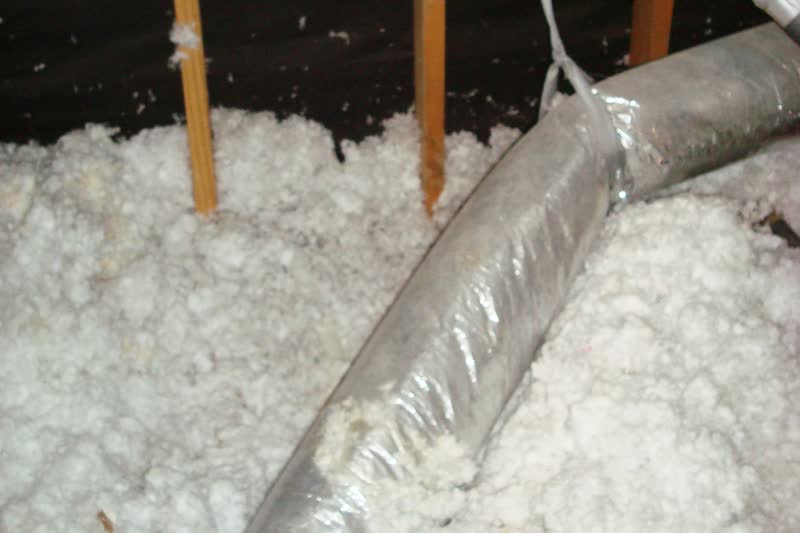
Blown-in fiberglass attic insulation, added to the depth your home needs, to even out hot and cold rooms and cut wasted heating and cooling.
On electric heat in King, the warmth that leaks up into the attic ends up on your power bill. More insulation blown in, ruined layers vacuumed out and the ceiling sealed: that's most of what we do in King's old bungalows, 1970s houses and newer builds.
King grew late and fast. The City says it was founded as a train depot in 1888, grew rapidly in the 1970s and incorporated in 1983. A 1989 historic survey of Stokes County ties the faster growth to the new US 52, finished in 1965. In the Census Bureau's 2020 to 2024 survey, more than a quarter of King homes date from the 1970s, more than a third from the 1990s and 2000s, and fewer than one in ten from before 1960. The old center around Dalton Road and Main Street, a National Register historic district, has frame houses from about 1905 and many Craftsman bungalows.
King sits near the base of the Sauratown Mountains, and the U.S. Department of Energy classes Stokes County as mixed-humid. In a King house on electric heat, the heat that slips up through the ceiling into the attic shows up on the power bill.
Insulation Pros is a family business, and King is part of our area. Most calls here are about adding attic insulation, attic insulation removal or air sealing. For any of them, tell us roughly how big the house is. That gets you most of the way to a price, with no appointment.

Monday to Friday 8:00 am to 5:00 pm. Saturday by appointment. Sunday closed.
King began as four small villages, and when the railroad came through, local families built a depot themselves and sold it to the line. Its historic district was built up chiefly in the tobacco years from about 1915 to 1950, so the attics there are three quarters of a century old or more.
The King Historic District's nomination picks two hip-roofed, two-story frame houses from about 1905 and 1907 as typical of its earliest homes. It says several houses on East Dalton Road are much like them. With a house of that height and age, find out first whether the walls are balloon framed. If so, their stud bays often run up with no plate across the top. Heated air from each floor can then rise inside the walls and spill out above the ceiling. We block those bays from the attic side before anything else. Where a two-tier porch roof is fixed to balloon-framed studs, that joint can let outdoor air into the walls as well.
Attic insulation, removal, air sealing and more. Open one to see how the work goes.
Blown-in fiberglass attic insulation, added to the depth your home needs, to even out hot and cold rooms and cut wasted heating and cooling.
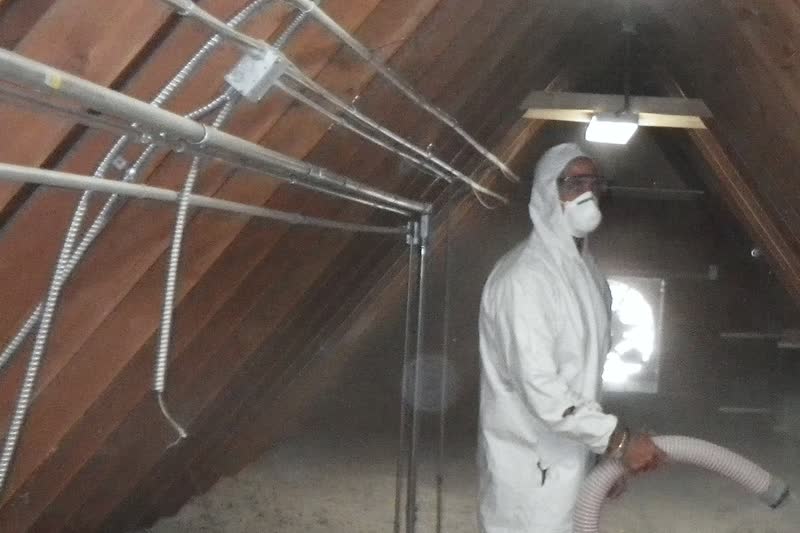
Old, wet, matted or animal-soiled attic insulation vacuumed out, so new insulation can go in on a clean, sealed attic floor.
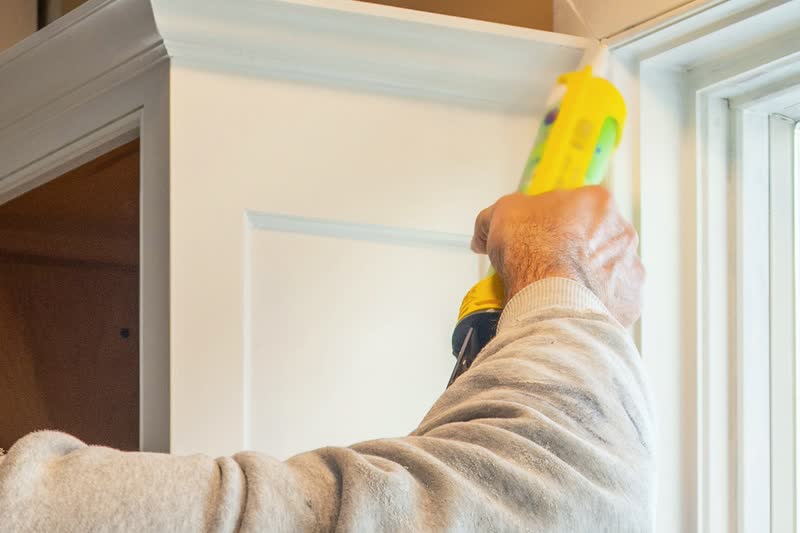
Sealing the gaps between your rooms and the attic, and leaky ductwork, so the air you pay to heat and cool stays inside.
Insulation blown into the closed walls of an existing house, batts in open walls for additions, remodels and new builds, and garage walls and ceilings.
Insulation for the garage ceiling under a bonus room, the wall shared with the house and the garage attic, with air leaks sealed first.
Floor insulation under the house: wet or fallen insulation pulled out, new batts between the floor joists, plastic over the dirt and the floor leaks sealed.
In a 1970s King house, attic insulation usually means blowing new loose-fill over a thin old layer until it reaches a modern depth. In a newer one it means evening out what the builder left. Either way the ceiling leaks get closed first, the order ENERGY STAR asks contractors to follow, and baffles keep the soffit vents open.
Most of King is in Stokes County, climate zone 4 on North Carolina's code map and on the newer national map too. ENERGY STAR's zone 4 targets are R-60 for a bare attic and R-49 over 3 to 4 inches of existing insulation. The Forsyth County corner of King moved to zone 3 on the newer map, where the targets are R-49 and R-38. Every King price we give names an R-value.
King's center sits about 1,120 feet above sea level, 4 miles from NOAA's Rural Hall station, the best match for King. The station's 1991 to 2020 normals average about 3,960 heating and 1,220 cooling degree days a year, so at King's station, heating needs outweigh cooling.
King sits about 150 feet above the station, so expect slightly colder winters.
Taking old insulation out is the exception. ENERGY STAR draws a plain line: a contractor can add on top of the old layer unless it's wet, moldy, smelly or fouled with animal waste. Insulation that's merely thin, flattened in places or a different material from what goes on top can stay, and we'll leave it.
When the old layer fails that test, the first job is finding out why. A roofer repairs a leak, and a wildlife control company deals with animals. Then the old insulation gets vacuumed out, the ceiling gaps it was hiding are sealed, and in most homes a new layer goes in right after. Removal on its own, with nothing new put back, is something we do as well.
The historic district around Dalton Road and Main Street is the old center of King. An attic that's been there since the early 1900s may have been insulated once, several times or never, and some of what turns up in attics that age is work for another trade before it's work for us. We'll probably ask to see a house this old on a special visit before pricing it.
Wiring is the first check. ENERGY STAR's hiring advice says to tell your contractor if the house dates from the 1930s or before, since knob and tube wiring may still be in the attic. If the crew finds any, an electrician looks at it before insulation goes near it. Loose, pebble-like fill is the second: if it's vermiculite, the EPA says to work on the basis that it holds asbestos and to leave it where it is, so our work waits for an asbestos contractor.
Where a chimney rises through the attic, ENERGY STAR's attic air sealing guide calls the opening around it a major path for warm air into the attic, and says to close it with lightweight aluminum flashing and high-temperature caulk. In an attic with a shallow roof, the crew also checks how far insulation can reach toward the eaves without covering the soffit vents.
Nearly four in ten homes in the city were built in the 1970s and 1980s, most of those in the 1970s.
North Carolina's rule that a new house must pass an insulation check before anyone moves in applies to houses started on or after January 1, 1978. A King house from earlier in the decade went up before it, so nobody can assume what its attic holds.
ENERGY STAR gives a quick test: look across the attic, and if the insulation sits level with the joists or below them, it probably needs more. Before adding any, the crew measures in several places, out to the eaves.
More than a third of King homes went up in these two decades, long after the 1978 insulation rule, so their attics should have started out with insulation. The question is whether it's still deep and even. ENERGY STAR's guide to adding attic insulation cautions that the eaves may be nearly bare even where the center is not, and the eaves are the tightest part of the attic to reach.
If your attic floor joists are still buried under a deep, even layer from wall to wall, we'll tell you the attic has enough. That's an honest answer, and it costs you nothing.
Air sealing is the part of an attic job nobody sees: closing the openings in the ceiling before the insulation hides them. ENERGY STAR singles out dropped soffits over kitchen cabinets and bath vanities, the tops of walls, wiring holes and the hatch.
Duct sealing matters here because so many King homes heat with electricity. With a heat pump or electric furnace and ducts running through the attic, every leaking joint lets heated or cooled air out into a space you're not trying to heat or cool. Our part is sealing the joints and connections within reach, and pointing out any run that's crushed or loose.
Power in and around King comes from Duke Energy Carolinas and Surry-Yadkin EMC; your bill says which. For gas, King is in the Stokes County franchise of Piedmont Natural Gas, and 14 percent of King homes heat with piped gas. Duke's free House Call fits many King homes: about 83 percent heat with electricity.
Rebate to check if Duke Energy Carolinas serves your King home: Smart $aver Insulate and Seal (Duke Energy; Insulation Pros is an approved trade ally). Before a King job, check its current terms; the Stokes County page lists every program.
The size of the house is the main thing we need. A square footage figure works, and so does an address. Most King attics can be priced from that, for free.
If you've seen roof stains, old wiring or pebbly fill up there, tell us. Those are the attics we'd rather see on a special visit first.
Before work begins, the installers show you around the attic: the depth in several spots, eaves included, the leaks in the ceiling below, the ducts, and any signs of animals. If something changes the job, you hear it then, before anything is done.

Each page has local notes on the homes and attics in that town.
Forsyth County, 19 miles southeast
Attic insulation contractor serving KernersvilleAlso in Stokes County: Danbury and Walnut Cove. Every town in Stokes County. See all service areas.
Local service pages: Attic Insulation in Asheville, Attic Insulation in Charlotte, Attic Insulation in Durham, Attic Insulation in Fayetteville, Attic Insulation in Greensboro, Attic Insulation in Greenville, Attic Insulation in High Point, Attic Insulation in Lexington, Attic Insulation in Raleigh, Attic Insulation in Thomasville, Attic Insulation in Wilmington, Attic Insulation in Winston-Salem.
Yes. Our service area is homes across North Carolina, and that takes in King and, next door, Rural Hall and Tobaccoville. Many King addresses lie outside the city limits. If you're unsure about yours, send us the street address.
Have the address handy, plus the square footage if you've got it. Then roughly what year the house went up, how you get into the attic, and what sent you looking: a cold room, an upstairs that bakes in summer, a climbing power bill.
Usually not. What's dry and clean stays, and the new layer goes on top once the ceiling leaks are sealed. Patches that are soaked, moldy or dirtied by animals get vacuumed out first and replaced. One caution: ENERGY STAR describes vermiculite as lightweight, pea-size gray granules, and the EPA's guidance is to treat it as if it held asbestos and not disturb it, so we wouldn't vacuum it out.
In most attics, yes. ENERGY STAR says you can mix types when you add insulation, and its guide to adding attic insulation names loose-fill over fiberglass batts as one way to do it. The batts need to be dry and in decent shape, and the ceiling leaks underneath get sealed before the loose-fill covers them.
Often they are. In a typical house, says ENERGY STAR, 20 to 30 percent of what the duct system carries escapes through leaks, holes and poor connections, and ducts in an attic are on its list of warning signs. Most King homes heat with electricity, so that lost air is paid for at the meter. We seal the joints we can reach and tell you when a duct is crushed or disconnected and needs an HVAC contractor first.
Mostly four things: the size of the attic floor, the gap between the insulation you have and the R-value you want, how much air sealing comes first, and how easy the attic is to move around in. Old insulation that has to be vacuumed out adds to the job. The size we can get from you or from the house's footprint, and the price costs nothing.
Because part of each upstairs room sits inside the roof. The district's inventory lists a number of one-and-a-half-story bungalows with a front gable or shed dormer, and one house under a gambrel roof. Upstairs in houses like these, low walls under the slope of the roof hide narrow, triangular attics along the sides. ENERGY STAR lists the spaces behind and under those kneewalls among the leaks to seal, and an Iowa state training text adds that the joist space beneath them is usually left unsealed. Those narrow side spaces get sealed and filled too, not just the main attic.
No. King's district went onto the National Register in 2002. For a house kept up with the owner's own money, the state preservation office says that listing imposes no restriction. Design review would come only from a local preservation commission. The 2023 statewide roster of those commissions has no Stokes County entry. Attic insulation and air sealing happen inside the house anyway.
Attic Insulation
North Carolina's energy code requires R-38 in a new ceiling, and ENERGY STAR recommends more for existing attics. See both numbers, which climate zone your county is in and how many inches each R-value takes.
Air Sealing
Thick insulation over a leaky ceiling is like a wool sweater in a stiff wind. Learn why sealing has to happen first, where leaks hide in attics and ducts, and what a sensible job looks like.
Census Bureau figures for King, NOAA normals for the Rural Hall station (October 2026). Compiled by Insulation Pros. How the town pages are made.
Sources for the King notes and questions (read October 20, 2026):
Insulation Pros is an insulation contractor serving North Carolina, King and the country roads around it included. Most King prices take nothing more than the house's size, and they're free.
Want to know what your King attic needs? Ask us. The price is free, it starts from the size of your house, and if it needs nothing, that's what we'll tell you.
What You Can Count On
We serve homes across North Carolina. These are the largest towns we work in.
Alamance County
Buncombe County
Cabarrus County
Cumberland County
Durham County
Forsyth County
Gaston County
Guilford County
Mecklenburg County
New Hanover County
Onslow County
Orange County
Pitt County
Wake County