Attic Insulation
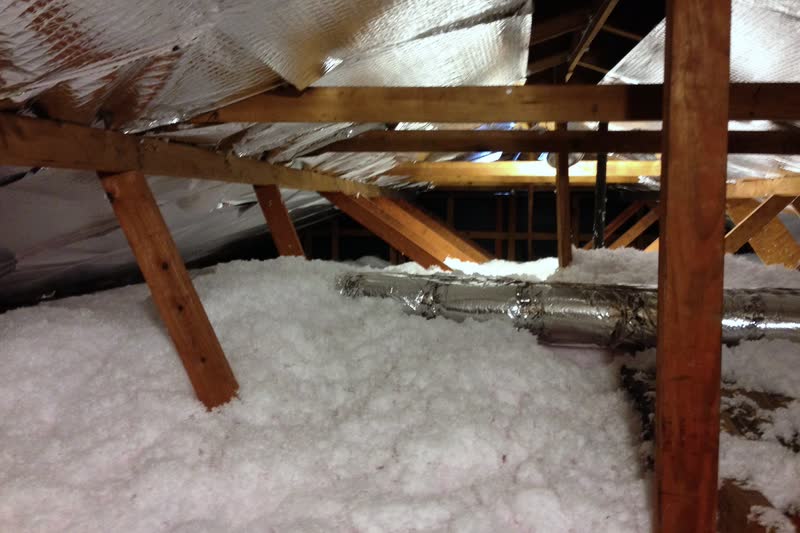
Blown-in fiberglass attic insulation, added to the depth your home needs, to even out hot and cold rooms and cut wasted heating and cooling.
Room over the garage too hot to use in August? We add attic insulation, take out ruined layers and seal the air and duct leaks in Mooresville homes, mill houses south of downtown and big subdivisions near Lake Norman alike. Free estimates, and no upselling.
Mooresville began as a railroad stop, chartered in 1873 with its limits drawn one mile out from the depot. Mooresville Cotton Mills started up in 1894 and built a village of workers' houses on the south side. Lake Norman was finished in 1964, and the town has grown toward the water ever since: 9,317 residents in the 1990 census, 50,193 in 2020. About eight in ten housing units here date from 1990 or later, by the Census Bureau's 2020 to 2024 survey.
Iredell County is mixed-humid on the U.S. Department of Energy's climate map, so a Mooresville house runs its heat in winter and its air conditioning through a muggy summer. In both seasons the attic is the layer between the top-floor rooms and the weather.
A thin attic shows in every season, so this page leads with attic insulation, attic insulation removal and air sealing. We're Insulation Pros, a family owned and operated insulation company, and Mooresville is in our service area. For a Mooresville house, the square footage is the starting number, and for most homes it's the only one we need from you.

Monday to Friday 8:00 am to 5:00 pm. Saturday by appointment. Sunday closed.
In the early 1900s, Mooresville's merchants and mill owners built Queen Anne houses on the in-town streets west of South Broad Street. Mill villages grew at the north and south ends of town, and each of these places left its own kind of attic.
Queen Anne houses were concentrated on the blocks west of South Broad Street, the 2016 survey of the town found. The finest have irregular massing, turrets, cutaway bays and gables crossing gables. In 2020 parts of this area, on West Center Avenue and South Academy Street, were added to the Mooresville Historic District. That nomination finds most of its houses frame and built from 1900 through the 1930s. Corbelled brick chimneys, dormers and rear wings are among their most frequent features. Under a roof like that, the attic breaks into pockets that each need checking. Any chimney rising out of a ceiling into one of those pockets has its surrounding gap sealed with thin aluminum sheet and caulk made for high heat. A metal collar then keeps insulation from touching the masonry.
Besides the big Mooresville Cotton Mills village on the south side, the town had a second, smaller one on the north side. Dixie Cotton Mills opened near Cascade Street in 1906, and by 1914 its hands lived in houses of three to five rooms on the streets running to the plant. The Burlington textile company bought the mill in 1934 and ran it as Cascade Mills until it closed in 1982. The 2016 survey found early frame mill houses with side-gable, hipped and L-shaped plans on parts of Cascade Street, Spencer Street and Selma Drive, nearly all changed by additions. An L-shaped roof meets itself at a valley, and an addition can bring a roof and a small attic of its own. Every section gets opened and measured, so no corner is left with a thin layer.
Attic insulation, removal, air sealing and more. Open one to see how the work goes.
Blown-in fiberglass attic insulation, added to the depth your home needs, to even out hot and cold rooms and cut wasted heating and cooling.
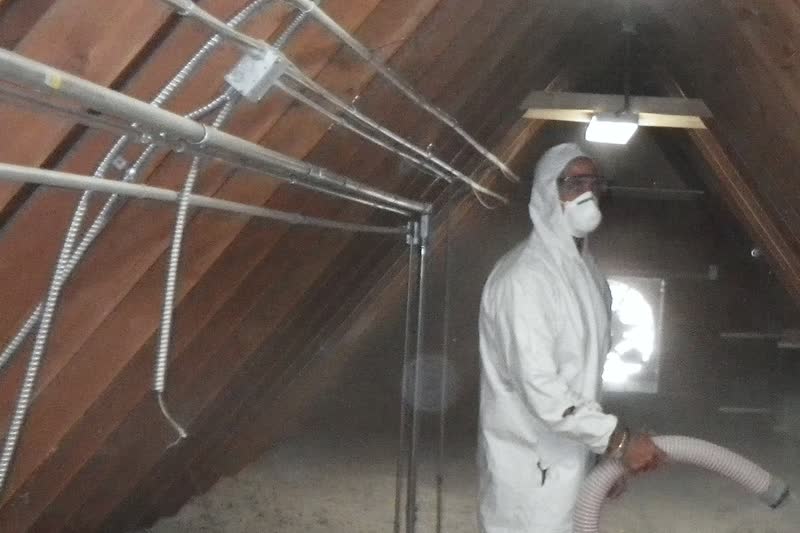
Old, wet, matted or animal-soiled attic insulation vacuumed out, so new insulation can go in on a clean, sealed attic floor.
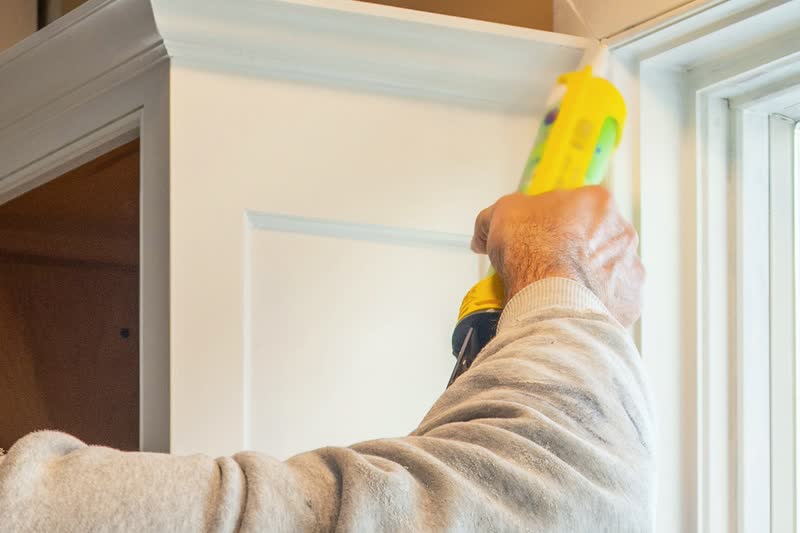
Sealing the gaps between your rooms and the attic, and leaky ductwork, so the air you pay to heat and cool stays inside.
Insulation blown into the closed walls of an existing house, batts in open walls for additions, remodels and new builds, and garage walls and ceilings.
Insulation for the garage ceiling under a bonus room, the wall shared with the house and the garage attic, with air leaks sealed first.
Floor insulation under the house: wet or fallen insulation pulled out, new batts between the floor joists, plastic over the dirt and the floor leaks sealed.
Attic insulation in Mooresville is mostly a matter of measuring. ENERGY STAR's test is to look across the attic floor: if the joists show, add more, and if you can't see them at all, you probably have enough. In the subdivisions built from the 1990s on, the likely job is a top-up. We seal the ceiling leaks, fit baffles so the soffit vents stay clear, and blow loose-fill in to one even depth.
A mill house or a 1950s ranch may have far less, and sometimes damp or soiled material that has to come out first. Either way your price states the target as an R-value, so you can hold our number up against another insulation contractor's.
Mooresville's center sits about 910 feet above sea level, 16 miles from NOAA's Statesville 2 NNE station, the best match for Mooresville. The station's 1991 to 2020 normals average about 3,990 heating and 1,260 cooling degree days a year, so at Mooresville's station, heating needs outweigh cooling.
Removal makes sense when the insulation already up there has been ruined, not just thinned. Soaked by a roof leak, spotted with mold, flattened into a mat or nested in by animals: insulation in that state gets vacuumed out instead of covered, because a fresh layer on top would only hide the damage. Thin but dry insulation stays, and we won't price a removal you don't need.
Before anything is vacuumed out, the cause gets dealt with. A leaking roof is a roofer's repair, and ENERGY STAR lists damp attic insulation as one of its signs. Animals are removed and shut out by a wildlife control company. With the old layer gone, the bare ceiling is open, which makes it the easiest moment for air sealing, and most homes have new insulation blown in once the sealing is done. Want the old insulation out and nothing more? We can do that.
One old material is left alone: vermiculite, the light, pebbly fill found in some older attics. ENERGY STAR cautions that it may hold asbestos and advises leaving it alone unless an approved lab's test shows otherwise, so an attic with vermiculite waits for an asbestos contractor.
Air reaches a Mooresville attic through small openings in the ceiling below. ENERGY STAR's attic air sealing guide names the usual ones: the attic hatch, wiring holes, holes for plumbing pipes, the places where walls meet the ceiling, and dropped soffits over kitchen cabinets or bath vanities. We close those before any new insulation goes in, because a leak under a deep layer is buried, not fixed.
Newer houses add a few of their own, like recessed lights and a chase for the furnace flue or the ducts. A recessed light that isn't rated for insulated ceilings needs 3 inches of clearance under ENERGY STAR's rule, so the new layer is held back from each one.
Duct sealing is the other half of the job. In the attic we seal every joint and register boot within reach. ENERGY STAR lists rooms that are hard to heat or cool, and ducts that run through an attic, among the signs that ducts are worth sealing. A crushed or disconnected run gets pointed out for an HVAC contractor instead of being taped over.
Duke Energy Carolinas serves most of Mooresville, EnergyUnited its edges; your bill says which. For gas, Mooresville is in the Iredell County franchise of Enbridge Gas North Carolina, and 51 percent of Mooresville homes heat with piped gas. Duke's free House Call fits many Mooresville homes: 47 percent heat with electricity.
Rebate to check in Mooresville: Smart $aver Insulate and Seal (Duke Energy; Insulation Pros is an approved trade ally). Before a Mooresville job, check its current terms; the Iredell County page lists every program.
South of downtown, Mooresville Cotton Mills put up its workers' village between about 1902 and 1930. The village went on the National Register of Historic Places in 2012, and its nomination describes wood frame houses of one and one-and-a-half stories.
It also records the changes owners made after the mill began selling the houses to its workers in 1950, enclosed back porches and new additions among them.
So a mill house is rarely one simple box above the ceiling. An old porch turned into a room may have its own low roof and a separate attic, and any upstairs rooms sit under the rafters with short walls around them. Wiring from the early decades may still be up there too. ENERGY STAR dates knob-and-tube wiring to before 1930, the years these houses went up, and flags it as a possible fire hazard when insulation lies against it, so any the crew finds stays clear of insulation until an electrician has checked it. A mill house with an addition or two may get a special visit before we price it.
A 2016 architectural survey for the state Historic Preservation Office records the rest of the older town: 1920s bungalows on South Academy Street, compact one-story houses from the 1940s, and blocks of ranch and split-level houses on the eastern edge, along streets like Cedar, Magnolia and Glenwood.
A ranch roof is low-pitched, so the attic pinches down to almost nothing at the outside walls, and that's the first place attic insulation comes up short. Soffit vents must never be buried, ENERGY STAR says, so baffles hold the eaves open while the new layer is worked out toward them. A split-level often has roofs at more than one height, which can mean more than one attic to measure.
Most Mooresville houses are newer still. The same survey ties the change to Lake Norman and to Interstate 77, finished through Iredell County in 1966. Lakeside subdivisions and weekend places followed, Brawley School Road became the spine of the lake neighborhoods, and the town annexed land west of the interstate. Census estimates date about two-thirds of housing units to 2000 or later, and about a third have four or more bedrooms.
These houses were insulated when new, so the question is how that insulation has held up. ENERGY STAR notes that an attic can be deep in the middle and thin at the eaves. A bigger house also has longer duct runs to check, and sometimes a room over the garage. Even a four-bedroom house near the lake can usually be priced from its square footage alone.
The address and square footage get us going. If you only have the address, the house's outline from above tells us the attic's size. Mention a room over the garage or any part of the house with its own attic. That's usually enough for a price, and it costs nothing.
Install day starts with a look at the attic, you and the crew together. They measure the depth at the center and at the edges, look at what shape the insulation is in, find the air leaks, and check the duct joints and whether the soffit vents are open. You hear what they found in everyday language before any work begins.

Each page has local notes on the homes and attics in that town.
Cabarrus County, 12 miles southeast
Median home built 1989, 17 years older than Mooresville's
Insulation contractor serving KannapolisIredell County, 14 miles north
Median home built 1982, 24 years older than Mooresville's
Insulation contractor serving StatesvilleCabarrus County, 17 miles southeast
Median home built 1998, 8 years older than Mooresville's
Insulation company serving ConcordRowan County, 20 miles east
Median home built 1976, 30 years older than Mooresville's
Insulation company serving SalisburyAlso in Iredell County: Harmony, Love Valley, and Troutman. Every town in Iredell County. See all service areas.
Local service pages: Attic Insulation in Asheville, Attic Insulation in Charlotte, Attic Insulation in Durham, Attic Insulation in Fayetteville, Attic Insulation in Greensboro, Attic Insulation in Greenville, Attic Insulation in High Point, Attic Insulation in Lexington, Attic Insulation in Raleigh, Attic Insulation in Thomasville, Attic Insulation in Wilmington, Attic Insulation in Winston-Salem.
Yes. We serve homes across North Carolina, and Mooresville is inside that area. Not sure about your address? Send it over and we'll tell you.
The address, the size of the house if you know it, and a rough idea of its age. Tell us if part of it, like a room over the garage, has its own attic. Mention what you've noticed, too: an upstairs that runs hot, a ceiling stain, a room that never warms up.
Two maps give two answers. North Carolina's 2018 energy code lists Iredell County in climate zone 4. The national map was redrawn for the 2021 model code, and the U.S. Department of Energy's county guide shows Iredell moving to zone 3. ENERGY STAR's chart follows the newer map. Its zone 3 line is R-49 where the attic is bare and R-38 on top of 3 to 4 inches. Its zone 4 line is R-60 and R-49. For a new ceiling, the state code's own figure is R-38.
Not always. If the old layer is dry and clean, there's usually no need to take it out first. What comes out is insulation that's wet, moldy, crushed flat or soiled by animals, once the roof leak or the animals behind it have been dealt with. Vermiculite is the exception to both: it's neither vacuumed out nor covered until an asbestos contractor has handled it.
Not necessarily. A house built in the 2000s can still have open gaps around recessed lights, the attic hatch, the flue chase and the holes where wires and pipes pass up through the ceiling. Darkened patches on the insulation over those spots are a sign air is moving through. If you see them, tell us, and you can decide whether to seal before more insulation goes on.
There's no price list: a mill cottage with two additions and a four-bedroom house near the lake are different jobs. An attic goes by its square footage, the depth already there, the leaks to seal and whether old insulation has to be vacuumed out first. Getting your price is free, and it only includes what your attic needs.
Not for the inside work. The town's development ordinance maps a Historic Preservation Overlay for locally designated districts and landmarks. It also notes that the overlay need not match the National Register district. Within the overlay, outside changes need a certificate of appropriateness first. The ordinance sets apart interior work that leaves the outward look and the floor area alone, and insulating and air sealing fit that description. New vents in the roof or the soffits are exterior changes, so raise them with the town first.
No law asked them to. Both villages were built long before North Carolina, starting with homes begun on January 1, 1978, made occupancy wait on its insulation standards. Any insulation over a mill house ceiling was someone's later choice, in whatever amount, so two houses side by side can differ a great deal. The main attic and the one over each addition get measured separately when the crew arrives.
Maybe not, so look before assuming. After Lake Norman was built, weekend retreats went up beside the new marinas, the 2016 survey records. A house planned for summer weekends may never have been insulated for winter. We measure what is in each part of the attic, including over any wing added later, and check that the bath, kitchen and dryer vents run outdoors rather than into the attic.
Attic Insulation
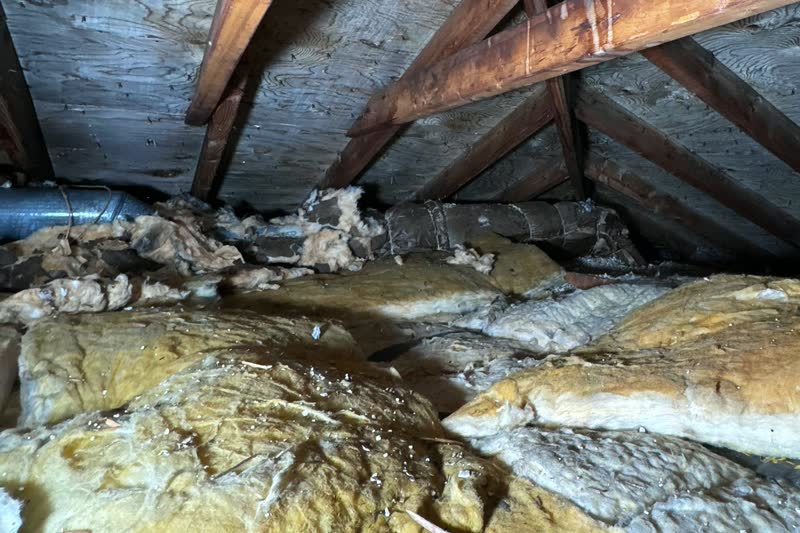
Uneven rooms, creeping energy bills and insulation you can barely see are all clues. These are the safe checks any homeowner can do from the attic hatch, and how to decide between topping off and starting over.
Attic Insulation
Blown-in insulation is loose-fill fiberglass or cellulose blown across an attic floor. See how the job is done, how it compares with batts, what R-value and depth mean, and where another material fits better.
Census Bureau figures for Mooresville, NOAA normals for the Statesville 2 NNE station, Duke Energy Carolinas (October 2026). Compiled by Insulation Pros. How the town pages are made.
Sources for the Mooresville notes and questions (read October 20, 2026):
Mooresville, NC
Open in Google Maps (opens in a new tab)Insulation Pros is an insulation contractor serving North Carolina, from the old mill village out to the lake neighborhoods of Mooresville. Prices are free, honest and built on your attic's size.
Mill cottage, brick ranch or a newer place near Lake Norman: send us the square footage and we'll price the attic for free. Nobody will push you.
What You Can Count On
We serve homes across North Carolina. These are the largest towns we work in.
Alamance County
Buncombe County
Cabarrus County
Cumberland County
Durham County
Forsyth County
Gaston County
Guilford County
Mecklenburg County
New Hanover County
Onslow County
Orange County
Pitt County
Wake County