Attic Insulation
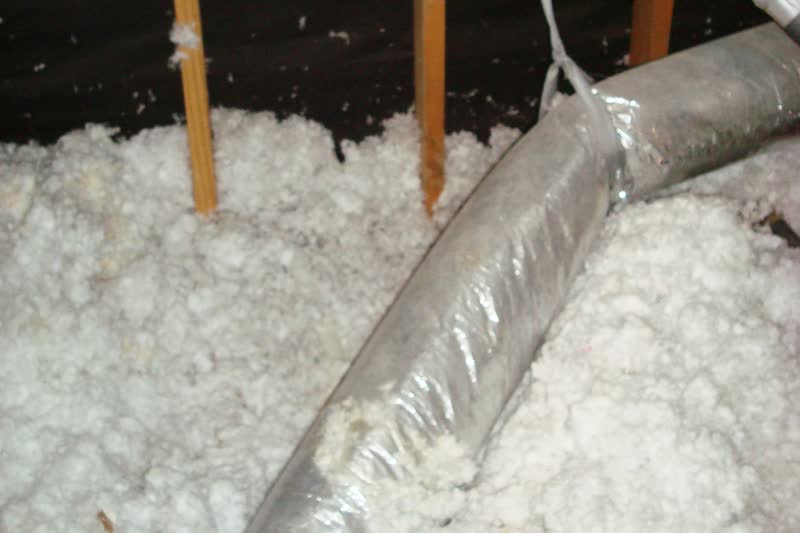
Blown-in fiberglass attic insulation, added to the depth your home needs, to even out hot and cold rooms and cut wasted heating and cooling.
Bonus room that bakes in July, or a big upstairs that never quite cools down? In a Summerfield house, the attic is the first place to look. We top up attic insulation, take out spoiled layers and seal the air leaks under them. The estimate is free.
Summerfield is an old crossroads and a young town: the Town traces the settlement to 1769 and its incorporation to 1996. In the Census Bureau's 2020 to 2024 survey, about six in ten homes here date from the 1990s and 2000s, and about three-quarters from 1990 or later. Nearly all are detached single-family houses, and more than half have four or more bedrooms.
Houses that size spread a lot of ceiling under the roof, and plans from those decades can include a bonus room, a vaulted ceiling or attic spaces at more than one height. So the attic is the place to look first: whether the insulation reaches its target everywhere, the awkward corners included, and whether the ceiling under it leaks air.
Insulation Pros is a family owned and operated insulation company, and Summerfield is inside the area we cover. Your home's size is usually all we need for a number, even for a big house. Below is how attic insulation, removing old insulation and air sealing apply to Summerfield houses.

Monday to Friday 8:00 am to 5:00 pm. Saturday by appointment. Sunday closed.
Summerfield's old crossroads, listed on the National Register in 2005, shows how some of its houses grew in stages over a century or more. That history matters overhead, because a house built in pieces can have more than one attic to check.
The district's nomination gives two clear cases. A two-story frame Greek Revival house of about 1858 shows signs in its attic that its center gable came later. Two one-story ells were then added behind it, one rebuilt in 1963 and the other built in 1990. A concrete-block house from 1945 was faced with brick in 1965 and given a frame addition at the back. A one-story ell behind a two-story house has its own lower roof, and a rear addition can too. Either may conceal an attic of its own, holding more or less insulation than the rest. Each one is reached, measured and filled evenly so no low pocket is left behind.
Attic insulation, removal, air sealing and more. Open one to see how the work goes.
Blown-in fiberglass attic insulation, added to the depth your home needs, to even out hot and cold rooms and cut wasted heating and cooling.
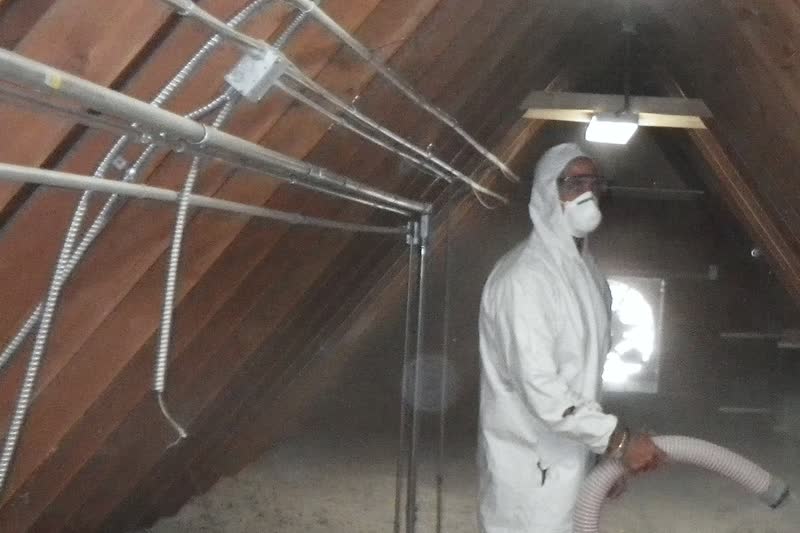
Old, wet, matted or animal-soiled attic insulation vacuumed out, so new insulation can go in on a clean, sealed attic floor.
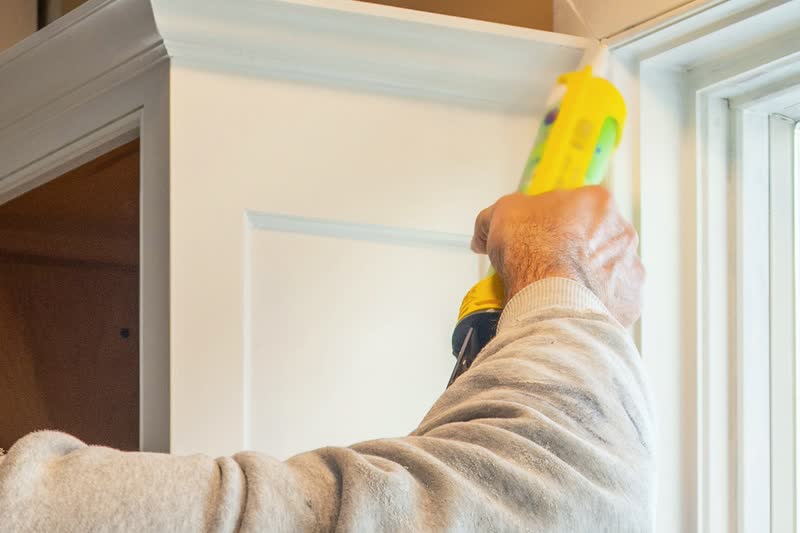
Sealing the gaps between your rooms and the attic, and leaky ductwork, so the air you pay to heat and cool stays inside.
Insulation blown into the closed walls of an existing house, batts in open walls for additions, remodels and new builds, and garage walls and ceilings.
Insulation for the garage ceiling under a bonus room, the wall shared with the house and the garage attic, with air leaks sealed first.
Floor insulation under the house: wet or fallen insulation pulled out, new batts between the floor joists, plastic over the dirt and the floor leaks sealed.
In a Summerfield house from the 1990s or 2000s, attic insulation is likely a top-up job. The depth gets measured all the way out to the eaves. The ceiling is sealed first, because the EPA recommends air sealing an attic before insulating it. Then loose-fill is blown in to one even depth, with baffles keeping the soffit vents clear.
How much to add is an R-value question. Guilford County is in climate zone 4 on North Carolina's energy code map and in zone 3 on the newer national one, which ENERGY STAR's chart follows. Over an existing 3 to 4 inches, that chart calls for R-38 in zone 3 and R-49 in zone 4. The state's own figure for a new ceiling is R-38. Your price gives the R-value we'd bring your Summerfield attic to, so you can hold us to it.
Summerfield's center sits about 900 feet above sea level, 8 miles from NOAA's Greensboro PTI Airport station, the best match for Summerfield. The station's 1991 to 2020 normals average about 3,500 heating and 1,550 cooling degree days a year, so at Summerfield's station, heating needs outweigh cooling.
Readings change over short distances around Summerfield: NOAA's Reidsville 2 NW station, 17 miles away, averages about 3,830 heating degree days.
In a house this young, the attic insulation can usually stay and be built on. The exceptions are a layer soaked by a roof leak, one lying under a roof deck stained by condensation, and one that rodents or squirrels have tunneled through and soiled. Once the cause is fixed, that material gets vacuumed out, and in most houses a new blown-in layer takes its place.
With the joists bare, the ceiling is as easy to seal as it'll ever be, so the leaks around wires, pipes and light fixtures get closed before anything goes back. Taking the old insulation out with nothing blown back in is also work we take on. And we only price removal for the parts that need it. The rest gets more on top.
Air sealing shuts the paths air takes from your rooms up into the attic: holes for plumbing vents and wiring, the edges of light fixtures, the hatch, and the top plates of the walls inside the house. It's done from the attic side and comes before any new insulation. In a house with a bonus room, the low side walls of that room and the floor edges behind them get the same attention.
Where a Summerfield house uses gas, ENERGY STAR advises having its gas appliances tested for proper drafting before and after the house is sealed. Tell us how the house is heated when you get in touch, so that test can be set up with your heating contractor.
If ducts cross the attic, each joint and each register boot gets mastic or metal tape. Ductwork that's been flattened or pulled apart needs a heating and cooling contractor, and we point it out when we see it.
Duke Energy supplies Summerfield's electricity. For gas, Summerfield is in the Guilford County franchise of Piedmont Natural Gas, and 38 percent of Summerfield homes heat with piped gas. Duke's free House Call fits many Summerfield homes: about 52 percent heat with electricity.
Rebate to check in Summerfield: Smart $aver Insulate and Seal (Duke Energy; Insulation Pros is an approved trade ally). Before a Summerfield job, check its current terms; the Guilford County page lists every program.
About six in ten Summerfield homes were built in the 1990s and 2000s, Census estimates say, and roughly another 15 percent in 2010 or later.
A North Carolina law covers every house started in 1978 or later: nobody may move in until its insulation has been shown to meet the state's minimum standard. More than four in five Summerfield houses were built in 1980 or later, so a bare attic is unlikely. Depth and evenness are the questions. ENERGY STAR's quick test: insulation level with the joists, or below them, needs adding to. It also notes that the center of an attic can be well covered while the edges at the eaves have almost nothing.
About a quarter of the homes in town predate 1990, by the Census Bureau's estimates. Some of the oldest stand where Oak Ridge Road meets Summerfield Road, a National Register historic district of frame and brick buildings from the 1830s to the 1950s.
In a house that old, nobody should assume anything. ENERGY STAR says to bring in a professional before insulating near knob-and-tube wiring, which it dates to before 1930, and to leave vermiculite alone until a lab has tested it. We point out what we see, and an electrician, a testing lab or an asbestos contractor settles it before any insulating starts. A house this old is also one we'd likely look at on a special visit before pricing.
Your address plus the home's square footage is the usual starting point. No square footage? The outline of the house seen from above is close enough to start. Most Summerfield prices come from that alone, and they cost nothing.
A few houses are worth seeing first, like one with attic spaces at three different heights or a roof deck with stains on it. For those we set up a special visit.
On the day of the job, the crew's first stop is the attic, with you along: the depth out to the eaves, the ceiling leaks, the ducts, the bath fan and the walls of any bonus room. If something up there changes the job, you'll know before any work starts. We won't pad the price with work your attic doesn't need.

Each page has local notes on the homes and attics in that town.
Guilford County, 8 miles southeast
Median home built 1985, 15 years older than Summerfield's
Insulation contractor serving GreensboroForsyth County, 12 miles southwest
Median home built 1995, 5 years older than Summerfield's
Attic insulation contractor serving KernersvilleGuilford County, 15 miles south
Median home built 1989, 11 years older than Summerfield's
Insulation contractor serving High PointRandolph County, 20 miles south
Median home built 1986, 14 years older than Summerfield's
Insulation contractor serving ArchdaleAlso in Guilford County: Gibsonville, Jamestown, Oak Ridge, Pleasant Garden, Sedalia, Stokesdale, and Whitsett. Every town in Guilford County. See all service areas.
Local service pages: Attic Insulation in Asheville, Attic Insulation in Charlotte, Attic Insulation in Durham, Attic Insulation in Fayetteville, Attic Insulation in Greensboro, Attic Insulation in Greenville, Attic Insulation in High Point, Attic Insulation in Lexington, Attic Insulation in Raleigh, Attic Insulation in Thomasville, Attic Insulation in Wilmington, Attic Insulation in Winston-Salem.
Yes. We work at homes across North Carolina, and Summerfield is part of it. So are Oak Ridge and Stokesdale. The Town itself notes that "Summerfield" in an address doesn't always mean the house is inside the town limits, which changes nothing for us. Send your street address and you'll get a plain yes, along with a price.
Your address and, if you have it, the square footage. Also about when the house was built, how it's heated and what you've noticed: a hot bonus room, an upstairs that never cools down, a stain on a ceiling. That's usually enough for us to price it.
Maybe, and it takes a tape measure to know. ENERGY STAR says that when insulation rises well above the joists and hides them, there's probably enough, and more may not be worth paying for. When the joists show, the shortfall is worth measuring against ENERGY STAR's R-values. If your attic is already deep and even, we'll tell you to leave it alone.
Often it can. A room built under the roof has attic space behind its low side walls, and sometimes under its floor too. ENERGY STAR's rundown of the usual attic air leaks includes the spaces behind and beneath knee walls. How those walls, the floor edges and the sloped ceiling are insulated and sealed decides the fix, and we'll tell you what we can reach. Where the room sits over the garage, insulating the garage ceiling may be part of the answer.
We don't publish prices, because size is only where the figure starts. Size does count here: more than half of Summerfield homes have four or more bedrooms. Then come the depth already in the attic, how easily every part of it can be reached, whether part of the old layer has to be vacuumed out first, and how much air sealing comes before the new insulation. You get the figure free, and for most houses the square footage is enough to work it out.
Yes, as a rule. Once a new layer covers the ceiling, any gap beneath it is hidden and much harder to reach, and air moving through it carries heat around the insulation. So the leaks around wires, pipes, fixtures and the hatch are closed first, and the insulation goes on after. An attic that already has enough insulation can still leak, and if sealing alone is the right job, that's the only job we'll price.
Not from the listing itself. The crossroads district is on the National Register, and the state preservation office says such a listing does not restrict a private owner using private money. On the state's 2023 roll of local commissions, Guilford County shows Greensboro, High Point, Oak Ridge and a county joint commission, but none for Summerfield. A house designated as a county landmark is different, since some of those designations reach inside. The county can tell you if yours is one.
Never touching, and usually 2 inches back. The district's nomination records several older houses with chimneys inside the walls, among them a 1919 Colonial Revival house with two interior brick stacks and a center-hall house with three. Each stack that rises through the ceiling leaves a ring of open space beside the brick, and warm air pours up through it. ENERGY STAR's method is aluminum flashing pressed into heat-resistant caulk to close that ring, then a metal dam so the blown insulation stays off the masonry.
Attic Insulation
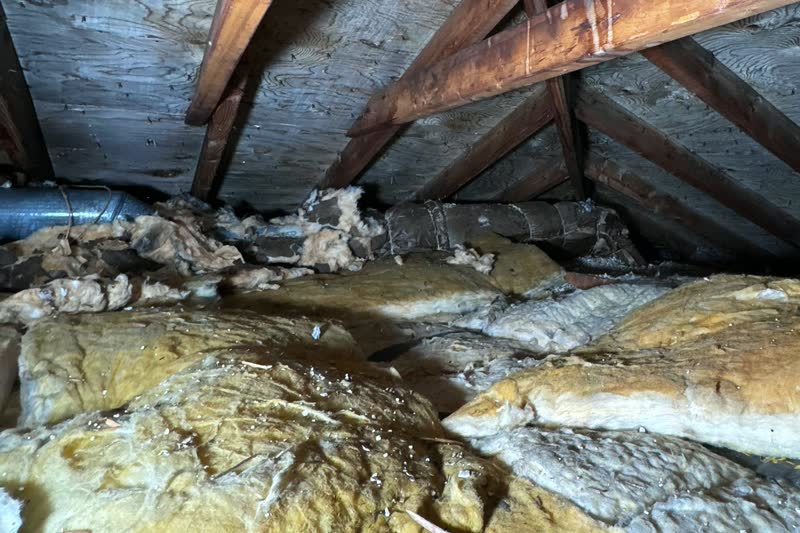
Uneven rooms, creeping energy bills and insulation you can barely see are all clues. These are the safe checks any homeowner can do from the attic hatch, and how to decide between topping off and starting over.
Air Sealing
Thick insulation over a leaky ceiling is like a wool sweater in a stiff wind. Learn why sealing has to happen first, where leaks hide in attics and ducts, and what a sensible job looks like.
Census Bureau figures for Summerfield, NOAA normals for the Greensboro PTI Airport station, Duke Energy (October 2026). Compiled by Insulation Pros. How the town pages are made.
Sources for the Summerfield notes and questions (read October 20, 2026):
Summerfield, NC
Open in Google Maps (opens in a new tab)Insulation Pros is an insulation contractor serving North Carolina, Summerfield addresses inside and outside the town limits alike. A four-bedroom house is priced the same simple way as a small one.
However big your Summerfield attic is, the price starts with its size, and it's free. Send us the square footage and we'll get you a number.
What You Can Count On
We serve homes across North Carolina. These are the largest towns we work in.
Alamance County
Buncombe County
Cabarrus County
Cumberland County
Durham County
Forsyth County
Gaston County
Guilford County
Mecklenburg County
New Hanover County
Onslow County
Orange County
Pitt County
Wake County