Attic Insulation
Blown-in fiberglass attic insulation, added to the depth your home needs, to even out hot and cold rooms and cut wasted heating and cooling.
Upstairs too hot to sleep in July, or a power bill that jumps every summer? In a Charlotte house, the attic is often why. We're an insulation contractor serving Charlotte: attic insulation blown in, ruined insulation vacuumed out, and the ceiling sealed first. Most attics we can price from the square footage, with no visit needed.
Charlotte is the biggest city in North Carolina, about 965,000 people as of the Census Bureau's 2025 estimate, and its houses cover more than a hundred years. A brick Colonial from the streetcar days can sit a few miles from a subdivision that's barely finished. Up in the attic, those two houses have almost nothing in common. That's why this page goes through the city decade by decade.
Most Charlotte jobs come down to three things. We seal the gaps in the ceiling, blow insulation across the attic floor to the right depth, and vacuum out old insulation that's been ruined. Wall insulation, garage insulation, crawl space insulation and commercial insulation are part of the work too, and home energy audits are a paid service.
Here's how pricing works. We quote most attics by the square foot: you tell us the size, or we work it out from your home's footprint, and nobody has to come out first. If something needs a closer look, like an old roof leak or signs of animals, we'll make a special visit. We price what the attic needs and nothing more, and if it doesn't need anything, you'll hear that from us. Insulation Pros is family owned.
More for Charlotte homeowners: Attic insulation in Charlotte.

Monday to Friday 8:00 am to 5:00 pm. Saturday by appointment. Sunday closed.
Charlotte, the Mecklenburg County seat, was founded in 1768 and named for Queen Charlotte, wife of George III. Its historic neighborhoods include Dilworth, the streetcar suburb laid out in 1891, and the North Charlotte mill villages built between about 1903 and 1915.
Dilworth began in 1891 as a street grid wrapped by a boulevard that carried the city's first streetcar line. Its National Register nomination, listed in 1987, names the story-and-a-half frame cottage as the most common late Victorian house in that first grid. It adds that most homes put up between 1910 and 1925 lean toward the bungalow. Any of those houses given electric service before about 1930 could still carry knob-and-tube, which ENERGY STAR calls a fire hazard once insulation buries it. So in a Dilworth attic the wires get traced first. Any live old runs are replaced or retired by an electrician, and only then do we seal and insulate.
Workers' houses spread across North Charlotte from about 1903 to 1915 around Highland Park Mill No. 3 and the Mecklenburg Mill, nearly all one-story frame. The district's 1990 nomination counted 189 side-gable mill houses in rows along North Davidson, Yadkin, Alexander and Mallory streets. Each has two front rooms in the main block and a two-room kitchen ell behind, usually with one main chimney where the ell joins the house. That brick passes up through the ceiling right where two roofs meet, and the ell can hide a second, smaller attic. Following ENERGY STAR, we bend aluminum flashing over the gap, seal it with high-temperature caulk and set a metal dam that keeps insulation off the chimney.
Homes from 1970 on make up the bulk of the city, as this page's Census numbers bear out, yet the 2015 citywide survey also recorded older postwar streets. One is Hyde Park Estates, about ten blocks of ranch and split-level houses from roughly 1962 to 1970. A split-level joins a one-story wing to a two-story wing under roofs at different heights. That can leave two attics, one above the living room and one above the bedrooms, each reached and insulated on its own.
Attic insulation, removal, air sealing and more. Open one to see how the work goes.
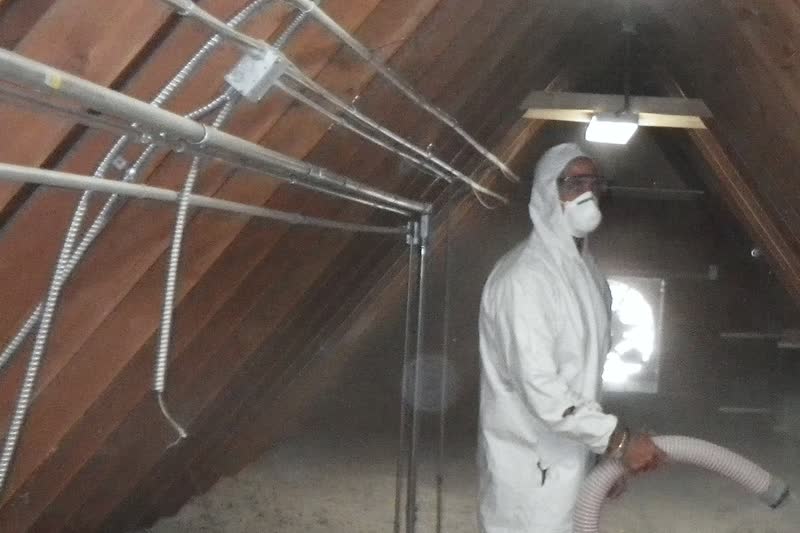
Blown-in fiberglass attic insulation, added to the depth your home needs, to even out hot and cold rooms and cut wasted heating and cooling.
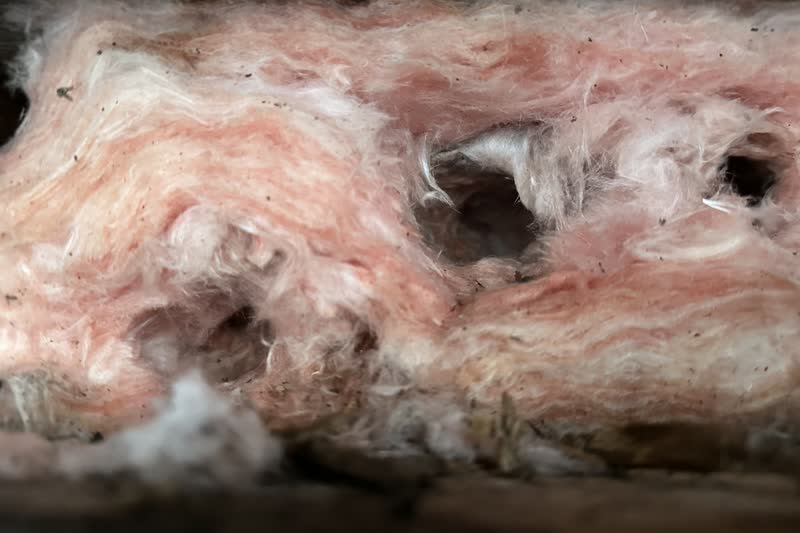
Old, wet, matted or animal-soiled attic insulation vacuumed out, so new insulation can go in on a clean, sealed attic floor.
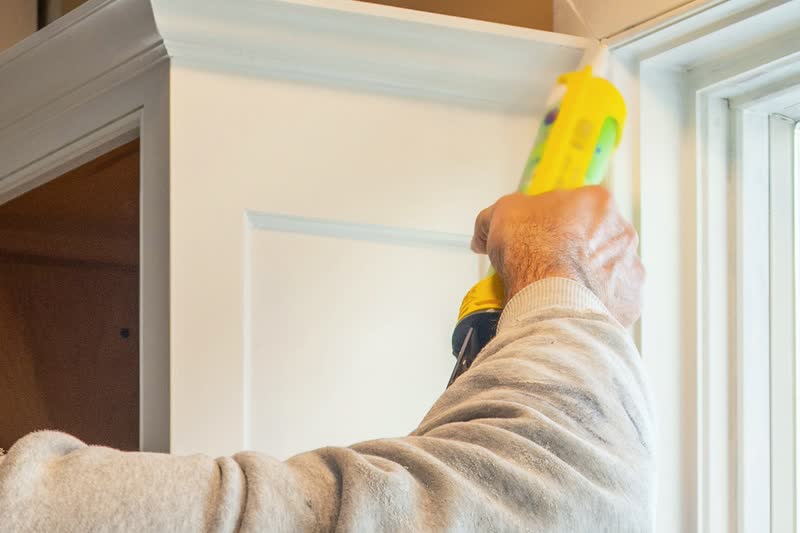
Sealing the gaps between your rooms and the attic, and leaky ductwork, so the air you pay to heat and cool stays inside.
Insulation blown into the closed walls of an existing house, batts in open walls for additions, remodels and new builds, and garage walls and ceilings.
Insulation for the garage ceiling under a bonus room, the wall shared with the house and the garage attic, with air leaks sealed first.
Floor insulation under the house: wet or fallen insulation pulled out, new batts between the floor joists, plastic over the dirt and the floor leaks sealed.
Most of the time, adding attic insulation means building on what's already there. The gaps in the ceiling get sealed, then loose-fill goes over the old layer until the floor is level from the eaves to the hatch. Mecklenburg County is climate zone 3 on both the state energy code's map and the newer national map. For zone 3, ENERGY STAR recommends R-49 over a bare attic floor, or adding R-38 on top of an attic that already has 3 to 4 inches.
Attic insulation in Charlotte has a page of its own, with the materials, how deep each target runs and what goes into the price.
Charlotte's center sits about 760 feet above sea level, 6 miles from NOAA's Charlotte Douglas Airport station, the best match for Charlotte. The station's 1991 to 2020 normals average about 3,060 heating and 1,770 cooling degree days a year, so at Charlotte's station, heating needs outweigh cooling.
Most old insulation can stay, and we won't charge you to pull out insulation that's fine. ENERGY STAR's advice is that new insulation can go right on top unless the old layer is wet or moldy, smells bad, or has animal waste in it. Each of those has a cause, and the cause gets fixed first. A leaking roof is a roofer's job. Animals still getting in are a job for a wildlife control company. Then we vacuum the ruined insulation out, seal the bare ceiling while every gap is easy to see and, in most homes, blow a fresh layer back in.
Storms are one way an attic gets soaked. Hurricane Hugo's center passed just west of Charlotte before dawn on September 22, 1989. The State Climate Office reports an 87 mph gust at the airport, and tens of thousands of trees flattened along the storm's path. When a limb comes through the roof or a row of shingles lifts, rain gets in, and insulation that soaks it up can stay matted and stained long after the roof is fixed. If all you want is the old layer gone, with nothing new blown in yet, just ask.
Vermiculite is the one old fill we won't vacuum out. It looks like little pebbles, usually gray-brown or silver-gold, and the EPA says to assume it has asbestos in it and leave it alone. If we find it, we stop and tell you, because getting it out is work for a professional asbestos contractor.
John Nolen, a landscape architect, planned Myers Park in 1911 on what its National Register nomination calls a nearly treeless cotton farm. Earle Draper took over the design in 1917. The first houses were mostly wood. Brick caught on in the 1920s, in Colonial Revival, bungalow and Tudor Revival designs, and the two-story brick Colonial stayed the usual house on the main streets until the neighborhood filled up in the late 1950s. Many of the side streets, built last, got ranch houses.
In a two-story Colonial, the attic sits over the upstairs bedrooms, and you usually get in through a ceiling hatch or pull-down stairs. ENERGY STAR lists the attic hatch as one of the common air leaks in a house, so we weatherstrip and insulate the hatch or the stairs too, not just the floor around them. A Tudor Revival with several gables can split its attic into separate pockets, some with no way in from the main one. Mention the extra gables when you call. If we can't size every pocket from what you tell us, that's a house we'll come and look at before we price it.
Elizabeth starts about a mile east of the business district. It was pieced together from five subdivisions opened between 1891 and 1915, and its 1989 nomination counts 803 principal buildings. About 83 percent of them are single-family houses and small multi-family buildings put up between 1910 and 1941, with an unusual number of duplexes, triplexes and quadraplexes from the late 1920s and 1930s. Wesley Heights, about a mile northwest of the square, put its lots on sale at the end of 1921, and most of its houses were up by the end of that decade. Its nomination names the bungalow as the most common style, with a broad, low-pitched roof and wide overhanging eaves, and it counts 44 duplexes and 11 quadriplexes.
A low, wide bungalow roof leaves hardly any room where it meets the outside walls, and that edge is where insulation usually comes up short. Baffles go into the rafter bays first so the soffit vents stay open, and then the loose-fill gets carried all the way out to the edge. In a duplex or a fourplex, one roof may cover every unit, and the attic over your ceiling can run right into the next one. The work gets set up with whoever owns each part of the building, and on install day the crew walks you through where each attic space starts and stops.
Some 51 percent of Charlotte housing units are detached single-family houses.
Built from 1970 to 1989, 23 percent of Charlotte homes may hold settled fiberglass; check its depth against the joists.
About 28 percent of Charlotte's housing units predate 1980; nearly all predate the state's 1978 insulation rule too. Some 38 percent of Charlotte units sit in buildings of two or more homes, where the attic is often shared.
Look at the year-built numbers above and you'll see where most of Charlotte's housing comes from: 1990 and after. Newer doesn't mean well insulated, though. North Carolina's energy code sets R-38 as the least a builder can put over a new ceiling, which is the bottom of ENERGY STAR's range for this zone, and blown insulation settles over the years. So the age of the house doesn't settle it. What's actually lying on the attic floor does.
These attics have more going on, too. The air handler and long duct runs are often up there. Recessed lights are cut into the ceilings below, and a bonus room over the garage brings knee walls and a sloped ceiling of its own. A recessed light that isn't rated for contact with insulation needs a cover that keeps at least 3 inches of clear space all around it, by the Building America Solution Center's guidance, or a rated fixture in its place. If your house has a bonus room or a lot of can lights, say so when you ask for a price, so they're counted from the start.
Air sealing comes first, and we do it from the attic side before any new insulation goes down. ENERGY STAR's list of the usual attic leaks covers holes for wiring and plumbing, dropped soffits open to the attic, the chase around a flue or ductwork, recessed lights, the hatch and the spaces behind knee walls. Small holes get caulk. Bigger openings get a rigid cover sealed in place. Around a flue or chimney, ENERGY STAR notes that codes usually require 1 inch of clearance from a metal flue and 2 inches from masonry, and no insulation goes inside that space.
Ducts deserve a close look here. NOAA's 1991 to 2020 normals for the Charlotte Douglas Airport station count roughly 49 days a year at 90 degrees or more, and the attic gets hotter than the air outside on those afternoons. A leaky joint up there dumps cooled air into the hottest part of the house. Every joint, seam and register boot we can get to gets mastic or a foil tape made for ductwork. If a run is crushed or has pulled loose, that's work for a heating and cooling contractor, and we'll show you where it is.
Duke Energy Carolinas serves most of Charlotte, Union Power Cooperative its edges; your bill says which. For gas, Charlotte is in the Mecklenburg County franchise of Piedmont Natural Gas, and 44 percent of Charlotte homes heat with piped gas. Duke's free House Call fits many Charlotte homes: 54 percent heat with electricity.
Rebate to check in Charlotte: Smart $aver Insulate and Seal (Duke Energy; Insulation Pros is an approved trade ally). Before a Charlotte job, check its current terms; the Mecklenburg County page lists every program.
ENERGY STAR tells homeowners to get estimates from more than one contractor, and to make sure the one they hire seals attic holes and gaps before any insulation goes in. Quotes are only easy to compare when they cover the same ground. Check the R-value the attic will end up at, not just the inches. Then see which leaks get sealed, whether any old insulation comes out, how the eaves and the hatch are handled, and whether baffles are included, which ENERGY STAR says any estimate should have.
Watch for add-ons you didn't ask about, too. We don't upsell. If a full removal wouldn't do much for your attic, we'll say so and leave it off the price.
After a blown-in job, federal rules give you a paper trail. The Federal Trade Commission's R-value Rule requires a dated, signed receipt, and for loose-fill it has to show the area covered, the installed thickness, the minimum settled thickness, the R-value and the number of bags.
Each page has local notes on the homes and attics in that town.
Mecklenburg County, 9 miles southeast
Median home built 1994 (Charlotte: 1995)
Attic insulation in MatthewsMecklenburg County, 9 miles southwest
Median home built 1999 (Charlotte: 1995)
Attic insulation in PinevilleMecklenburg County, 14 miles north
Median home built 2004 (Charlotte: 1995)
Attic insulation in HuntersvilleCabarrus County, 17 miles northeast
Median home built 1998 (Charlotte: 1995)
Insulation company serving ConcordGaston County, 20 miles west
Median home built 1978 (Charlotte: 1995)
Attic insulation in GastoniaAlso in Mecklenburg County: Cornelius, Davidson, and Mint Hill. Every town in Mecklenburg County. See all service areas.
Local service pages: Attic Insulation in Asheville, Attic Insulation in Charlotte, Attic Insulation in Durham, Attic Insulation in Fayetteville, Attic Insulation in Greensboro, Attic Insulation in Greenville, Attic Insulation in High Point, Attic Insulation in Lexington, Attic Insulation in Raleigh, Attic Insulation in Thomasville, Attic Insulation in Wilmington, Attic Insulation in Winston-Salem.
Yes. We serve homes all over North Carolina, and that's all of Charlotte, from the older neighborhoods around uptown to the newer subdivisions out by the county line. Pricing works the same anywhere in the city. We quote from the attic's size, and on install day the crew walks through it with you first.
Ask before the work starts. In Charlotte, building, electrical, plumbing and mechanical permits go through Mecklenburg County Code Enforcement. Its permitting page says smaller jobs under a cost limit set in state law may not need a permit, unless the work touches load-bearing structure, plumbing, heating and air conditioning, or wiring. Whether your attic job needs one depends on what's in it, so Code Enforcement is the office to confirm it for your house.
ENERGY STAR's project guide puts a contractor's time for adding attic insulation at one to two days. An open ranch attic with a few leaks to seal is the short end. Vacuuming out a ruined layer, a lot of sealing around ducts and lights, or an attic split into several sections all take longer, and we'll tell you what to expect when we give you the price.
Usually, yes. The Census Bureau counts about 9 percent of Charlotte's housing units as attached houses, like townhouses. What matters is where the attic over your ceiling ends. If it's walled off between units, your attic is a job of its own, priced from your unit's square footage. If it's open to the neighbor's side, we work out where your part ends before we price it. An owners' association may have rules about work under a shared roof, so check those first.
Mostly the size. Send the attic floor's square footage, or just the street address and we'll size it from the footprint of the house. It helps to know roughly when the house was built, whether the roof has ever leaked and which rooms run hot or cold. If you've heard scratching overhead, tell us, because droppings change what the attic needs and that's one we'd want to see first. Before install day, clear a path to the hatch or the pull-down stairs.
Yes. We blow insulation into finished walls, fit batts in open ones, insulate garages and the floors over crawl spaces, and take on commercial insulation. A home energy audit is a paid service of its own. Most Charlotte jobs still start in the attic, with insulation, removal and air sealing.
No, not for work indoors. The city's Historic District Commission appears on the state's 2023 list of local commissions, next to the joint city and county Historic Landmarks Commission. Under North Carolina law, those boards rule on how a designated building looks from outside and have no power over how its rooms are arranged. A National Register listing, such as Dilworth's, does not by itself bind a private owner. New roof or soffit vents do alter the outside, so ask the commission before that part.
There is no record that it did, and nothing required it. The mills' owner sold all of the worker housing to occupants and other buyers in 1953, the North Charlotte nomination says. The state statute on insulating new homes reaches only houses started January 1, 1978 or later, some seven decades after these went up. When the crew comes to do the work, they go over both attics with you, the main one and the one above the kitchen ell, before any insulation goes in.
Yes. Insulating the attic is the property owner's decision, whether the owner lives in the house or rents it out. If you rent and your rooms run hot in summer or cold in winter, raise it with your landlord, because the work is arranged with the owner. A rental gets the same look as any other house before we start. We check how old its wiring is, whether a chimney comes up through the ceiling, and whether the roof above has been leaking.
Attic Insulation
Most old attic insulation can stay under a fresh top-up. Wet, moldy, animal-soiled or smoke-damaged material cannot. Learn how to tell the difference, what removal involves and what to do about vermiculite.
Attic Insulation
Start with the free checks, then work up through the attic: insulation depth, air leaks, ducts and roof heat. Each step says plainly whether it is a job for an HVAC technician or an insulation contractor.
Census Bureau figures for Charlotte, NOAA normals for the Charlotte Douglas Airport station, Duke Energy Carolinas, Myers Park Historic District nomination (NC HPO), Elizabeth Historic District nomination (NC HPO), Wesley Heights Historic District nomination (NC HPO), NC State Climate Office on Hurricane Hugo, ENERGY STAR recommended insulation R-values, ENERGY STAR Well-Insulated and Sealed Attic page, ENERGY STAR attic air sealing project, Building America Solution Center on non-IC recessed lights, EPA on vermiculite insulation, FTC R-value Rule (16 CFR 460.17), Mecklenburg County Code Enforcement permitting (October 2026). Compiled by Insulation Pros. How the town pages are made.
Sources for the Charlotte notes and questions (read October 20, 2026):
Charlotte, NC
Open in Google Maps (opens in a new tab)Insulation Pros is an insulation contractor serving North Carolina, Charlotte included. A free estimate here usually takes nothing more than the size of your attic.
Want a price for your Charlotte attic? Call or text, or send its size through the form. The estimate is free, there's no pressure, and nothing goes on it that your attic doesn't need.
What You Can Count On
We serve homes across North Carolina. These are the largest towns we work in.
Alamance County
Buncombe County
Cabarrus County
Cumberland County
Durham County
Forsyth County
Gaston County
Guilford County
Mecklenburg County
New Hanover County
Onslow County
Orange County
Pitt County
Wake County