Attic Insulation
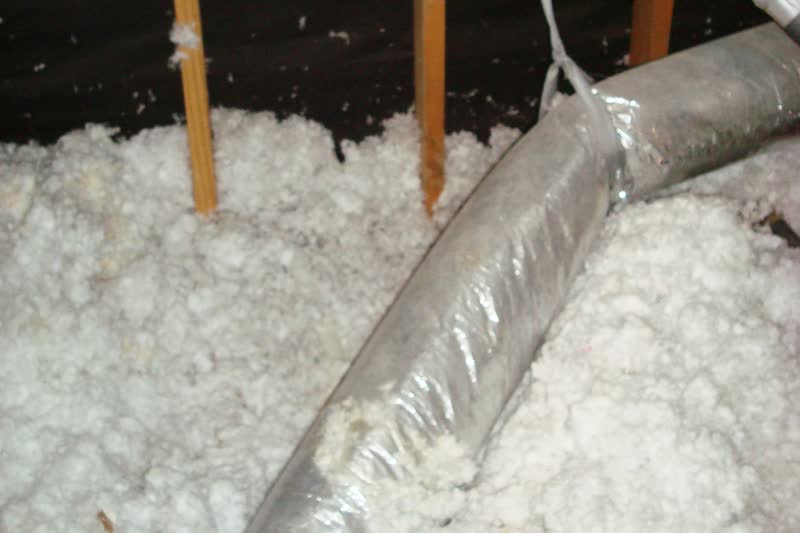
Blown-in fiberglass attic insulation, added to the depth your home needs, to even out hot and cold rooms and cut wasted heating and cooling.
In Raleigh, a hot upstairs in July and a chilly one in January often trace back to the same place, the attic. We're an insulation contractor serving Raleigh, for houses from the 1920s streets near Five Points to the subdivisions past the Beltline. We blow insulation in to depth, vacuum out what's been ruined and seal the ceiling and ducts. The estimate is free, and most attics are priced from the square footage.
Raleigh is the state capital and the second-largest city in North Carolina, with about 506,000 people by the Census Bureau's 2025 estimate. It added roughly 40,000 people between 2020 and 2025, and most of its housing went up in the last few decades. The neighborhoods near downtown still hold houses from the 1910s and 1920s, though, and their attics are a whole different job from one built in 2005.
People picture the insulation going in, but the real work starts before that. First we close up the gaps in the ceiling and vacuum out any insulation that's past saving. Then we blow loose-fill across the attic floor to the depth the house needs. We do wall insulation, garage insulation, crawl space insulation, paid home energy audits and commercial insulation, too.
Pricing is simple. For most Raleigh attics, the square footage is enough: tell us the size, or let us figure it from your home's footprint, and you'll have a free price without anyone coming out. When an attic needs a closer look first, we'll set up a special visit. Either way, you pay for what the attic needs. We don't push extras, and if your attic is already in good shape, we'll tell you. We're a family owned company.
More for Raleigh homeowners: Attic insulation in Raleigh.

Monday to Friday 8:00 am to 5:00 pm. Saturday by appointment. Sunday closed.
Raleigh was chosen as the state capital in 1792 and incorporated in 1794. Victorian Oakwood, bungalow Boylan Heights and the postwar subdivisions that spread out to the Beltline and past it each left their own kind of attic.
Boylan Heights was platted in 1907 on a curving street plan over a sloping, wooded site, and its 1985 National Register nomination says it might be called the suburb of the bungalow. Its chief building block, the nomination says, is the wood-frame bungalow, whether a single floor or with a half story above, many with a dormer set into a long sweep of roof. When bedrooms are tucked up under a roof like that, short knee walls close off wedge-shaped side attics. ENERGY STAR puts the cavities around and under knee walls on its list of common leaks. In Boylan Heights, we treat those side pockets as part of the job, not an afterthought to the main attic.
Raleigh's 1945 to 1965 survey counted more than 18,000 buildings from those twenty years, the great majority of them houses, and recorded 75 postwar subdivisions, 27 of them in North Raleigh. Split-levels first appeared about 1955, and in Chestnut Hills they were sprinkled among blocks of ranches. Per the housing figures on this page, the bulk of the city's homes date from 1970 on. Still, in these earlier neighborhoods a split-level can hide attics at two heights, one over each wing. Both get measured, and baffles keep the soffit vents clear as the low edges are filled.
Modern design took hold in Raleigh after 1948, when North Carolina State College opened its School of Design, and the movement's most copied form was boxy and flat-roofed. The postwar survey counted only about 100 contemporary houses among some 15,000 single-family homes of the era, several described as flat-roofed rectangles. A flat or very shallow roof can leave little or no space above the ceiling, so there may be nowhere to blow loose insulation. If yours is one, tell us when you call, and we will say plainly whether attic work suits the house or needs a closer look first.
Attic insulation, removal, air sealing and more. Open one to see how the work goes.
Blown-in fiberglass attic insulation, added to the depth your home needs, to even out hot and cold rooms and cut wasted heating and cooling.
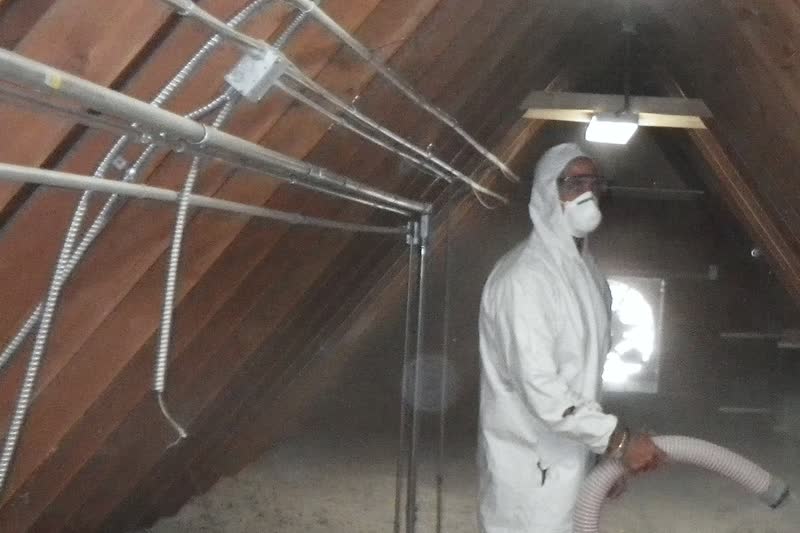
Old, wet, matted or animal-soiled attic insulation vacuumed out, so new insulation can go in on a clean, sealed attic floor.
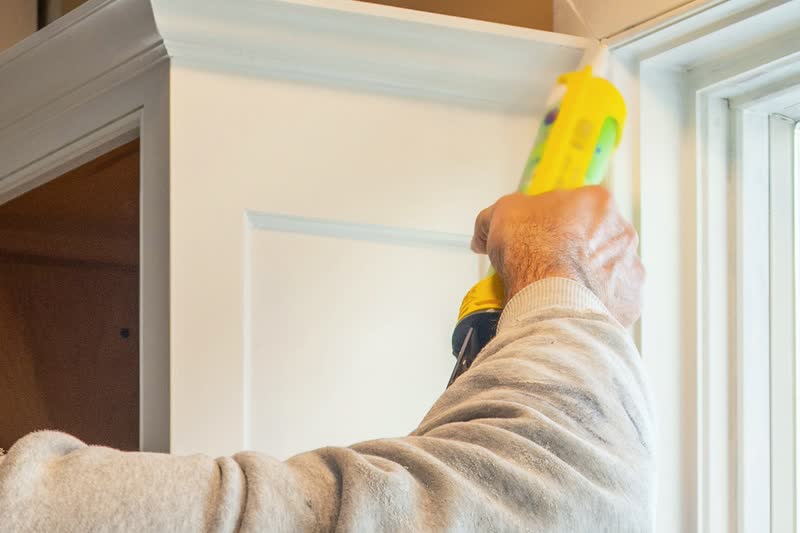
Sealing the gaps between your rooms and the attic, and leaky ductwork, so the air you pay to heat and cool stays inside.
Insulation blown into the closed walls of an existing house, batts in open walls for additions, remodels and new builds, and garage walls and ceilings.
Insulation for the garage ceiling under a bonus room, the wall shared with the house and the garage attic, with air leaks sealed first.
Floor insulation under the house: wet or fallen insulation pulled out, new batts between the floor joists, plastic over the dirt and the floor leaks sealed.
Wake County sits where two climate maps disagree. North Carolina's energy code puts it in zone 4, and the newer national map drawn for the 2021 model code moves it to zone 3. ENERGY STAR's recommendations follow the zone: R-60 or R-49 over a bare attic floor, and R-49 or R-38 where 3 to 4 inches are already down. The state code asks for R-38 in every new ceiling.
Our page on attic insulation in Raleigh explains how we pick a target inside that range, what we blow in and what the price depends on.
Raleigh's center sits about 320 feet above sea level, 4 miles from NOAA's Raleigh State University station, the best match for Raleigh. The station's 1991 to 2020 normals average about 3,170 heating and 1,780 cooling degree days a year, so at Raleigh's station, heating needs outweigh cooling.
Readings change over short distances around Raleigh: NOAA's Garner station, 7 miles away, averages about 3,640 heating degree days.
We only take old insulation out when it's been ruined. ENERGY STAR's rule of thumb is that removal usually isn't needed and new insulation can go right over the old, unless it's damp or moldy, gives off a smell, or animals have soiled it. When one of those applies, the cause comes first. The roof gets repaired, or the hole the animals used gets closed, before anything else happens in the attic.
Then the ruined material gets vacuumed out. With the attic floor bare, every gap in the ceiling is easy to reach, so that's the right time to air seal, and in most homes a fresh blown-in layer goes in after that. Some owners want the old layer gone and nothing put back for now. We'll do that too.
One fill changes the plan. A loose, pebble-like layer that's gray-brown or silver-gold may be vermiculite, and the EPA says to assume it contains asbestos and leave it undisturbed. If we find it, we stop and point you to a professional asbestos contractor.
Hayes Barton, northwest of downtown, was laid out by the landscape architect Earle Sumner Draper, and its oldest houses go back to about 1920. Its National Register nomination says nearly half of them went up in the mid and late 1920s, most in period revival styles. The two-story brick Georgian Revival is the most common. You'll also find Dutch Colonial Revival houses under gambrel roofs, Tudor Revival houses, and bungalows and Minimal Traditional cottages east of Glenwood Avenue.
Two things in these attics take care. A gambrel roof puts the upstairs rooms inside the roof itself, which leaves a short attic above them and knee-wall pockets beside them, a lot like the Boylan Heights bungalows described above. The nomination also noted, in 2002, that several houses there, small and large, had been given second stories or big wings. An addition usually has its own attic, sometimes with no hatch at all, and the seam where it meets the old roof can leak air. Tell us about any additions when you ask for a price, so every section gets counted. If one can't be sized from what you tell us, we'll come out and see it.
After the war, Raleigh spread out in one-story houses. Longview Gardens, on New Bern Avenue east of downtown, was planned in 1938, and its nomination says the ranch was its most popular house type from the late 1940s to 1965. Lots there run from three-quarters of an acre to more than four acres, which made room for rambling ranches with side and rear wings under low side-gable or hipped roofs. Madonna Acres, platted in 1960 beside the Saint Augustine's campus, is recorded as the earliest subdivision in Raleigh built by African Americans for African Americans. Most of its houses are brick ranches.
A ranch spreads one attic over every room. A low hipped roof comes down close to the ceiling on all four sides, so the outer few feet are where the insulation runs thin, and they get the most care. A wing added at the side or back often has its own attic at a different height, and it's priced as its own section. The hatch, often in a hallway ceiling, gets weatherstripped and insulated so it doesn't stay the weak spot in a long, deep floor.
Some 44 percent of Raleigh housing units are detached single-family houses.
Built from 1970 to 1989, 25 percent of Raleigh homes may hold settled fiberglass; check its depth against the joists.
About 23 percent of Raleigh's housing units predate 1980; nearly all predate the state's 1978 insulation rule too. Some 41 percent of Raleigh units sit in buildings of two or more homes, where the attic is often shared.
Most of Raleigh's housing dates from 1980 on, as the year-built figures above show, and the 2000s added more than any other decade. Those houses were insulated to the code of their day, so the answer is usually a top-up over a sealed ceiling, not starting over. The trouble spots are settling, thin patches at the eaves, insulation pushed aside during cable or heating and cooling work, and leaks around recessed lights and the attic access.
Raleigh has a lot of attached housing, too. The Census Bureau's 2020 to 2024 survey counts about 14 percent of the city's housing units as attached houses, such as townhouses. In a townhouse, only the attic over your own unit is part of your job, and the walls between units decide whether that attic is closed off or open to the neighbors'. An owners' association may get a say in work under a shared roof, so check with it before you book.
Raleigh summers are rough on attic ductwork. At the Raleigh State University station, July afternoons average about 91 degrees in NOAA's 1991 to 2020 normals, and roughly 47 days a year reach 90 or more. Ducts in the attic carry cooled air through that heat, and a loose joint spills it before it ever reaches a room. Wherever we can reach them, joints, seams and register boots get sealed with mastic or foil tape made for ducts. A crushed or split run goes to a heating and cooling contractor.
Air sealing does the same job for the ceiling. We close the openings where wiring, plumbing and flues pass into the attic, cap any dropped soffit that's open on top, and weatherstrip the hatch, all from above and before the new insulation goes down. Our guide on why air sealing comes before insulation explains the order.
Duke Energy serves most of Raleigh, Wake Electric its edges; your bill says which. For gas, Raleigh is in the Wake County franchise of Enbridge Gas North Carolina, and 39 percent of Raleigh homes heat with piped gas. Duke's free House Call fits many Raleigh homes: 59 percent heat with electricity.
Rebate to check in Raleigh: Smart $aver Insulate and Seal (Duke Energy; Insulation Pros is an approved trade ally). Before a Raleigh job, check its current terms; the Wake County page lists every program.
Raleigh has plenty of insulation contractors, and the way to compare them is line by line. Get each quote in writing, with the target R-value, the air sealing, any removal, and how the eaves, the hatch and the ducts will be handled. ENERGY STAR's own advice is to make sure a contractor will seal attic holes and gaps before adding insulation, and to call someone else if they won't.
Ask whether the price includes baffles at the eaves, which ENERGY STAR says any estimate should, and whether you'll get the receipt the Federal Trade Commission's R-value Rule requires, with the R-value, the thickness and the number of bags.
And watch for a quote padded with extras. We leave off anything your attic doesn't need, and we'll tell you why it's not there.
Each page has local notes on the homes and attics in that town.
Wake County, 10 miles south
Median home built 2001 (Raleigh: 1997)
Attic insulation in GarnerWake County, 9 miles east
Median home built 2008 (Raleigh: 1997)
Attic insulation in KnightdaleWake County, 12 miles northeast
Median home built 2009 (Raleigh: 1997)
Attic insulation in Wake ForestDurham County, 18 miles northwest
Median home built 1995 (Raleigh: 1997)
Insulation contractor serving DurhamAlso in Wake County: Apex, Fuquay-Varina, Holly Springs, Morrisville, Rolesville, Wendell, and Zebulon. Every town in Wake County. See all service areas.
Local service pages: Attic Insulation in Asheville, Attic Insulation in Charlotte, Attic Insulation in Durham, Attic Insulation in Fayetteville, Attic Insulation in Greensboro, Attic Insulation in Greenville, Attic Insulation in High Point, Attic Insulation in Lexington, Attic Insulation in Raleigh, Attic Insulation in Thomasville, Attic Insulation in Wilmington, Attic Insulation in Winston-Salem.
Yes. We serve homes across North Carolina, and that takes in every part of Raleigh, from the older streets inside the Beltline to North Raleigh and the newer neighborhoods beyond it. Wherever you are in the city, we can usually price your attic from its square footage alone.
Ask the city before work starts. The City of Raleigh's guide to residential permits says that if you live in Raleigh and are starting a construction project, you'll likely need a permit, and city staff review each application, which is tracked in the Permit and Development Portal. Whether a job that only adds insulation or seals the attic floor needs one is a question for the city's development services staff. The answer can change if the job also touches ductwork, wiring or the roof.
Sometimes, and usually after the insulation. The Building America Solution Center's view is that an attic already at R-30 or more leaves very little heat flow for a radiant barrier to reduce. Its clear exception is ductwork in the attic, which a radiant barrier keeps cooler in summer. So the attic floor comes up to its target first, and that's the work we do.
Yes. The insulation goes on top of the ceiling from the attic side, so the plaster below isn't touched. Old plaster cracks, though, and air slips through those cracks and around the light fixtures, so the ceiling gets sealed from above before anything covers it. In the attic we step on the joists, never between them. If a ceiling already sags, the crew shows you before any work starts.
The size of the attic floor drives most of the price. You give us the square feet, or the street address and we size it from the house's footprint. Add what you know, like when the house was built, any roof leaks and which rooms run hot, and we'll send the price in writing. If something sounds like it needs a closer look, we'll make a special visit. On install day the crew goes over the attic with you before they start.
Walls, yes: blown-in insulation can go into the closed walls of a house that's already built. Garages too, under a bonus room or along the wall shared with the house. Crawl space floors and commercial insulation are part of the work as well, and a home energy audit is a paid service of its own.
For the insulation itself, no. The commission is on the state's 2023 list, and under state law a commission's review in a local historic district or landmark reaches the outside of a building, never its interior arrangement. Insulating over the ceiling and sealing its gaps happen entirely indoors. Cutting new ridge, roof or soffit vents changes the exterior, so in a local district that part waits for a certificate of appropriateness.
The wiring, first. Oakwood's 1974 nomination describes a twenty-block neighborhood of mostly Victorian houses built between the Civil War and 1914. ENERGY STAR ties old knob-and-tube circuits to the decades before 1930 and warns they can catch fire where insulation smothers them. An electrician checks for live runs, and any that remain stay uncovered until they are replaced.
Yes, after the roof is fixed. When Hurricane Fran moved inland in September 1996, the National Weather Service recorded widespread damage to trees and roofs, and Wake County alone reported heavy losses to homes and businesses. To ENERGY STAR, an attic with wet insulation is an attic under a leaking roof. Once the roof is sound, any insulation that soaked up water is vacuumed out and replaced, and dry areas are left alone.
Attic Insulation
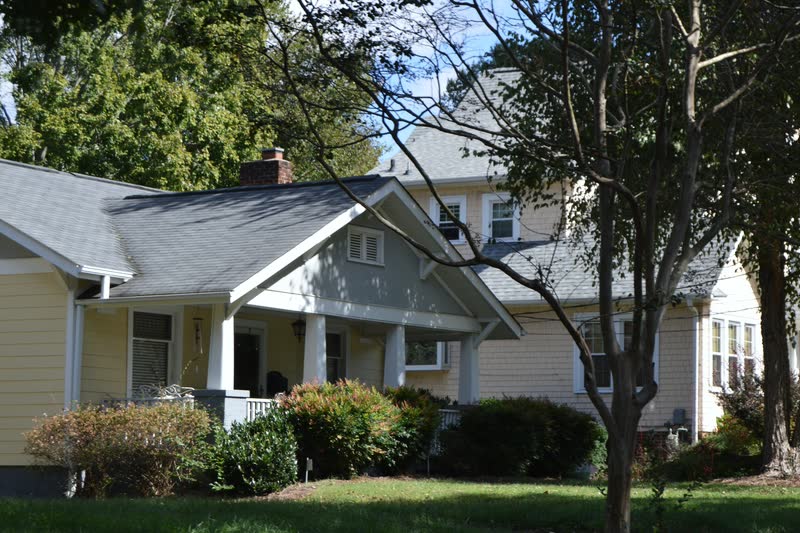
Houses built before the state's 1978 energy rules often have little in the attic and nothing in the walls. Learn the safety checks to make first, the leaks old framing hides and the order to do the work in.
Air Sealing
Ducts that run through the attic lose air where it hurts most. Learn how much leaks, the signs to check, how a duct test works, mastic versus tape versus sealing from inside, and why attic ducts sweat in July.
Census Bureau figures for Raleigh, NOAA normals for the Raleigh State University station, Duke Energy, Hayes Barton Historic District nomination (NC HPO), Longview Gardens Historic District nomination (NC HPO), Madonna Acres Historic District nomination (NC HPO), ENERGY STAR recommended insulation R-values, ENERGY STAR Well-Insulated and Sealed Attic page, ENERGY STAR attic air sealing project, Building America Solution Center on attic radiant barriers, EPA on vermiculite insulation, FTC R-value Rule (16 CFR 460.17), City of Raleigh, How to Get a Residential Permit (October 2026). Compiled by Insulation Pros. How the town pages are made.
Sources for the Raleigh notes and questions (read October 20, 2026):
Raleigh, NC
Open in Google Maps (opens in a new tab)Insulation Pros is an insulation contractor serving North Carolina, Raleigh and the rest of Wake County included. We can usually quote a Raleigh attic from its size, at no charge.
Curious what's over the ceilings of your Raleigh house? Call or text, or put the attic's size in the contact form, and we'll get you a free written price. You won't find anything on it your attic doesn't need.
What You Can Count On
We serve homes across North Carolina. These are the largest towns we work in.
Alamance County
Buncombe County
Cabarrus County
Cumberland County
Durham County
Forsyth County
Gaston County
Guilford County
Mecklenburg County
New Hanover County
Onslow County
Orange County
Pitt County
Wake County