Attic Insulation
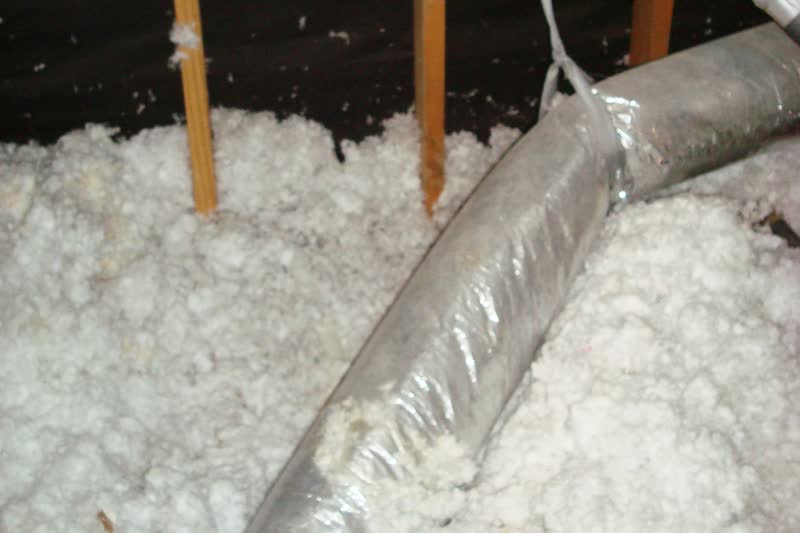
Blown-in fiberglass attic insulation, added to the depth your home needs, to even out hot and cold rooms and cut wasted heating and cooling.
Statesville houses get heated all winter and cooled through a humid summer, and a thin attic works against you both ways. We add or replace attic insulation and air seal the ceiling, in 1890s frame houses, brick ranches and new builds. Free estimates.
Statesville is the Iredell County seat, set where I-40 and I-77 cross. The state legislature created it in 1789, and it grew as a railroad town on textile and furniture work. Its housing spans the decades. The Census Bureau's 2020 to 2024 survey puts roughly one home in eight before 1940, about a third between 1950 and 1979, and about three in ten in 2000 or later.
Old Statesville's street grid follows ridge lines in hilly terrain, National Register records note. On the U.S. Department of Energy's climate map, Iredell County falls in the mixed-humid region. Houses here are heated through the winter and cooled through a humid summer, and a thin attic over the top-floor ceiling works against both.
Insulation Pros is a family owned and operated insulation company, and Statesville is in our area. Square footage, a few questions about the house, and you have a price. Below, attic insulation, attic insulation removal and air sealing come first, then Statesville's houses by age and what each means for the attic: older frame houses, mid-century brick ranches and those built after 2000.
Monday to Friday 8:00 am to 5:00 pm. Saturday by appointment. Sunday closed.
Statesville grew up around Fourth Creek Presbyterian Church, organized in 1753, and was incorporated in 1847. From the 1880s its neighborhoods spread along the roads into town and around its schools, and the houses in each one meet the attic in a different way.
East of downtown, houses rose along the roads coming into Statesville, Davie Avenue first and then East Broad and Elm streets. The district's 1980 nomination dates the oldest to about 1880, with about two-thirds standing by 1918 and nearly all by 1930. Furniture, veneer and sawmill men built a number of them, and most Davie Avenue houses are two-story frame. Some of the oldest have brick chimneys at the outside of each end wall. Those stand outside the house, so they leave no gap in the attic floor. The leaks to look for are at the tops of the walls. Where a house that old has balloon framing, the stud bays may open into the attic, with no top plate closing them off, so each one gets capped from above first.
Academy Hill, the smallest of the city's historic districts, takes its name from the Statesville Male Academy, built in 1874 on a rise beside Mulberry Street. Its 1980 nomination describes mostly one- and two-story frame houses, plainer than those in the other districts, with more than half built between 1886 and 1918. The usual style is a simple Queen Anne. The district's showpiece, a two-story brick house of 1901 with a round corner tower, has corbelled chimneys rising out of its hipped roof. A chimney that leaves through the roof crosses the attic on its way up. ENERGY STAR's fix at the ceiling is light aluminum sheet sealed with high-temperature caulk, with a sheet-metal shield standing between the brick and the insulation.
Southeast of downtown, the Garfield and Green Streets Historic District was the center of Black Statesville's schools, churches and businesses. It joined the National Register in December 2025. Its nomination finds the most common house there a one-story, front-gabled frame house with a full-width porch, built from about 1925 to 1950. The same type also comes as duplexes of about 1941 to 1959, with two front doors side by side. A few I-houses from before 1910 and story-and-a-half Craftsman houses round it out. In a front-gabled house the roof comes down over the two long side walls. Those edges are the hardest part of the attic to reach and can come up short of insulation. Rafter baffles go in first, so the new layer can be pushed to the wall plates with the soffit vents still clear.
Attic insulation, removal, air sealing and more. Open one to see how the work goes.
Blown-in fiberglass attic insulation, added to the depth your home needs, to even out hot and cold rooms and cut wasted heating and cooling.
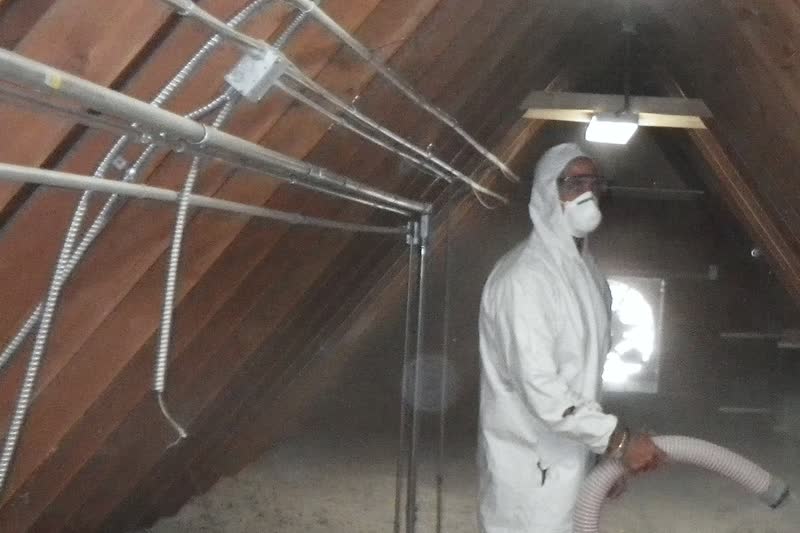
Old, wet, matted or animal-soiled attic insulation vacuumed out, so new insulation can go in on a clean, sealed attic floor.
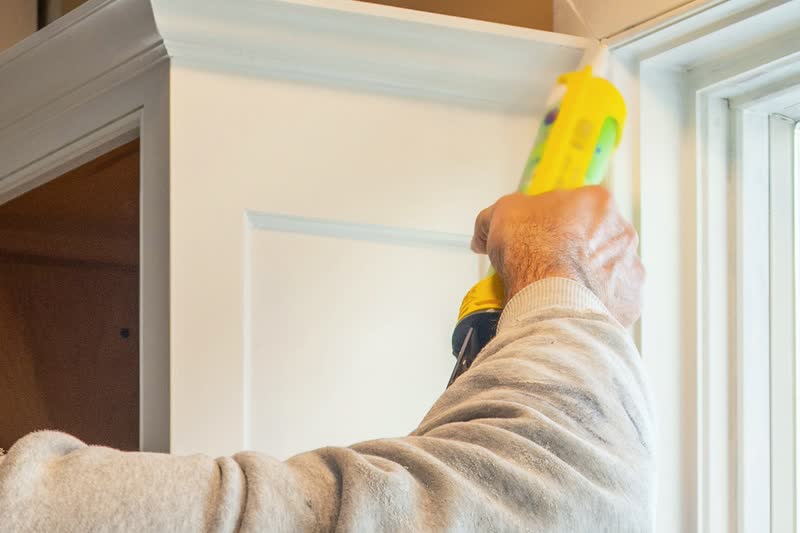
Sealing the gaps between your rooms and the attic, and leaky ductwork, so the air you pay to heat and cool stays inside.
Insulation blown into the closed walls of an existing house, batts in open walls for additions, remodels and new builds, and garage walls and ceilings.
Insulation for the garage ceiling under a bonus room, the wall shared with the house and the garage attic, with air leaks sealed first.
Floor insulation under the house: wet or fallen insulation pulled out, new batts between the floor joists, plastic over the dirt and the floor leaks sealed.
Attic insulation in Statesville is a different job in each kind of house. An old two-story frame house may have almost nothing over its ceiling, and any old wiring gets flagged for an electrician before it's covered. A brick ranch needs the most care along its low eaves, where baffles hold the new layer back from the soffit vents. A house from after 2000 may need only a top-up. In each, air sealing comes first, wet or fouled insulation comes out, and blown-in insulation goes in to one even depth.
How deep? Iredell County is climate zone 4 in North Carolina's 2018 energy code. The redrawn national map behind ENERGY STAR's chart puts it in zone 3. The zone 3 line calls for R-49 in an uninsulated attic and R-38 where 3 to 4 inches are already down. The zone 4 line asks for R-60 and R-49. Your price names the target R-value for your attic.
Statesville's center sits about 910 feet above sea level, 2 miles from NOAA's Statesville 2 NNE station, the best match for Statesville. The station's 1991 to 2020 normals average about 3,990 heating and 1,260 cooling degree days a year, so at Statesville's station, heating needs outweigh cooling.
Old insulation that's still dry and clean can usually stay, with the new layer blown on top of it. What comes out is insulation a roof leak has soaked, insulation mold has grown on, insulation that has packed down into a thin crust, and insulation mice or squirrels have nested in and soiled.
The reason for the damage gets fixed before the old layer goes. ENERGY STAR treats wet or damp attic insulation as a sign of a leaky roof, which a roofer repairs, and animals have to be out for good, which is work for a wildlife control company. Then we vacuum the old insulation out and seal the leaks in the bare ceiling while it's easy to reach. Straight after that, new insulation is usually blown in. We also do removal without replacement when that's what the owner wants.
Statesville's oldest houses call for one more check. Some attics hold vermiculite, a gravel-like fill that may contain asbestos; ENERGY STAR's advice is not to disturb it without first having an approved lab test it. It stays put: we neither vacuum it nor cover it, and the attic is left for an asbestos contractor. If you think your attic has it, tell us before we price anything.
In a Statesville attic the leaks are seldom where people expect. ENERGY STAR's attic air sealing guide sends you to the holes drilled for wiring, the open tops of interior walls, dropped soffits built over kitchen cabinets and bath vanities, and the attic hatch. Insulation stained dark gray is a hint, because house air leaves its dust behind as it filters through.
The EPA's advice, published on the ENERGY STAR site, is to seal the attic before adding insulation. A gap buried under a deep layer of loose-fill keeps leaking and is much harder to reach later, so the sealing is done first and priced as its own line.
If your house has ductwork in the attic, the duct joints are part of the same job. By ENERGY STAR's figure, a typical house loses about 20 to 30 percent of the air moving through its ducts to leaks, holes and poorly connected sections. We seal the joints and register boots we can reach, and a run that's crushed or has come loose gets pointed out for an HVAC contractor.
Statesville, an ElectriCities public power town, runs its own electric system. For gas, Statesville is in the Iredell County franchise of Enbridge Gas North Carolina, and 42 percent of Statesville homes heat with piped gas.
Program to ask about in Statesville: ElectriCities energy audits (Statesville's electric system), home energy audits for member-town customers; ask Statesville's utility office. Before a Statesville job, check its current terms; the Iredell County page lists every program.
National Register of Historic Places write-ups for Statesville's historic districts record how its oldest houses were built. In the Mitchell College district most are frame and more than 60 percent have two stories. The South Race Street district is mostly frame houses from 1894 into the 1930s. Entry after entry also notes a porch that was later enclosed or an addition built on the back.
For the attic, that age brings three things to check. Wiring from before 1930 may be knob-and-tube, which ENERGY STAR warns can be a fire hazard in contact with insulation, so it stays uncovered until an electrician has looked at it. A two-story house may have rooms tucked under the roof, and ENERGY STAR counts the spaces behind and under knee walls among the common attic leaks. An enclosed porch or a rear addition usually has a roof of its own, and its attic gets checked separately.
A house like this, with rooms under the roof and an addition or two, is where a special visit before pricing makes sense.
About a third of Statesville's housing went up between 1950 and 1979. National Register paperwork for the west side of the Mitchell College district says brick ranches dominated new building there by the late 1940s and 1950s, and the Garfield and Green Streets inventory describes brick veneer ranches as well.
A one-story house has its whole ceiling under the attic, so the attic decides more of how the house feels. ENERGY STAR's attic check is simple: if the insulation sits level with or below the floor joists, add more. If a later remodel put recessed lights in the ceiling, each one needs a 3-inch gap around it under ENERGY STAR's guidance unless it carries an IC rating, so the crew checks every one before blowing in.
Statesville's newest three in ten homes, from 2000 or later, were insulated when they went up, so the job is seldom a tear-out. North Carolina's 2018 energy code asks for R-38 in a new ceiling, the lowest figure on ENERGY STAR's chart for an existing attic here. A top-up is often all these attics need, and a top-up is all we'll price.
Two things get most Statesville houses priced: the street address and the square footage. Only have the address? The house's footprint fills in the rest. Mention anything odd, like a second attic over an addition or a ceiling stain. For most Statesville houses that's enough for a price, and getting it costs nothing.
The first bag doesn't get opened until the crew has looked at the attic with you: how deep the insulation is from hatch to eaves, what shape it's in, where air leaks through, how the ducts are joined and whether the soffit vents are still open. You see what they see.

Each page has local notes on the homes and attics in that town.
Iredell County, 14 miles south
Median home built 2006, 24 years newer than Statesville's
Insulation company serving MooresvilleDavie County, 19 miles northeast
Median home built 1986, 4 years newer than Statesville's
Insulation contractor serving MocksvilleRowan County, 23 miles east
Median home built 1976, 6 years older than Statesville's
Insulation company serving SalisburyCabarrus County, 25 miles southeast
Median home built 1989, 7 years newer than Statesville's
Insulation contractor serving KannapolisAlso in Iredell County: Harmony, Love Valley, and Troutman. Every town in Iredell County. See all service areas.
Local service pages: Attic Insulation in Asheville, Attic Insulation in Charlotte, Attic Insulation in Durham, Attic Insulation in Fayetteville, Attic Insulation in Greensboro, Attic Insulation in Greenville, Attic Insulation in High Point, Attic Insulation in Lexington, Attic Insulation in Raleigh, Attic Insulation in Thomasville, Attic Insulation in Wilmington, Attic Insulation in Winston-Salem.
Yes. We serve homes across North Carolina, and Statesville is inside that area. If you live beyond the city limits, send the address and we'll confirm it.
Jot down the address, roughly when the house was built, its square footage if you've got it, and whether it has more than one attic, like one over an addition. Add what sent you looking: an upstairs that bakes in summer, a stain on a ceiling, bedrooms that never warm up.
Usually. According to ENERGY STAR, what you add doesn't have to be the same kind of insulation that's up there now, so loose-fill can go over old batts or over old loose-fill. The old layer has to be dry and clean for that. If it's wet, moldy or soiled by animals, the cause gets fixed and the old insulation is vacuumed out before anything new goes in.
It can be. Knob-and-tube wiring dates from before 1930, ENERGY STAR says, and insulation packed against it can be a fire hazard. The Census Bureau's survey puts roughly one Statesville home in eight before 1940. If the crew finds it in your attic, that area stays uncovered, and the insulation waits until an electrician has said what's safe.
In nearly every attic, yes. Air passes through insulation: ENERGY STAR describes dirty, darkened insulation as the evidence of house air moving through it. So a hole left under the new layer keeps leaking, however deep the layer is. That's why the EPA recommends sealing the attic first, and why we seal before any new insulation is blown in.
There's no price list, because two Statesville attics are rarely the same job. The price follows the attic's size, the depth already there, how many leaks need sealing, whether old insulation has to be vacuumed out and how hard the space is to get into. Most of that we can get from a short conversation and your square footage, the price is free, and we don't pad it with work the attic doesn't need.
Not over the insulation itself. Statesville has a Historic District Commission, and under North Carolina law a commission in a local district or landmark reviews the outside of buildings only. The layout inside is beyond its reach. Insulating an attic and air sealing its ceiling are done from indoors. If your attic also needs new roof, ridge or soffit vents, those change the exterior, so ask the city whether a certificate of appropriateness is needed first.
No, not by itself. The State Historic Preservation Office explains that National Register listing places nothing on a private owner who repairs or alters a building with private money. It brings no review of your plans either. Local rules come only from a local designation, a separate step the city takes on its own. So the new listing changes nothing about insulating or sealing your attic.
Yes. Attic work is the owner's decision, whether you live there or rent it out. The district's nomination notes that duplexes were built there from the 1940s to the 1950s and that many houses have been bought as rentals. In a duplex both homes sit under one roof, so we check whether the attic is one open space or split by a wall, and then treat it end to end.
Attic Insulation
North Carolina's energy code requires R-38 in a new ceiling, and ENERGY STAR recommends more for existing attics. See both numbers, which climate zone your county is in and how many inches each R-value takes.
Air Sealing
Thick insulation over a leaky ceiling is like a wool sweater in a stiff wind. Learn why sealing has to happen first, where leaks hide in attics and ducts, and what a sensible job looks like.
Census Bureau figures for Statesville, NOAA normals for the Statesville 2 NNE station, Statesville's municipal electric system (October 2026). Compiled by Insulation Pros. How the town pages are made.
Sources for the Statesville notes and questions (read October 20, 2026):
Statesville, NC
Open in Google Maps (opens in a new tab)Insulation Pros is an insulation contractor serving North Carolina, Statesville and the rest of Iredell County included. A price here takes the size of the house and a few questions, not a sales visit.
What's your Statesville house's square footage? That's the start of a free attic price, and a straight answer, even if the answer is that the attic's fine.
What You Can Count On
We serve homes across North Carolina. These are the largest towns we work in.
Alamance County
Buncombe County
Cabarrus County
Cumberland County
Durham County
Forsyth County
Gaston County
Guilford County
Mecklenburg County
New Hanover County
Onslow County
Orange County
Pitt County
Wake County