Attic Insulation
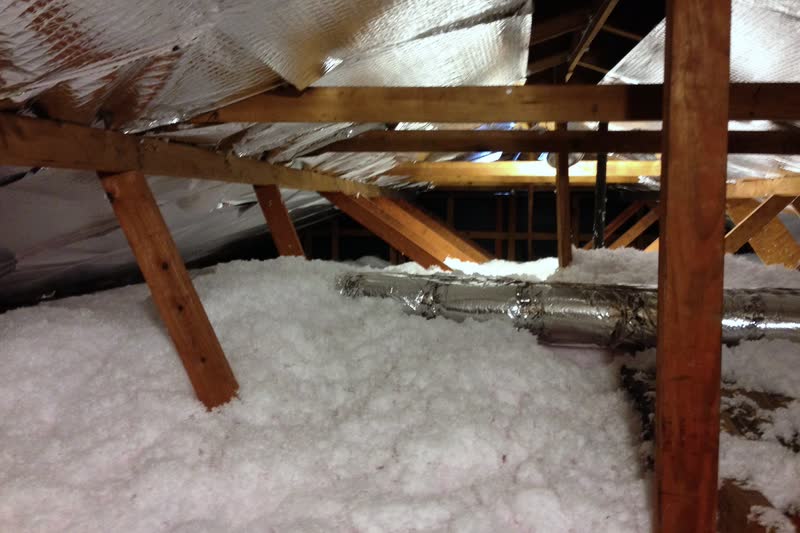
Blown-in fiberglass attic insulation, added to the depth your home needs, to even out hot and cold rooms and cut wasted heating and cooling.
If your upstairs won't cool down on a July afternoon, a thin attic is often the reason. We blow insulation in over a sealed ceiling for Charlotte homes of every age, vacuum out a ruined layer first when there is one, and can usually quote your attic from its square footage alone. Our family owned company keeps the price to what your attic needs.
What we install in Charlotte attics is blown-in loose-fill fiberglass. Once the gaps in the ceiling are closed, it goes across the attic floor at one even depth, all the way out to the eaves. If the old layer got soaked, grew mold, picked up a smell or has droppings in it, we vacuum it out first, and sanitize and deodorize after mice, so the new insulation lands on a clean, sealed floor.
Charlotte's median year built is 1995 in the Census Bureau's 2020 to 2024 survey. So a typical attic here holds insulation that went in about thirty years ago, and since then it may have settled, or been shoved aside for cable, ductwork and storage boxes. Send the square footage, or the address so we can figure the size from the footprint, and you'll get a price for the top-up. Before a single bag is opened on install day, the crew looks over the attic with you.
See all of our insulation services in Charlotte.

Monday to Friday 8:00 am to 5:00 pm. Saturday by appointment. Sunday closed.
Attic insulation, removal, air sealing and more. Open one to see how the work goes.
Blown-in fiberglass attic insulation, added to the depth your home needs, to even out hot and cold rooms and cut wasted heating and cooling.
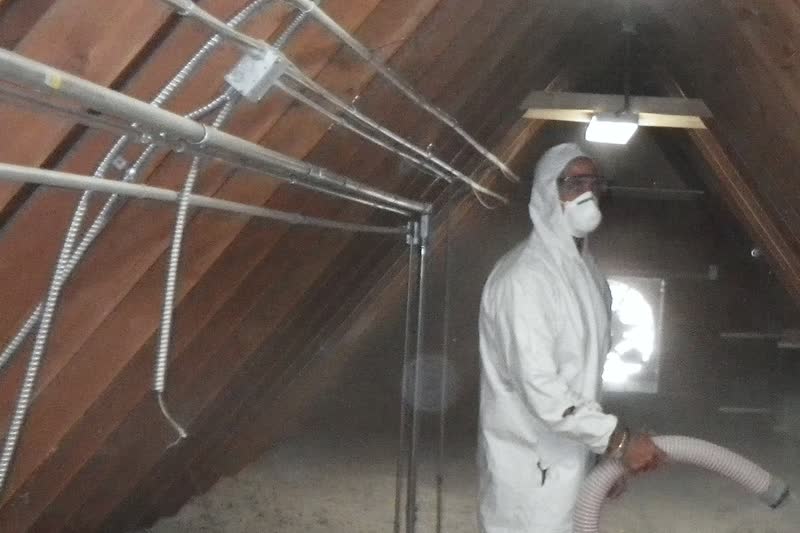
Old, wet, matted or animal-soiled attic insulation vacuumed out, so new insulation can go in on a clean, sealed attic floor.
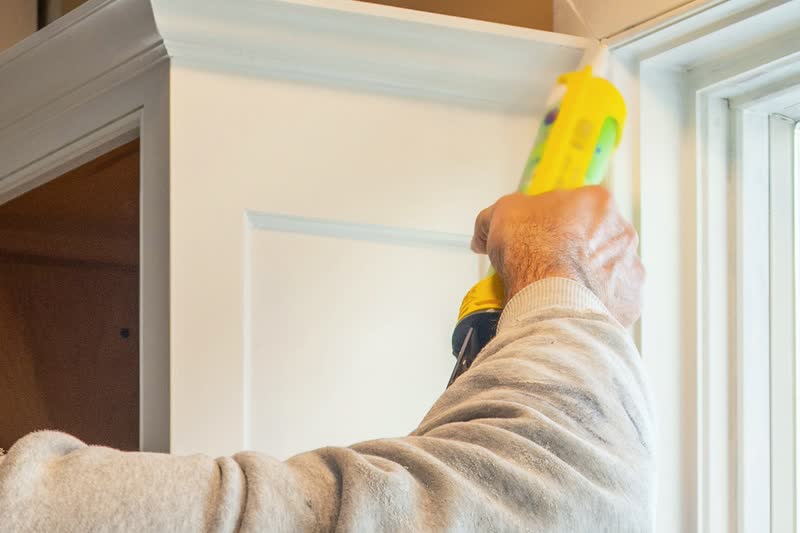
Sealing the gaps between your rooms and the attic, and leaky ductwork, so the air you pay to heat and cool stays inside.
Insulation blown into the closed walls of an existing house, batts in open walls for additions, remodels and new builds, and garage walls and ceilings.
Insulation for the garage ceiling under a bonus room, the wall shared with the house and the garage attic, with air leaks sealed first.
Floor insulation under the house: wet or fallen insulation pulled out, new batts between the floor joists, plastic over the dirt and the floor leaks sealed.
Blown-in insulation is loose fiberglass or cellulose, fed from a machine through a hose and spread across the attic floor, and fiberglass is the kind we blow in. Because it's loose, it settles in around wiring, pipes and joists that aren't evenly spaced, which rolls and batts can't do without a lot of careful cutting. ENERGY STAR notes that the new insulation doesn't have to match the old, so loose-fill can go over old batts or an older blown layer as long as it's dry and clean.
How it's set up decides how well it works. ENERGY STAR says any attic insulation estimate should include baffles, the channels at the eaves that keep the soffit vents open once the new layer is in. Recessed lights that aren't rated for contact with insulation get covered or replaced, a metal flue keeps its clearance, and the hatch gets weatherstripped and insulated so it doesn't stay the weak spot in an otherwise deep floor. Those come with the job. They aren't add-ons.
Mecklenburg County is climate zone 3 on both maps North Carolina uses, the one in the state energy code and the newer one drawn for the 2021 national model code. For zone 3, ENERGY STAR recommends R-49 when the attic floor is bare, or R-38 on top of 3 to 4 inches that are already there. North Carolina's code asks for R-38 in the ceiling of a new house, so topping up to R-49 goes past what a builder has to do today.
Any dry, sound insulation already up there counts toward the target, and you only pay to make up the difference. How many inches that takes depends on the material, since cellulose and loose-fill fiberglass reach the same R-value at different thicknesses, and every bag has a coverage chart for the installed and settled depth. Our R-value guide turns each target into inches, and your price names the R-value we'd aim for.
Summer is when a thin Charlotte attic gives itself away. The average July high at the Charlotte Douglas Airport station is about 90 degrees in NOAA's 1991 to 2020 normals, and the average January low is about 32. On a sunny afternoon the roof bakes the attic, and that heat works down through a thin layer into the rooms below, upstairs worst of all. A deep, even layer over a sealed ceiling slows it down.
A radiant barrier, the reflective foil fastened under the roof, is the other fix people ask about. The Building America Solution Center says that once an attic is insulated to R-30 or better, there's very little heat flow left for a radiant barrier to cut. Its one clear exception is ductwork in the attic, which the foil keeps cooler in summer. So the insulation goes up to target and the ducts get sealed first.
New insulation buries whatever is on the attic floor, so a few things get dealt with first. ENERGY STAR's list of problems to fix before insulating includes wet insulation from a leaking roof, kitchen, bath or dryer vents that blow moist air into the attic instead of outdoors, too little attic ventilation, and knob-and-tube wiring from before 1930, which can be a fire hazard where insulation touches it.
Some of that is our work and some isn't. Sealing, baffles and covers for lights are part of our job. A roof leak goes to a roofer, live old wiring to an electrician and a broken duct to a heating and cooling contractor. Know about anything on the list below already? Put it in your note when you send the square footage. The crew looks for all of it with you on install day, too.
Sometimes the old layer can't stay under the new one. When water, mold, a bad smell or animal waste has gotten into it, it fails ENERGY STAR's test. The cause gets fixed, the old material is vacuumed out, the bare ceiling is sealed and new insulation is blown in. That's removal and replacement in one job, and the bare floor halfway through is the easiest time you'll ever have to seal the ceiling right.
Vermiculite is the exception. It looks like small pebbles, usually gray-brown or silver-gold, and the EPA says to assume it contains asbestos and not to disturb it. If it turns up, the job stops and we tell you why. If you think you have it, that's an attic we'd rather see in person before anyone prices it.
Each page has local notes on the homes and attics in that town.
Mecklenburg County, 9 miles southeast
Median home built 1994 (Charlotte: 1995)
Attic insulation in MatthewsMecklenburg County, 9 miles southwest
Median home built 1999 (Charlotte: 1995)
Attic insulation in PinevilleMecklenburg County, 14 miles north
Median home built 2004 (Charlotte: 1995)
Attic insulation in HuntersvilleCabarrus County, 17 miles northeast
Median home built 1998 (Charlotte: 1995)
Insulation company serving ConcordGaston County, 20 miles west
Median home built 1978 (Charlotte: 1995)
Attic insulation in GastoniaAlso in Mecklenburg County: Cornelius, Davidson, and Mint Hill. Every town in Mecklenburg County. See all service areas.
Local service pages: Attic Insulation in Asheville, Attic Insulation in Durham, Attic Insulation in Fayetteville, Attic Insulation in Greensboro, Attic Insulation in Greenville, Attic Insulation in High Point, Attic Insulation in Lexington, Attic Insulation in Raleigh, Attic Insulation in Thomasville, Attic Insulation in Wilmington, Attic Insulation in Winston-Salem.
We don't print prices, because no two attics need the same work. The attic's floor area drives most of it, so your square footage, or your address, is usually enough for us to quote it. The rest depends on how far your insulation is from the target R-value, how much air sealing comes first and whether a ruined layer has to come out. Getting the price costs nothing, and it only covers what your attic needs.
For an open attic floor, usually. Loose-fill goes on as one continuous layer and fills in around wires, pipes and uneven framing, where batts leave seams and gaps unless each one is cut and fitted with care. Batts still have their place in walls, and we'll tell you which material fits each part of your attic.
Look across the attic floor from the hatch with a flashlight. ENERGY STAR's rule is that if the insulation is level with or below the tops of the floor joists, so you can easily see them, you should add more. If the joists are buried under an even layer, you may have enough, and we'll tell you so. A ruler pushed down to the ceiling gives you the depth. Check near the eaves too, where it's often thinnest.
Most of Charlotte is on Duke Energy Carolinas, and its Smart $aver insulation and sealing offer is the one to ask about. The work has to be done by a contractor in Duke's network, and the terms change, so check the current rules before the job starts. Insulation Pros is an approved Duke Energy trade ally.
Over its flat ceiling, usually, working from the attic beside or above it. The knee walls and the sloped ceiling are separate questions. Knee walls need sealing and insulation on the attic side, and a sloped ceiling closed in on both sides may leave no room to add anything. Mention the bonus room up front so it's in the price. The crew will point out on install day which parts can be reached.
Attic Insulation
Blown-in insulation is loose-fill fiberglass or cellulose blown across an attic floor. See how the job is done, how it compares with batts, what R-value and depth mean, and where another material fits better.
Attic Insulation
North Carolina's energy code requires R-38 in a new ceiling, and ENERGY STAR recommends more for existing attics. See both numbers, which climate zone your county is in and how many inches each R-value takes.
Census Bureau figures for Charlotte, NOAA monthly normals for the Charlotte Douglas Airport station, ENERGY STAR recommended insulation R-values, ENERGY STAR attic insulation project, ENERGY STAR Well-Insulated and Sealed Attic page, ENERGY STAR guide to adding attic insulation, Building America Solution Center on attic radiant barriers, EPA on vermiculite insulation, Duke Energy Carolinas (October 2026). Compiled by Insulation Pros. How the town pages are made.
Charlotte, NC
Open in Google Maps (opens in a new tab)Insulation Pros is an insulation contractor serving North Carolina, including Charlotte. Attics here usually get priced straight from their size, and the estimate is free.
Thinking about more insulation for your Charlotte attic? Use the contact form, or call or text with its size, and you'll get the target, the work and the price in writing for free, with nothing on it your attic doesn't need.
What You Can Count On
We serve homes across North Carolina. These are the largest towns we work in.
Alamance County
Buncombe County
Cabarrus County
Cumberland County
Durham County
Forsyth County
Gaston County
Guilford County
Mecklenburg County
New Hanover County
Onslow County
Orange County
Pitt County
Wake County