Attic Insulation
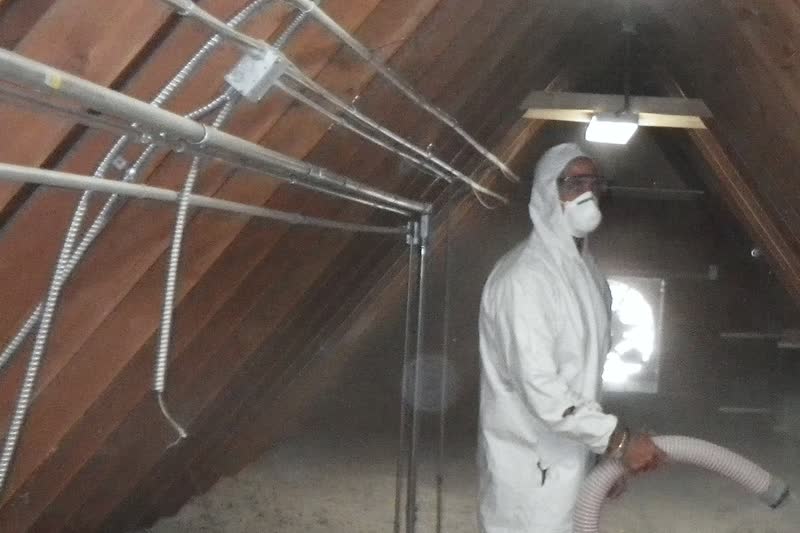
Blown-in fiberglass attic insulation, added to the depth your home needs, to even out hot and cold rooms and cut wasted heating and cooling.
From 1920s Ardmore bungalows to newer subdivisions, we blow in attic insulation, remove old insulation that's gone bad, seal air leaks and ducts, and insulate walls and garages across Winston-Salem. Family owned, free estimates.
Insulation Pros is a family owned and operated insulation company, and we handle home insulation all over Winston-Salem: the attic first, then air sealing and duct sealing, wall insulation, garage insulation and crawl space insulation under the floor. The city is the seat of Forsyth County and the fifth-largest in North Carolina, and its houses cover more than a century: cottages from the tobacco and textile boom near downtown, mid-century neighborhoods farther out, and subdivisions built in recent decades. Each kind can have its own attic problems, so the sections below say what can turn up over the ceilings of each.
The Census Bureau's American Community Survey estimates for 2020 to 2024 put numbers on that range. About six in ten housing units in the city are detached single-family houses. Roughly one in four was built before 1960, nearly half before 1980, and about one in four in 2000 or later. Our guide on how old homes in North Carolina are puts the city's 48 percent built before 1980 beside Forsyth County's 44 percent and the state's 34.
Take all of it as general guidance, not a diagnosis. Two houses on the same street can have very different attics. That's also why our price follows your attic and not a sales script: we figure it from the size of the attic floor and the work it actually needs, and nobody has to come by for most homes.
More for Winston-Salem homeowners: Attic insulation removal in Winston-Salem, Attic insulation in Winston-Salem.

Monday to Sunday 8:00 am to 5:00 pm.
Some of Winston-Salem's oldest houses stand in Salem, the Moravian town laid out in 1766. Its tobacco years left whole neighborhoods behind, among them Reynoldstown, where the Reynolds tobacco company put up bungalows for its workers in 1919 and 1920.
Salem's first family houses went up along Main Street from 1768 on, in half-timber, log or frame. The district's 2016 National Historic Landmark documentation says their plan, three or four rooms gathered around one central chimney, stayed in use into the 1830s and 1840s. It adds that most houses in Old Salem are privately owned. In a house built around one stack, the brick comes up through the middle of the attic floor. That opening gets a skirt of thin aluminum sheet, bedded in heat-proof caulk instead of foam. A metal collar then keeps the loose fill a safe distance from the masonry.
Waughtown Street began as the plank road to Fayetteville, and a streetcar line ran out Sprague Street by about 1901. The Waughtown-Belview Historic District's nomination, listed in 2005, describes its houses from about 1890 to 1915. Most are one-story frame cottages one room deep, almost always with a rear ell or a shed added at the back. Each of those back sections sits under its own roof and can hide its own small attic. Every one needs a look and its own measurement, because a full main attic says nothing about the space over the back rooms. New insulation is spread evenly in each, with no low spots.
Reynoldstown was a planned development of the R.J. Reynolds Tobacco Company. It built the first houses for employees in 1919 and 1920 and sold them to private owners from 1937 on, the 2008 nomination records. The houses are frame bungalows of one story or one and a half, and several came as pre-cut packages from the Minter Homes Company. In the taller ones, the upstairs rooms tuck under the rafters with low walls along each side. ENERGY STAR counts the hollows behind and beneath those low walls among a house's usual leaks. So the wedge of attic on each side gets its own sealing and insulation, not just the open floor above.
Attic insulation, removal, air sealing and more. Open one to see how the work goes.
Blown-in fiberglass attic insulation, added to the depth your home needs, to even out hot and cold rooms and cut wasted heating and cooling.
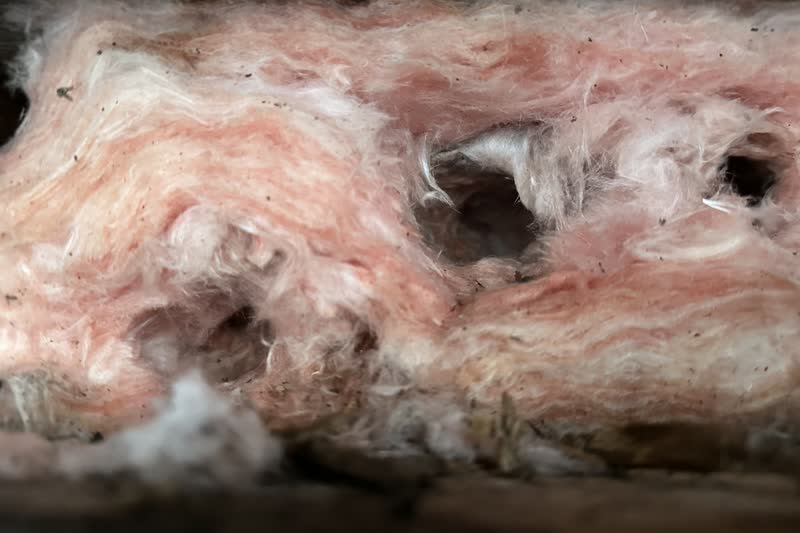
Old, wet, matted or animal-soiled attic insulation vacuumed out, so new insulation can go in on a clean, sealed attic floor.
Sealing the gaps between your rooms and the attic, and leaky ductwork, so the air you pay to heat and cool stays inside.
Insulation blown into the closed walls of an existing house, batts in open walls for additions, remodels and new builds, and garage walls and ceilings.
Insulation for the garage ceiling under a bonus room, the wall shared with the house and the garage attic, with air leaks sealed first.
Floor insulation under the house: wet or fallen insulation pulled out, new batts between the floor joists, plastic over the dirt and the floor leaks sealed.
Savings vary. Find out why in the seller's fact sheet on R-values. Higher R-values mean greater insulating power. In blown-in fiberglass, the attic insulation we install, ENERGY STAR's estimating figure puts R-38 at about 15 inches; the coverage chart of the product used gives the exact installed thickness for each R-value.
In a Winston-Salem house the attic job can be adding to what's already up there: the ceiling leaks get sealed, then loose-fill fiberglass is blown across the floor to one even layer, out to the eaves, with baffles keeping it off the soffit vents. How much to add in Forsyth County, and how a house's decade changes the work, is on our page about attic insulation in Winston-Salem.
Winston-Salem's center sits about 910 feet above sea level, 3 miles from NOAA's Winston-Salem Reynolds Airport station, the best match. The station's 1991 to 2020 normals average about 3,500 heating and 1,510 cooling degree days a year, so heating needs outweigh cooling there.
Readings change over short distances here: NOAA's Rural Hall station, 10 miles away, averages about 3,960 heating degree days.
Old insulation has to come out when it's wet, moldy, smelly or holds animal waste, the exceptions ENERGY STAR names in its advice on hiring an attic insulation contractor. When one applies, a roofer or a wildlife control company stops the cause first; once the mice are gone, we vacuum the old layer out, the attic is sanitized and deodorized, and we air seal the bare floor and, in most homes, blow in a fresh layer. We also do removal without a new layer.
When none applies, the old layer stays and gets topped up. Our page on attic insulation removal in Winston-Salem goes through the job in older and newer houses.
A mid-century Winston-Salem ranch can have a low, open attic that's easy to cross, and blown-in insulation over a sealed ceiling does most of the work there. What needs attention is whatever got added later. Recessed lights cut into the ceiling need clear space around them unless they're rated for contact with insulation, and ENERGY STAR puts that space at 3 inches. A bath fan whose duct stops in the attic should vent outdoors instead, and we run that duct outside as part of the job. Ductwork laid across the joists when central air went in gets its joints sealed before it's covered.
Houses from the last few decades bring different questions. Vaulted ceilings, bonus rooms and roofs with several hips and valleys leave cramped corners near the eaves, and those corners are where insulation can run thin. A newer house isn't automatically well insulated, either. North Carolina's 2018 code sets R-38 as the minimum for a new ceiling, the bottom of the range ENERGY STAR recommends for attics here, so what counts is what's in the attic, not the year it was built. Baffles at the eaves keep the soffit vents open, so air can move from the eaves to the roof vents.
Kernersville, which lies mostly in Forsyth County, has a lot of newer housing: a little over half its homes went up between 1990 and 2019. Our page on attic insulation in Kernersville covers those attics.
In an older Winston-Salem house, air sealing comes before insulation. Plaster ceilings crack, chimneys and plumbing stacks pass through the attic floor, and the tops of interior walls can be open to the attic. Warm air finds every one of those gaps in winter, so they get closed before new insulation goes over them. Loose duct joints in the attic are sealed in the same job.
These houses went up long before energy codes. Winston and Salem were separate towns until they merged in 1913, and the tobacco and textile boom had already built whole neighborhoods around them. The West End, planned in 1890 as a streetcar suburb, has buildings dating from about 1887 to 1930, including many bungalows from the 1910s and 1920s. Ardmore was platted mostly between 1910 and 1924 and is known for bungalows and small cottages.
Their attics can hold surprises. Some houses from this period were framed so the wall cavities rise unbroken into the attic, letting air travel up through the walls. Knob-and-tube wiring, which ENERGY STAR says can be a fire hazard where insulation touches it, needs an electrician's check before any work. Loose, pebble-like fill may be vermiculite, and the EPA's advice is to assume it contains asbestos and leave it undisturbed, so it's a job for an asbestos contractor and not something we vacuum out. Expect us to ask for a look at a house like this before we put a price on it. If the outside walls are hollow too, wall insulation blown into the closed walls can go on the same price.
Duke Energy Carolinas serves most of Winston-Salem, Surry-Yadkin EMC its edges; your bill says which. For gas, the city is in the Forsyth County franchise of Piedmont Natural Gas, and 32 percent of homes heat with piped gas.
Rebate to check here: Smart $aver Insulate and Seal (Duke Energy's contractor network). Before a job, check its current terms; the Forsyth County page lists every program.
Each page has local notes on the homes and attics in that town.
Forsyth County, 9 miles southwest
Median home built 1994, 13 years newer than Winston-Salem's
Insulation contractor in ClemmonsForsyth County, 9 miles west
Median home built 1987, 6 years newer than Winston-Salem's
Insulation contractor in LewisvilleForsyth County, 10 miles east
Median home built 1995, 14 years newer than Winston-Salem's
Insulation contractor in KernersvilleAlso in Forsyth County: Bethania, Rural Hall, Tobaccoville, and Walkertown. Every town in Forsyth County. See all service areas.
Local service pages near Winston-Salem: Attic Insulation in Clemmons, Attic Insulation in Midway, Attic Insulation in Lewisville, Attic Insulation in King, Attic Insulation in High Point, Attic Insulation in Thomasville, Attic Insulation in Lexington, Attic Insulation in Summerfield, Attic Insulation in Archdale, Attic Insulation in Greensboro, Attic Insulation in Salisbury, Attic Insulation Removal in Clemmons, Attic Insulation Removal in Lewisville, Attic Insulation Removal in Kernersville, Attic Insulation Removal in High Point, Attic Insulation Removal in Thomasville, Attic Insulation Removal in Lexington, Attic Insulation Removal in Greensboro.
They can, though not always. A house from the early 1900s can have a thin layer of attic insulation, plaster ceilings and lots of paths for air to leak, so air sealing and a much deeper layer may be the advice. A newer house may need smaller fixes, like thin spots near the eaves or loose duct joints. The age of a house only tells us where to start looking. If your attic turns out to be in good shape, we'll say so.
All of those. Existing walls can be drilled and filled with blown fiberglass where the cavities allow it, and the open walls of an addition, a remodel or a new build get batts. Garage walls and ceilings are part of the work too. For the floor, the crew works from below: whatever has sagged or dropped is pulled out, new batts are fitted between the floor joists, air leaks through the floor get sealed, and plastic sheeting goes over the dirt as a ground cover. Most of our jobs still start with the attic, and one free estimate can cover any of it.
Usually. ENERGY STAR says the new layer doesn't have to be the same type as the old one, and it gives loose-fill blown over fiberglass batts as an example. The batts stay if they're dry, clean and lying flat against the ceiling, and the gaps under them are sealed before they're covered. Batts that are soaked, stained or full of droppings are a different story. Those come out with the rest of the old insulation, and new insulation is blown in after.
Start with the attic. On a sunny afternoon the roof heats the attic, and that heat works down through thin insulation and comes in through gaps in the ceiling. Ducts in the attic add to it, because they carry cooled air through the hottest part of the house. Sealing the ceiling, bringing the insulation up to depth and sealing the duct joints can do the most.
Enough detail to set it beside another insulation company's quote. Look for the R-value the attic will reach, not just a number of inches, along with which areas get air sealing, whether old insulation comes out first and how the eaves and the hatch are handled. After the job, the Federal Trade Commission's R-value Rule says the installer owes you a receipt, and for blown-in insulation it shows the area covered, the installed and settled thickness, the R-value and the number of bags. Ask us about any line you're unsure of.
Not for most homes. The attic's size is what we price from, and your home's footprint gives us that if you don't know it. An old house with knob-and-tube wiring or pebbly fill is different. We'd rather see one of those first, on a trip made just for that. And nothing goes into any attic until the installers have been up there with you.
Not for the insulation itself. Salem has had local review from 1948 on, when a city and county zoning ordinance created the Old and Historic Salem District. Under state law, a preservation commission rules on exterior changes, and the way rooms are arranged inside is outside its reach. New roof or soffit vents count as exterior work, so take those to the Historic Resources Commission first. Read your deed as well: property that passed through the Old Salem restoration organization can carry covenants, and some of them reach interior features.
Nothing required it to. The company built them in 1919 and 1920. The state law tying move-in to insulation standards reaches only houses whose building began in 1978 or later. The 2008 nomination is silent on insulation, and the company began selling the houses to private owners in 1937, so someone has to go up and see. The depth above the main rooms and above any later addition can differ, and the chimney needs a look and the wiring an electrician before anything goes in.
Not on its own. The city has many listed districts, among them West End, Washington Park, Ardmore, Waughtown-Belview and Reynoldstown. North Carolina's preservation office states plainly that an owner spending their own money on a listed house is not limited by the listing. A local district is different. The commission's own publications name three local historic or overlay districts, Old Salem, Bethabara and West End, where outside changes need the Historic Resources Commission's approval. If you are unsure which applies to your street, ask the commission first.
Attic Insulation
North Carolina's energy code requires R-38 in a new ceiling, and ENERGY STAR recommends more for existing attics. See both numbers, which climate zone your county is in and how many inches each R-value takes.
Attic Insulation
Sound old attic insulation can stay under a fresh top-up. Wet, moldy, animal-soiled or smoke-damaged material cannot. Learn how to tell the difference, what removal involves and what to do about vermiculite.
Census Bureau figures for Winston-Salem, NOAA normals for the Winston-Salem Reynolds Airport station, Duke Energy Carolinas (October 2026). Compiled by Insulation Pros. How the town pages are made.
Sources for the Winston-Salem notes and questions (read October 2026):
Winston-Salem, NC
Open in Google Maps (opens in a new tab)Insulation Pros is an insulation contractor serving North Carolina, with free attic estimates for every Winston-Salem street.
Live in Winston-Salem and wondering what's going on above your ceilings? Get us the square footage and a few words about the house. The estimate is free, and if the attic doesn't need work, you'll hear that too.
What You Can Count On
Insulation Pros just finished sealing and insulating the attic in our 4,500-square-foot home, and they did a really solid job. They were here for two full days and were careful about every detail—installing the insulation properly and sealing everything up tight. They also gave us the best price by a long shot. Nobody else came close. The whole time they made us feel like we were their only customer, which was nice. When they wrapped up, they cleaned everything so thoroughly it looked like they had never even been here. I could tell right away that the new insulation is helping keep the house cooler. … I'd recommend them 100% to anyone in the Lexington, NC area.
Jeremy S.
Attic Air Sealing & InsulationLexington area
… Needed insulation added and received Quick service, a friendly demeanor, and great prices! … They did great work and left things clean after work was done. Would recommend to anyone needing insulation services.
Ellen N.
Insulation Added
For some time I had issues with my home staying cool/heated. Insulation Pros came out and insulated my attic and crawl space. The guys were so polite and worked in a timely manner. Satisfied customer!
Daisy D.
Attic & Floor Insulation
Very impressed with the work they did. They came out to quote the job, and had the job completed within the week! Great turn around time and we did not have to wait. Very professional. Would recommend them to anyone!
Landon R.
Great job, very fast follow up, and scheduling. Good pricing…. Totally recommend this company for your insulation needs.
Bobby W.
Great job for a great price!
Dale B.
We serve homes across North Carolina. Listed here: the Triad area first, then the big cities.
Davidson County
Guilford County
Forsyth County
Rowan County
Across the State