Attic Insulation
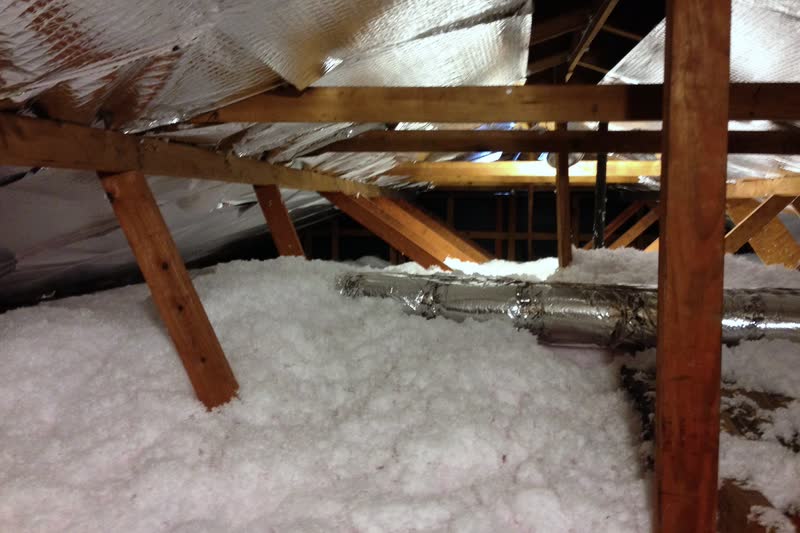
Blown-in fiberglass attic insulation, added to the depth your home needs, to even out hot and cold rooms and cut wasted heating and cooling.
The typical Archdale house was built in the mid-1980s, to an energy code that asked less of the attic than today's does. We add blown-in insulation, take out any old layer a leak or animals have ruined, and seal the air and duct leaks. No charge for the price.
Archdale sits at the northern edge of Randolph County, on the south side of High Point, and part of the city lies in Guilford County. The community has Quaker roots and was called Bush Hill until 1887, but the present city wasn't incorporated until a vote on July 8, 1969. The Census Bureau's American Community Survey puts the median year built for its housing at 1986, and about seven in ten of the city's housing units are detached houses.
Insulation Pros is a family owned and operated insulation company. All of Archdale, on both sides of the county line, is in our service area. The size of the attic floor is the number we start from when we price a job, and most homeowners can get that number to us without anyone coming out. The sections below start with the work itself, blown-in attic insulation and attic insulation removal, then turn to what each of Archdale's building eras means for the attic, and end with air sealing and how pricing works.

Monday to Friday 8:00 am to 5:00 pm. Saturday by appointment. Sunday closed.
Before High Point drew industry away, Archdale, then called Bush Hill, made building trim for much of Randolph County at the Petty sash and blind works. Few of its nineteenth-century houses survive, a 1989 nomination found, and its one listed example spreads across several roofs.
Moses Hammond and his brothers-in-law, W. C. and O. M. Petty, made furniture, window sashes, doors, blinds and mantels at Bush Hill, and they built houses as well. The factory's machine-made trim turns up in houses across Randolph County. Hammond's own house, built about 1880 and listed in 1989, once stood in a group of three similar houses, and its nomination counts it among the few nineteenth-century homes left in Archdale. Its 1989 description gives it a story-and-a-half kitchen ell behind and later additions on both sides. A house that grew that way can keep a separate attic under each roof, and each one can hold a different depth. We open every one, measure it, and bring the shallow ones up level with the rest.
Attic insulation, removal, air sealing and more. Open one to see how the work goes.
Blown-in fiberglass attic insulation, added to the depth your home needs, to even out hot and cold rooms and cut wasted heating and cooling.
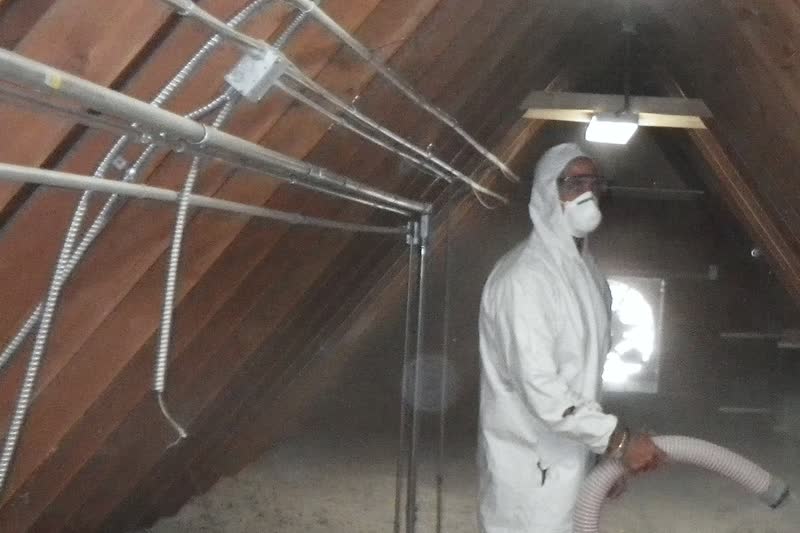
Old, wet, matted or animal-soiled attic insulation vacuumed out, so new insulation can go in on a clean, sealed attic floor.
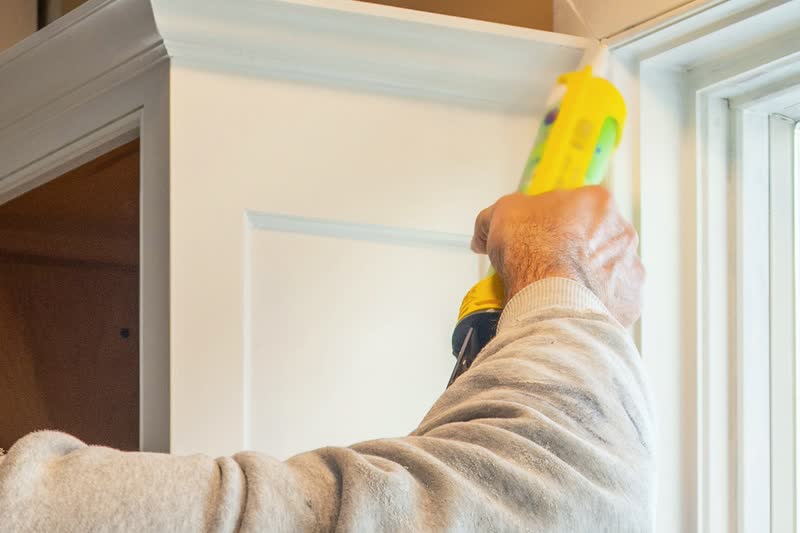
Sealing the gaps between your rooms and the attic, and leaky ductwork, so the air you pay to heat and cool stays inside.
Insulation blown into the closed walls of an existing house, batts in open walls for additions, remodels and new builds, and garage walls and ceilings.
Insulation for the garage ceiling under a bonus room, the wall shared with the house and the garage attic, with air leaks sealed first.
Floor insulation under the house: wet or fallen insulation pulled out, new batts between the floor joists, plastic over the dirt and the floor leaks sealed.
Before any attic insulation goes into an Archdale house, somebody has to know what's already there. Both climate maps, the one in North Carolina's code and the newer national one, put Randolph County in zone 3. That makes ENERGY STAR's targets R-49 if the attic floor is bare and R-38 if it already carries 3 to 4 inches. On install day the crew probes the depth from hatch to eaves and tells you the R-value you have now.
In a house built from 1970 through the 2000s the fix is usually more blown-in insulation over the old layer, leveled to a single depth, with baffles at the roof edge so the soffit vents stay open. An older attic sometimes holds a layer that's soaked, flattened or nested in by animals, and that comes out first, as the next section explains. We'll quote it as a target R-value, not just a depth in inches.
Archdale's center sits about 870 feet above sea level, 4 miles from NOAA's High Point station, the best match for Archdale. The station's 1991 to 2020 normals average about 3,120 heating and 1,710 cooling degree days a year, so at Archdale's station, heating needs outweigh cooling.
Readings change over short distances around Archdale: NOAA's Greensboro PTI Airport station, 13 miles away, averages about 3,500 heating degree days.
Most old insulation can be built on. ENERGY STAR's advice for hiring an attic insulation contractor is that new insulation can go over the old unless the existing layer is wet, moldy, smelly or holds animal waste, so a sound layer in an Archdale attic stays and counts toward the target. We won't talk you into removing it. Removal is for the attic that fails that test: insulation soaked by a roof leak, gone moldy or smelly, or soiled by mice or squirrels.
In that case the cause is stopped first, with the roof repaired or the animals removed. After that, the spoiled insulation comes out by vacuum. Over most Archdale ceilings a new layer is blown in next, once the bare floor's leaks are sealed, so the rooms below aren't left without cover. If you'd rather have the attic emptied and left that way, just ask.
The city's comprehensive plan counts roughly one-third of today's housing as built between 1900 and the 1969 incorporation, in homes that tend to sit on larger lots in the north of the city. Census estimates narrow the dates: about a quarter of all units went up in the 1950s and 1960s, and about 4 percent before 1950. On the Guilford County side, the plan's tally shows three of every four homes were built before 1970.
A house from those decades has had more than half a century of settling, storage and foot traffic in the attic. Expect a thin, uneven layer over a ceiling that was never sealed. That sets the order on the job: leaks get closed before insulation is added, and brittle or outdated wiring gets an electrician's opinion before it's covered.
One old material stops us. If the attic of an older Archdale house holds vermiculite, a pour-in fill the EPA describes as pebble-like and usually gray-brown or silver-gold, the agency wants it left undisturbed and presumed to contain asbestos. We leave it in place, and taking it out is a job for an asbestos contractor. If you suspect yours does, mention it up front.
After incorporation the city built a sewer system, and by the plan's count more than four in ten of today's dwellings went up from 1970 through 1999. Census estimates put a little over half of Archdale's units between 1980 and 2009. The plan notes that home building slowed sharply after 2008.
The insulation in a house is sized to the code in force the year it was built, and the code has moved since. North Carolina's 2009 and 2012 energy codes set the ceiling of a new house in Randolph County's climate zone at R-30. The 2018 edition lifted it to R-38. So your attic can be exactly as the builder left it and still sit below today's minimum for a new house. In practice the job is usually sealing the ceiling leaks, then adding to the layer already there.
Whatever heats an Archdale house, air sealing keeps that heat in the rooms. It closes the ceiling gaps around the attic hatch, plumbing stacks, wiring holes and light fixtures, and it comes before the insulation, because blown-in material doesn't stop air.
Duct sealing closes the duct joints we can reach with mastic or metal tape. Ducts that run through an attic are on ENERGY STAR's list of signs that a duct system may be performing poorly. If yours do, they can go on the same job.
Duke Energy supplies Archdale's electricity. For gas, Archdale is in the Randolph County franchise of Piedmont Natural Gas, and 27 percent of Archdale homes heat with piped gas. Duke's free House Call fits many Archdale homes: 68 percent heat with electricity.
Rebate to check in Archdale: Smart $aver Insulate and Seal (Duke Energy; Insulation Pros is an approved trade ally). Before an Archdale job, check its current terms; the Randolph County page lists every program.
Most Archdale houses are priced from the attic's square footage. Know yours? Send it. If not, an address does the job, because the footprint of a house is close to the size of its attic floor. Either way it costs nothing.
An older house on the Guilford side with brittle wiring, or a ceiling with a fresh stain, may need a closer look before we can price it fairly. In that case we'll make a special visit.
Install day begins in the attic, with you. The crew pushes a tape measure into the insulation in several places, looks at the hatch or pull-down stair, finds the gaps that leak air, checks any ducts and recessed lights, and looks over the roof deck for signs of an old leak. You see what they see before anything is done.

Each page has local notes on the homes and attics in that town.
Guilford County, 6 miles north
Median home built 1989, 3 years newer than Archdale's
Insulation contractor serving High PointDavidson County, 7 miles west
Median home built 1983, 3 years older than Archdale's
Insulation contractor serving ThomasvilleGuilford County, 15 miles northeast
Median home built 1985, 1 year older than Archdale's
Insulation contractor serving GreensboroRandolph County, 15 miles southeast
Median home built 1981, 5 years older than Archdale's
Insulation contractor serving AsheboroAlso in Randolph County: Franklinville, Liberty, Ramseur, Randleman, Seagrove, Staley, and Trinity. Every town in Randolph County. See all service areas.
Local service pages: Attic Insulation in Asheville, Attic Insulation in Charlotte, Attic Insulation in Durham, Attic Insulation in Fayetteville, Attic Insulation in Greensboro, Attic Insulation in Greenville, Attic Insulation in High Point, Attic Insulation in Lexington, Attic Insulation in Raleigh, Attic Insulation in Thomasville, Attic Insulation in Wilmington, Attic Insulation in Winston-Salem.
Yes, on both the Randolph County and the Guilford County sides. We take on homes across North Carolina, so all of Archdale is inside our area. Send us your Archdale street address and we'll price the attic.
Three things help most: the address, the year the house was built, which tells us the code the attic was built under, and how the attic is reached. The square footage too, if it's handy. Then say what made you reach out: a hot upstairs room, a high summer bill, a stain on a ceiling.
Yes, when it has to go. Insulation that's wet, moldy, matted or fouled by animals gets vacuumed out once the cause has been fixed; most homes then get a new blown-in layer over a sealed ceiling. A dry, sound layer usually stays and gets added to. Want it taken out and the attic left empty? We can do that too.
That depends on the year. North Carolina's 2009 and 2012 energy codes required R-30 in a new ceiling in Randolph County's climate zone, and the 2018 edition requires R-38. An attic can have met the code of its year and still fall short of today's. For existing homes in this zone, ENERGY STAR recommends R-38 to R-49, depending on what's already there. We give the target as an R-value, since different materials reach it at different depths.
Sometimes. NOAA's 30-year normals for the High Point station make June through September the four warmest months, and summer is when a barrier under the roof does its work. The Department of Energy's Building America Solution Center notes two things: ducts in the attic stay cooler in summer under a radiant barrier, and once the attic floor reaches R-30 or more, little heat is left flowing for one to stop. So insulation comes first, and a barrier is worth a thought only where the ducts run through the attic.
The house does. The size of the attic floor matters most, along with how much insulation is there now, how many ceiling leaks need sealing, whether a spoiled layer has to come out first and whether the job includes duct sealing. The size can come from you or from the house's footprint, and the crew measures the depth before starting. A surprise up there gets talked through with you first.
Probably not. Only one Archdale property appears among Randolph County's rows in the state's Register list: the Moses Hammond House, a bank branch by the time it was added in 1989. Randolph County has a landmark preservation commission on the state's 2023 roster. Outside changes to a house it designates need its sign-off, yet state law leaves interior work, attic included, beyond its reach. National Register listing by itself, the state preservation office notes, puts no restriction on a private owner.
Not right up to the brick. The Hammond House nomination describes a pair of tall, corbeled interior chimneys rising from the ridge of its roof. Where such a stack crosses the attic floor in an Archdale house, the opening gets aluminum flashing and heat-rated caulk. A sheet-metal dam then rings the brick, following ENERGY STAR's method. Typical codes keep loose fill 2 inches off masonry, or 1 inch off a metal flue pipe. Foam is never used at a chimney.
Attic Insulation
North Carolina's energy code requires R-38 in a new ceiling, and ENERGY STAR recommends more for existing attics. See both numbers, which climate zone your county is in and how many inches each R-value takes.
Attic Insulation
Blown-in insulation is loose-fill fiberglass or cellulose blown across an attic floor. See how the job is done, how it compares with batts, what R-value and depth mean, and where another material fits better.
Census Bureau figures for Archdale, NOAA normals for the High Point station, Duke Energy (October 2026). Compiled by Insulation Pros. How the town pages are made.
Sources for the Archdale notes and questions (read October 20, 2026):
Archdale, NC
Open in Google Maps (opens in a new tab)Insulation Pros is an insulation contractor serving North Carolina, on the Randolph and Guilford sides of Archdale alike. Most prices here need nothing more than the size of the house.
An Archdale attic price is free. Give us the square footage, and if a top-up is all it needs, a top-up is all you'll see on it.
What You Can Count On
We serve homes across North Carolina. These are the largest towns we work in.
Alamance County
Buncombe County
Cabarrus County
Cumberland County
Durham County
Forsyth County
Gaston County
Guilford County
Mecklenburg County
New Hanover County
Onslow County
Orange County
Pitt County
Wake County