Attic Insulation
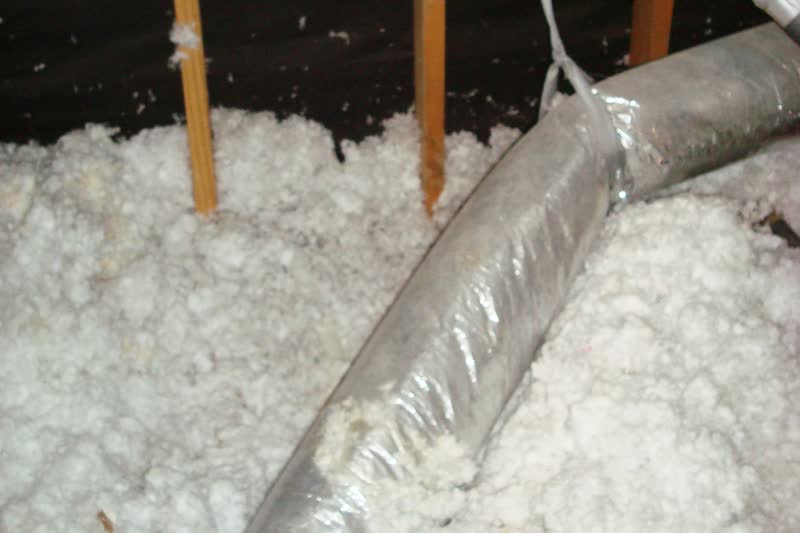
Blown-in fiberglass attic insulation, added to the depth your home needs, to even out hot and cold rooms and cut wasted heating and cooling.
Second floor that stays hot all summer, or a room that never warms up in January? In Asheboro houses of every era, the attic is usually where it starts. We blow in or top up insulation, replace layers that have failed, and seal the leaks. Getting a price is free.
Asheboro is Randolph County's seat and its largest city: about 28,000 people by the Census Bureau's 2025 estimate. It stayed a small courthouse town until the railroad arrived in July 1889. Hosiery and furniture mills followed, and houses have gone up in every decade since. By Census survey estimates, about a quarter of the city's housing was built before 1960, nearly another quarter in the 1960s and 1970s, and about half in 1980 or later. Many of the oldest are frame houses from the mill years, and a house's decade says a lot about its attic.
Then there's the weather, which works on an attic from both sides. NOAA's normals for the Asheboro 2 W station count about 32 days a year at 90 degrees or hotter, and January lows average 29 degrees. In summer the roof heats the attic, and in winter the warmth of the rooms escapes up through the ceiling, so the same layer of insulation has two jobs.
Insulation Pros is family owned and operated, and Asheboro falls inside the area we cover. A number for most Asheboro attics takes a few questions and the square footage, not an appointment. Below, attic insulation and the removal of old insulation come first, then Asheboro's houses by era, summer heat, and air and duct sealing.

Monday to Friday 8:00 am to 5:00 pm. Saturday by appointment. Sunday closed.
Asheboro built its houses in waves that tracked its hosiery mills and furniture plants. Mill workers got new streets around the First World War, Craftsman houses took hold in the 1910s, and veterans home from the Second World War created a fresh need for housing.
As Asheboro's mills and factories took on more hands in the 1910s, the workers needed places to live, the 2022 nomination for the downtown district explains. Some went into mill-owned villages and the blocks beside them. The town laid out new streets of house lots, and contractors built fast to ease the shortage. In an attic that has sat over a house for a century, the old insulation tells a story. Gray or black smudges in it, ENERGY STAR says, show warm room air escaping upward through the fibers. Each opening under a smudge gets closed, and the smudged layer around them can usually stay.
The Craftsman style took hold in Asheboro's houses during the 1910s, the same nomination says. Nationally, magazines printed its house plans, and companies such as Sears and Montgomery Ward sold them by mail. The plans called for low, horizontal lines and wide overhanging eaves. A roof that low leaves the attic pinched where it meets the outside walls, and ENERGY STAR finds the insulation is sometimes thinnest right there. Baffles go in at the soffits first to hold a channel open for outside air. Then the insulation is carried out over the top of those walls.
Building materials were scarce during the war, and only a few downtown projects went ahead. Once restrictions eased in 1946, the nomination says, returning veterans starting families created a need for housing after the lean years of the Depression and the war. Where a postwar kitchen has a boxed-in space over its wall cabinets, its top may lie open in the attic, hidden by loose fill. We rake the fill aside, cap the box with board, seal the edges and rake the fill back. A split-level, one of the postwar forms a state study describes, can also hide attics at two heights.
Attic insulation, removal, air sealing and more. Open one to see how the work goes.
Blown-in fiberglass attic insulation, added to the depth your home needs, to even out hot and cold rooms and cut wasted heating and cooling.
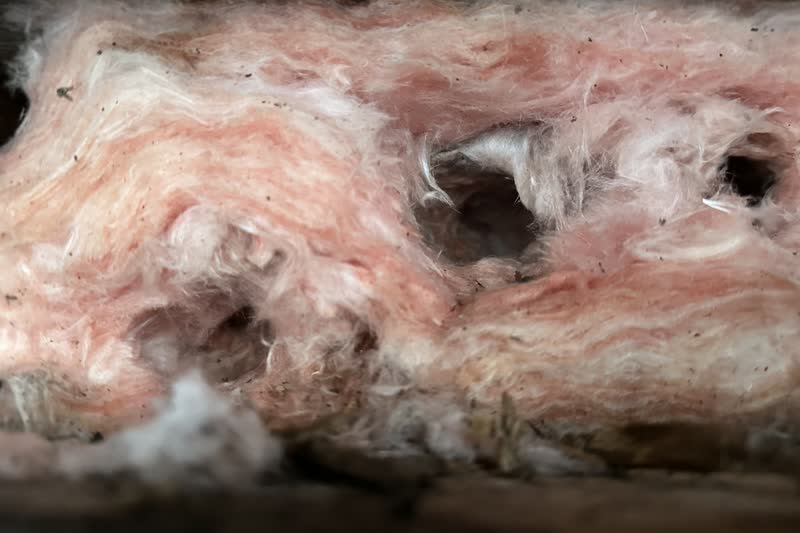
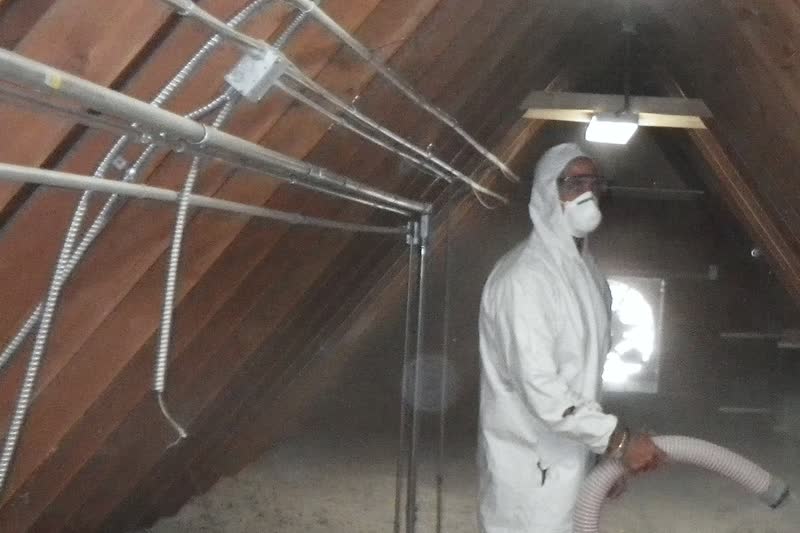
Old, wet, matted or animal-soiled attic insulation vacuumed out, so new insulation can go in on a clean, sealed attic floor.
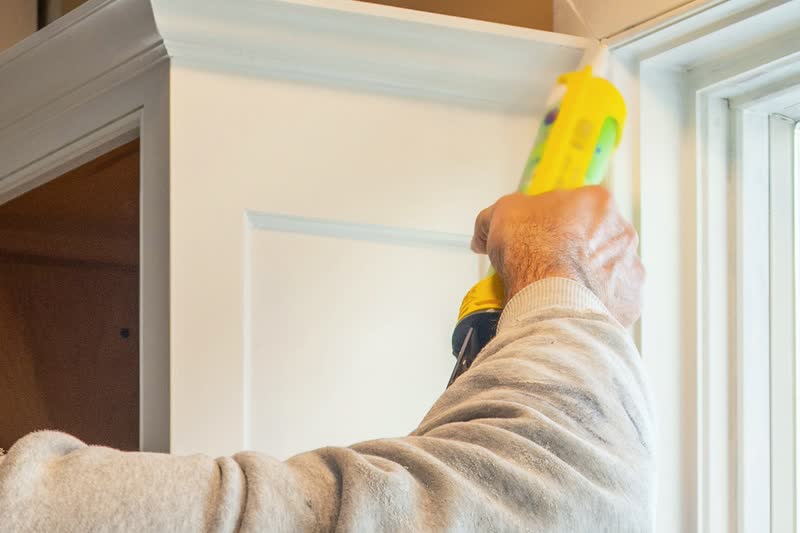
Sealing the gaps between your rooms and the attic, and leaky ductwork, so the air you pay to heat and cool stays inside.
Insulation blown into the closed walls of an existing house, batts in open walls for additions, remodels and new builds, and garage walls and ceilings.
Insulation for the garage ceiling under a bonus room, the wall shared with the house and the garage attic, with air leaks sealed first.
Floor insulation under the house: wet or fallen insulation pulled out, new batts between the floor joists, plastic over the dirt and the floor leaks sealed.
North Carolina's energy code places Randolph County in climate zone 3, and so does the national map behind ENERGY STAR's chart. For zone 3 that chart calls for R-49 in an attic that has nothing, or R-38 more over an existing 3 to 4 inches. Your price names the R-value we're aiming for. Inches come second.
A postwar attic with a few inches in it usually gets a deep top-up once the ceiling is sealed. Whatever's still clean and dry stays, and new blown-in insulation goes over it until the whole floor is level, with baffles keeping the soffit vents open. A newer attic may need only its thin spots filled, and then that's all we'll price.
Asheboro's center sits about 840 feet above sea level, 1 mile from NOAA's Asheboro 2 W station, the best match for Asheboro. The station's 1991 to 2020 normals average about 3,540 heating and 1,390 cooling degree days a year, so at Asheboro's station, heating needs outweigh cooling.
Old insulation has to come out when it's soaked or stained by a roof leak, moldy, or soiled by rats, squirrels or birds. Asheboro gets about 47 inches of precipitation in an average year by NOAA's normals for the local station, and no month averages under three inches, so a roof leak gets plenty of chances to wet the insulation under it. Before any of it comes out, the leak is repaired or the animals' way in is closed, which may mean calling a roofer or a wildlife control company.
Then we vacuum the damaged material out. In most homes, new blown-in insulation follows once the bare ceiling has been sealed and baffles are in at the eaves. If removal alone is what you need, with nothing going back, we handle that as a job by itself.
The city's own history counts 992 residents in 1900 and 5,021 in 1930. The National Register nomination for downtown describes what that boom built: mostly modest frame houses, with the Craftsman style common from the 1910s. By Census survey estimates, about one in ten housing units in Asheboro predates 1950.
A house that old went up long before any energy code. Whatever insulation is in the attic may have gone in decades later, and it may sit over open gaps in the ceiling. The wiring gets checked before anything is covered, and dated wiring goes to an electrician first. If the attic holds loose, pebble-like fill that could be vermiculite, we leave it alone and point you to an asbestos contractor. Then the gaps are closed, and only then does insulation go down. With a mill-era house, we may want a special visit before we price it.
Nearly four in ten housing units in Asheboro date from 1950 through 1979. An attic from those decades usually holds an older, thinner layer. Insulation that's still clean and dry stays, and more is blown on top. Tearing it all out is the exception.
About half the city's housing is newer still, built in 1980 or later. Those attics usually started with more, but loose-fill can settle, the edges at the eaves can run thin, and a cable or duct job since can leave a path through it. We recommend only what the depth shows. Sometimes that's nothing, and you'll hear it from us.
On a sunny summer day the roof deck heats up and radiates that heat down onto the attic insulation and any ducts below it. The Department of Energy's Building America Solution Center explains that the better an attic is insulated, the less heat a radiant barrier has left to cut: in an attic at R-30 or better, it says, there's very little. Ducts change the picture, though. By the same source's account, ductwork in an attic with a radiant barrier stays cooler through the summer, which can be a significant benefit.
So insulation and air sealing come first. A radiant barrier helps most in a sun-baked attic with ducts running through it. The crew also checks how the attic breathes. Soffit vents buried in insulation get baffles so air can still come in at the eaves, and anything about the ventilation a roofer should see, we'll pass along.
In an Asheboro house with a heat pump, one set of ducts carries the heating and the cooling, often through the attic. ENERGY STAR says the duct system in a typical house leaks away 20 to 30 percent of what it carries.
Air sealing means closing the gaps that connect your rooms to the attic. It comes before insulation, which would only hide the gaps. In a mill-era house the big gaps tend to be around the chimney and the plumbing stack, and in a newer one at light fixtures and the duct fittings behind each vent. Duct sealing closes those fittings and the duct joints with mastic or metal tape. A crushed or separated duct is work for a heating and cooling company, and we'll tell you if we see one.
Duke Energy serves most of Asheboro, Randolph EMC its edges; your bill says which. For gas, Asheboro is in the Randolph County franchise of Piedmont Natural Gas, and 28 percent of Asheboro homes heat with piped gas. Duke's free House Call fits many Asheboro homes: 70 percent heat with electricity.
Rebate to check in Asheboro: Smart $aver Insulate and Seal (Duke Energy; Insulation Pros is an approved trade ally). Before an Asheboro job, check its current terms; the Randolph County page lists every program.
Tell us where the house is and how big it is. Not sure of the square footage? We can get the attic's size from the house's outline. That's enough to price most Asheboro attics, and it's free.
Renters hold 55 percent of Asheboro's occupied homes, by Census Bureau estimates, so in a rented Asheboro house the attic work is the owner's call. The owner is the one to ask us for the price.
Installers head up to the attic with you before any work. They take the depth at several points, hunt for gaps in the ceiling, trace the ducts, look at the roof deck and the insulation for stains from a leak or signs of animals, and check that the vents at the eaves are clear. If part of the fix belongs to an electrician, a roofer or a heating and cooling contractor, they'll say so before starting.

Each page has local notes on the homes and attics in that town.
Randolph County, 15 miles northwest
Median home built 1986, 5 years newer than Asheboro's
Insulation contractor serving ArchdaleDavidson County, 19 miles northwest
Median home built 1983, 2 years newer than Asheboro's
Insulation contractor serving ThomasvilleGuilford County, 21 miles northwest
Median home built 1989, 8 years newer than Asheboro's
Insulation contractor serving High PointGuilford County, 26 miles north
Median home built 1985, 4 years newer than Asheboro's
Insulation contractor serving GreensboroAlso in Randolph County: Franklinville, Liberty, Ramseur, Randleman, Seagrove, Staley, and Trinity. Every town in Randolph County. See all service areas.
Local service pages: Attic Insulation in Asheville, Attic Insulation in Charlotte, Attic Insulation in Durham, Attic Insulation in Fayetteville, Attic Insulation in Greensboro, Attic Insulation in Greenville, Attic Insulation in High Point, Attic Insulation in Lexington, Attic Insulation in Raleigh, Attic Insulation in Thomasville, Attic Insulation in Wilmington, Attic Insulation in Winston-Salem.
Yes. We serve homes across North Carolina, and Asheboro sits inside that area. If your mail says Asheboro but the house is well out in the county, send us the street address and we'll check it against the map.
The street address and about how old the house is, plus the square footage if you know it. Then tell us the trouble: a second floor that stays hot, a room that never warms up in winter, a water stain on a ceiling, an electric bill that jumped.
The price follows the attic: how big it is, how far its depth falls short of the R-value target, whether old insulation has to come out, and how much of the ceiling needs sealing first. Your square footage plus a couple of answers from you covers most of it, so you don't have to wait on a visit to get a number. Asking costs nothing.
Often it can stay. Dry, clean insulation still counts toward the total, and new material goes over it once the ceiling is sealed. It comes out when it's wet, matted, moldy or soiled by animals: we vacuum it out after the cause has been fixed, and then the replacement goes in. Two things stop the work until another professional has dealt with them: loose, pebbly vermiculite, which can contain asbestos, and old knob-and-tube wiring.
It can, when the attic is the cause. A thin or patchy layer lets the heat of a sun-baked roof work down into the room, and gaps in the ceiling let hot attic air in. Ducts that cross a hot attic and leak lose cooled air before it reaches the vents. If the trouble turns out to be the heating and cooling system itself, we'll say so and point you to a contractor who works on it, instead of selling you insulation that won't fix it.
Closing, from the attic side, the openings that join your rooms to the attic: holes around wiring and plumbing stacks, the edges of the hatch, light fixtures, chases and the tops of interior walls. Small cracks get caulk or sealant. Big openings, like a chase, are covered with rigid board sealed at the edges, and around a chimney, sheet metal and heat-rated caulk keep anything that burns at a distance. Every bit of this happens before new insulation covers the attic floor.
Rarely. The Asheboro Downtown Historic District, listed in 2022, is mostly commercial and takes in only two residential buildings, a bungalow and an apartment building. Central School on the East Side is listed as a single building. Listing alone puts no limits on a private owner, the state preservation office says. A designated local landmark is different. Randolph County has a landmark preservation commission, and under state law outside changes to a landmark need its approval, though the interior is not reviewed. Attic insulation is inside work, while new roof vents are not.
No, they were not all built at once. African American families owned land and built houses on the East Side from the 1900s, the 1993 nomination for Central School records. Even so, most buildings there appeared to date from the 1920s through the 1960s, so neighbors can be forty years apart. A 1920s house there could still have porcelain knobs and cloth wire strung across its ceiling joists. Buried in loose fill, that pre-1930 circuitry is a fire hazard by ENERGY STAR's account, so an electrician sees it first. The newer house next door may need none of that, so each attic is judged on its own.
From the side attics, after sealing. The downtown nomination describes a 1919 brick bungalow on Worth Street with wood-shingled shed dormers running almost its full width. A bungalow built like that tucks its upstairs rooms partly into the sloping roof. Low knee walls stand beside them, with wedge-shaped attic pockets behind. ENERGY STAR warns that the open bays in the floor framing under those walls leak air even when insulation is stuffed into them. We close those bays first, then insulate each knee wall and the floor of each wedge, as well as the flat attic overhead.
Attic Insulation
North Carolina's energy code requires R-38 in a new ceiling, and ENERGY STAR recommends more for existing attics. See both numbers, which climate zone your county is in and how many inches each R-value takes.
Attic Insulation
Most old attic insulation can stay under a fresh top-up. Wet, moldy, animal-soiled or smoke-damaged material cannot. Learn how to tell the difference, what removal involves and what to do about vermiculite.
Census Bureau figures for Asheboro, NOAA normals for the Asheboro 2 W station, Duke Energy (October 2026). Compiled by Insulation Pros. How the town pages are made.
Sources for the Asheboro notes and questions (read October 20, 2026):
Asheboro, NC
Open in Google Maps (opens in a new tab)Insulation Pros is an insulation contractor serving North Carolina, Asheboro and the rest of Randolph County included. For most homes, a few questions and the square footage are all it takes to get a price.
Mill-era or built last year, your Asheboro house can have a free attic price. Just send us its size. No pressure, and no extras.
What You Can Count On
We serve homes across North Carolina. These are the largest towns we work in.
Alamance County
Buncombe County
Cabarrus County
Cumberland County
Durham County
Forsyth County
Gaston County
Guilford County
Mecklenburg County
New Hanover County
Onslow County
Orange County
Pitt County
Wake County