Attic Insulation
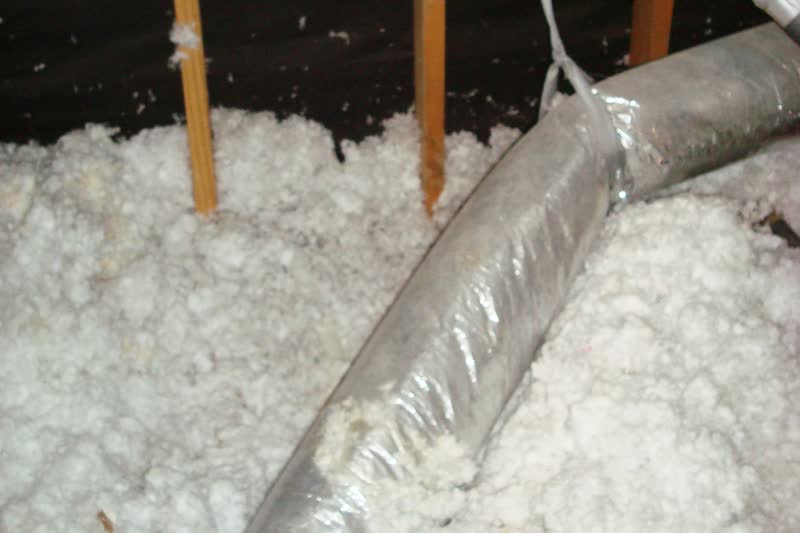
Blown-in fiberglass attic insulation, added to the depth your home needs, to even out hot and cold rooms and cut wasted heating and cooling.
Long mountain winters find every gap in an Asheville ceiling. We do attic insulation, insulation removal and air sealing for Asheville houses, from prewar homes near downtown to houses built in the last thirty years. Insulation Pros is a family owned company serving homes across North Carolina, and for most attics a free price starts with nothing more than the square footage.
Asheville has about 50,000 housing units, going by the Census Bureau's 2020 to 2024 survey. About 18 percent of them were built before 1940, about 40 percent from 1940 through 1989, and about 42 percent in 1990 or later.
Winter is the long season here. NOAA's 1991 to 2020 normals for its Asheville station give a January high under 48 degrees and about 77 nights a year at or below freezing, with about 11.5 inches of snow in an average year. July's average high is 86. Buncombe County is zone 4 on the state code's climate map and on the newer national map too, so attic targets here run higher than on the coast.
If you're comparing insulation companies in Asheville, ask how they price. We price most attics from the floor area, which you can send us or we can work out from the footprint of the house. No waiting on a visit. Old houses with complicated roofs sometimes need a closer look, and then we make a special visit. Whatever the house, the price covers what the attic needs and nothing else. This page covers attic insulation, insulation removal, flues and chimneys, air and duct sealing, and whether a radiant barrier makes sense this high up.
More for Asheville homeowners: Attic insulation in Asheville.

Monday to Friday 8:00 am to 5:00 pm. Saturday by appointment. Sunday closed.
Asheville, the Buncombe County seat on the French Broad River, grew to nearly twice its 1920 size during the boom of that decade, and then building almost stopped through the Depression. Neighborhoods such as Montford and Norwood Park were largely built before that pause.
The Montford Area Historic District's 1977 nomination counts well over six hundred buildings, the great majority of them houses. The earliest are Queen Anne houses of the late 1800s. Many of the rest blend Queen Anne, shingle, bungalow and Colonial Revival styles, with gambrel gables, hipped gables, turrets and dormers, several by the architect Richard Sharp Smith. Under a roof with that many parts there can be several attic spaces rather than one, some reached only from a finished room, and each may hold a different depth of insulation. Each one is found, measured and filled evenly with blown-in insulation, with no low spots, instead of only the space you can see from the main hatch.
Norwood Park, off Merrimon Avenue north of downtown, was platted in 1914. Its 2008 nomination finds the Craftsman bungalow the most common house there, followed by Colonial Revival, Minimal Traditional, Dutch Colonial and Tudor Revival houses built from about 1900 to the early 1950s. About twenty entries in its inventory are a story and a half, many with shed or gable dormers, and the Dutch Colonials sit under gambrel roofs. Upstairs in houses like these, the bedrooms tuck under the roof slope and the side walls stop short. The narrow triangles of attic beyond those low walls, and the floor beneath them, let air slip through, so they are sealed and insulated as well as the space overhead.
Attic insulation, removal, air sealing and more. Open one to see how the work goes.
Blown-in fiberglass attic insulation, added to the depth your home needs, to even out hot and cold rooms and cut wasted heating and cooling.
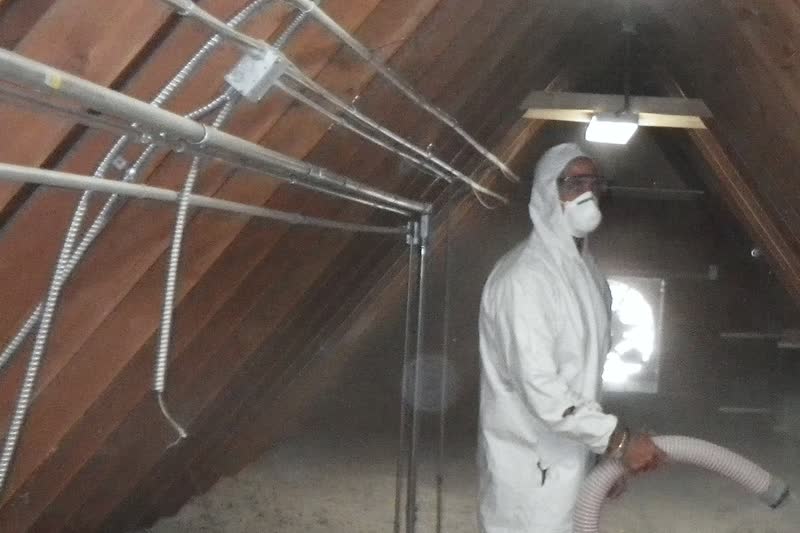
Old, wet, matted or animal-soiled attic insulation vacuumed out, so new insulation can go in on a clean, sealed attic floor.
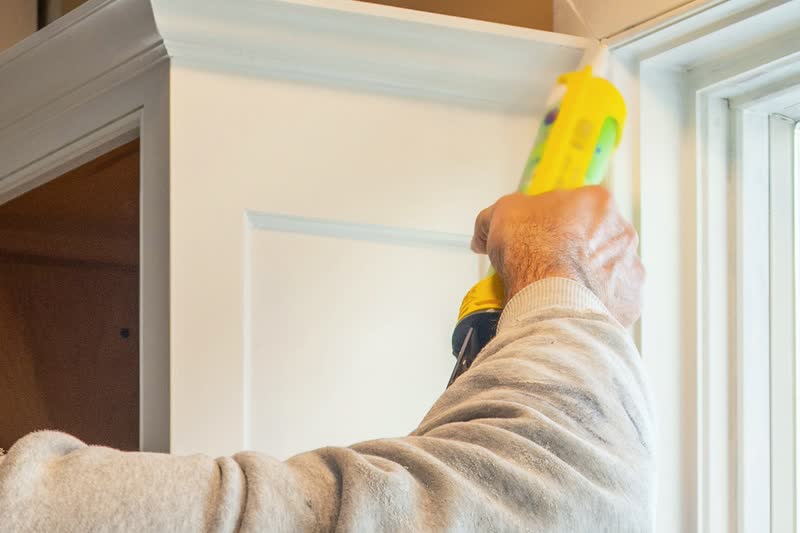
Sealing the gaps between your rooms and the attic, and leaky ductwork, so the air you pay to heat and cool stays inside.
Insulation blown into the closed walls of an existing house, batts in open walls for additions, remodels and new builds, and garage walls and ceilings.
Insulation for the garage ceiling under a bonus room, the wall shared with the house and the garage attic, with air leaks sealed first.
Floor insulation under the house: wet or fallen insulation pulled out, new batts between the floor joists, plastic over the dirt and the floor leaks sealed.
In most Asheville houses, attic insulation is a top-up. Blown-in fiberglass goes over the dry layer that's already there, once the gaps in the ceiling are sealed, until the floor sits at one even depth out to the eaves. In zone 4, ENERGY STAR's target is R-60 for an attic with nothing in it and R-49 added where 3 to 4 inches already lie. Those are the same figures it gives the state's coldest mountain counties.
A new ceiling only needs R-38 under North Carolina's energy code. So even a house built to code can be well short of R-60. How deep R-60 runs, and what older and newer houses usually need, are on the page for attic insulation in Asheville.
Asheville's center sits about 2,130 feet above sea level, under a mile from NOAA's Asheville station, the best match for Asheville. The station's 1991 to 2020 normals average about 3,880 heating and 1,090 cooling degree days a year, so at Asheville's station, heating needs outweigh cooling.
Readings change over short distances around Asheville: NOAA's Bent Creek station, 7 miles away, averages about 4,590 heating degree days.
Old insulation stays unless it has failed. ENERGY STAR's guide to hiring an attic insulation contractor names four ways it fails: it gets wet, grows mold, smells, or holds animal waste. Whatever caused the damage gets fixed first. A leaking roof goes to a roofer. Squirrels or mice have to be gone, with the way in closed, before anything new goes up.
From there, attic insulation removal is a vacuum job. The spoiled layer comes out through a hose, the bare ceiling gets sealed while every gap is in plain sight, and in most homes new insulation is blown in to the target depth. Want the old layer out and nothing put back? Tell us when you call.
Vermiculite is the fill we never vacuum. It's pebble-like and usually gray-brown or silver-gold, the EPA says, and homeowners should assume it holds asbestos, leave it be and have a professional asbestos contractor deal with it before any work disturbs it. If it's in your attic, the job stops there and we explain why.
A gas or oil furnace, boiler or water heater vents through a metal flue or a masonry chimney, and in many houses that pipe passes up through the attic floor. ENERGY STAR calls the opening around it a major source of warm air moving into the attic. It says the gap should be closed with aluminum flashing and high-temperature caulk, never with foam. By its account, codes usually call for 1 inch of space between a metal flue and anything that can burn, insulation included, and 2 inches at a masonry chimney. A metal dam keeps the loose fill back.
Sealing the attic floor changes how a house moves air, so ENERGY STAR suggests having oil and gas appliances tested before and after the work to make sure they still draft properly. Where that equipment sits in the attic itself, the EPA recommends that a professional HVAC contractor run a combustion safety test after any air sealing. We'll tell you when your house calls for one.
About 36 percent of Asheville's housing units are in buildings with two or more homes, the Census figures show. Some of that housing has a history of its own. The 2012 update to the city's architectural survey describes Edgewood Knoll on Merrimon Avenue, 27 two-story buildings with 168 apartments, finished in 1949 and 1950, and notes how much it raised the density of that stretch of Merrimon.
An attic over several apartments or townhouses is the building owner's or the association's call, not one tenant's. A multi-unit attic is a case where we'll usually make a special visit. Then we write one price for the attic as a whole, so the owner can see what each part needs.
ENERGY STAR lists drafty rooms, dry indoor air in winter and dust in the rooms right under the attic among the signs that an attic needs air sealing. In a house that heats through a long winter, those leaks run for months. The big openings get closed first: dropped soffits over cabinets, wall cavities open to the attic floor, the space behind and under kneewalls, and the chases around flues and ducts. Then come the holes for wiring and pipes.
The way into the attic counts too. ENERGY STAR's hiring guide says the hatch or attic door should be weatherstripped and insulated, since a bare hatch in an R-60 ceiling is basically a hole in it. Where ducts run through the attic, we seal their joints and the boots behind the registers with mastic or metal tape. ENERGY STAR counts ducts in an attic as one sign of a poorly performing system.
Usually not as a first step, and often not at all. The Building America Solution Center says their advantages shrink where the attic takes on little summer heat, and that above R-30 of attic insulation, there's very little heat flow left for foil to cut. NOAA's Asheville station averages about 16 days a year at 90 degrees or more.
The one case worth a look is ductwork in the attic, which a radiant barrier keeps cooler in summer. Otherwise your money goes further on sealing and depth, which is the work we do.
Duke Energy serves most of Asheville, French Broad EMC its edges; your bill says which. For gas, Asheville is in the Buncombe County franchise of Enbridge Gas North Carolina, and 28 percent of Asheville households heat with piped gas. Duke's free House Call fits many Asheville homes: 63 percent of households heat with electricity.
Rebate to check in Asheville: Smart $aver Insulate and Seal (Duke Energy; Insulation Pros is an approved trade ally). Before an Asheville job, check its current terms; the Buncombe County page lists every program.
Each page has local notes on the homes and attics in that town.
Buncombe County, 3 miles south
Median home built 1959, 23 years older than Asheville's
Attic insulation in Biltmore ForestBuncombe County, 6 miles northwest
Median home built 1999, 17 years newer than Asheville's
Attic insulation in WoodfinHenderson County, 10 miles south
Median home built 2001, 19 years newer than Asheville's
Attic insulation in FletcherBuncombe County, 13 miles east
Median home built 1986, 4 years newer than Asheville's
Attic insulation in Black MountainAlso in Buncombe County: Montreat. Every town in Buncombe County. See all service areas.
Local service pages: Attic Insulation in Asheville, Attic Insulation in Charlotte, Attic Insulation in Durham, Attic Insulation in Fayetteville, Attic Insulation in Greensboro, Attic Insulation in Greenville, Attic Insulation in High Point, Attic Insulation in Lexington, Attic Insulation in Raleigh, Attic Insulation in Thomasville, Attic Insulation in Wilmington, Attic Insulation in Winston-Salem.
Choose one that tells you plainly what your attic needs and prices only that. ENERGY STAR's hiring guide says a good estimate includes baffles at the eaves and sealing of the attic floor before insulation, and it suggests comparing more than one. Ask for the target as an R-value. In Asheville's zone that's R-60 for an empty attic. After the job, the FTC's R-value Rule entitles you to a receipt listing what went in.
The insulation that got wet usually does, but the roof comes first. The National Weather Service's summary of Helene records gusts of 55 to 70 mph across the region and hundreds of trees falling on houses. ENERGY STAR reads wet insulation as a sign of a leaking roof, and moldy or rotted rafters as a moisture problem, both to be put right before any insulation work. Once the roof is sound, we vacuum out what got soaked, seal the bare ceiling and blow in a new layer. Dry insulation away from the damage can stay. Storm damage is one case where we'll come see the attic before we price it.
Yes, by ENERGY STAR's table. Buncombe County is in climate zone 4, where the targets are R-60 for an empty attic and R-49 added over 3 to 4 inches. New Hanover County, around Wilmington, is in zone 3, where the same figures are R-49 and R-38. How much your attic needs depends on what's already up there, so tell us the depth you have when you ask for a price.
Yes. We serve all of North Carolina, so the mountain towns around Asheville are covered, Fletcher and the rest of Henderson County included. Weaverville, Woodfin and Black Mountain each have their own page in the list of nearby towns. Wherever the house is, the price comes on paper, and for most attics the square footage is enough to get it.
We do. Most of our work is in attics, but closed walls in an existing house can be filled with blown-in insulation, a garage ceiling under a bedroom or bonus room can be insulated and sealed, and commercial buildings get attic and ceiling work too. Home energy audits are a paid service, kept apart from the free attic estimate.
For most Asheville attics, it starts with the square footage. You send it, or you give us the address and we figure it ourselves, along with anything you know about the flues, the chimney, the hatch and any extra attic spaces. You get the price in writing. A house with a complicated roof or old wiring may get a special visit first. When install day comes, the crew checks the attic with you before they unload anything. If your attic needs nothing, we'll say so.
Not for the insulation itself. The Historic Resources Commission was set up in 1979 by the city and Buncombe County. It reviews work on local landmarks and in the four local historic districts: Montford, Biltmore Village, Albemarle Park and Saint Dunstan's. State law gives a commission a say over the outside of a building, not the arrangement inside, and attic insulation and air sealing are indoor work. Adding roof, ridge or soffit vents alters the exterior, so talk to the commission before that part. The city adds that a National Register district alone, such as Norwood Park, brings no design review.
Often it is warmth escaping from the rooms below. Asheville gets real snow: the Weather Service's list of the city's greatest snowstorms, kept from 1869, is led by the March 1993 storm at 18.2 inches. When warm air leaks into the attic, it melts snow on the upper roof, and the water refreezes at the cold eaves. Building America's remedy is a tight, well-insulated ceiling with air moving from soffit to ridge, which keeps the attic cold. So we seal the ceiling first, then insulate, and keep the soffit vents open.
An electrician, before any insulation goes in. Asheville built at a furious pace through the mid-1920s, then the bank failures of November 1930 brought building nearly to a stop until the late 1930s. Montford and Norwood Park both date largely from those years or earlier. Wiring of that era can include knob-and-tube. ENERGY STAR calls it a fire risk where insulation covers it, and it is to be corrected before the attic is insulated. We look for it first, and wherever it is live, no insulation goes over it.
Attic Insulation
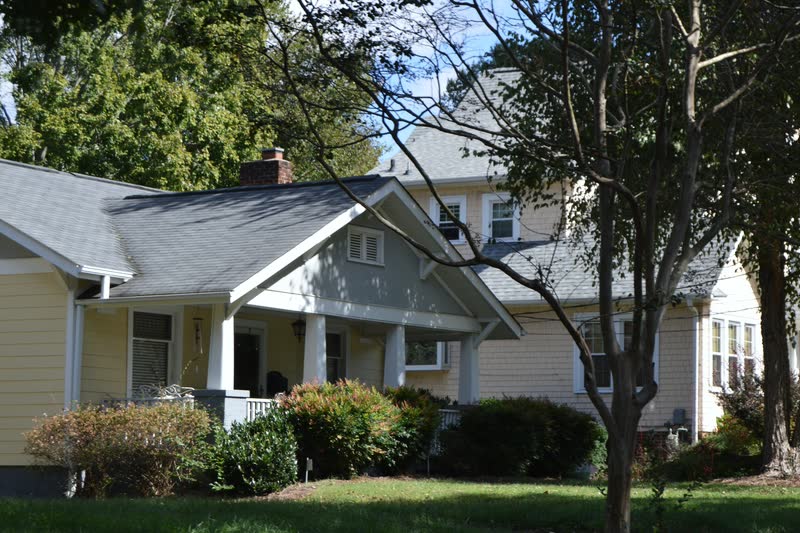
Houses built before the state's 1978 energy rules often have little in the attic and nothing in the walls. Learn the safety checks to make first, the leaks old framing hides and the order to do the work in.
Attic Insulation
IC, non-IC and ICAT labels, the 3-inch rule, sheet metal dams at flues and chimneys, and the bath fans and junction boxes in between. How to check your own attic and what a careful job should leave in place.
Census Bureau figures for Asheville, NOAA normals for the Asheville station, NOAA monthly normals for the Asheville station, Duke Energy, Asheville Survey Update, Phase II Summary Report (NC HPO), Tropical Cyclone Helene event summary (National Weather Service Greenville-Spartanburg), How to Hire an Attic Insulation Contractor (ENERGY STAR), Recommended Home Insulation R-Values (ENERGY STAR), Attic Air Sealing Project (ENERGY STAR), Attic Insulation Project (ENERGY STAR), Duct Sealing (ENERGY STAR), Asbestos-contaminated vermiculite insulation (EPA), Attic Radiant Barriers (Building America Solution Center), FTC R-value Rule (16 CFR 460.17), North Carolina codes in force (Office of State Fire Marshal) (October 2026). Compiled by Insulation Pros. How the town pages are made.
Sources for the Asheville notes and questions (read October 20, 2026):
Asheville, NC
Open in Google Maps (opens in a new tab)Insulation Pros is an insulation contractor serving North Carolina, Asheville and the mountains included. Mountain attics get priced the same way as anywhere else, from their size, at no cost.
Wondering how your Asheville attic will hold up this winter? Call or text, or send the size, and we'll write up a free price for just the work it needs.
What You Can Count On
We serve homes across North Carolina. These are the largest towns we work in.
Alamance County
Buncombe County
Cabarrus County
Cumberland County
Durham County
Forsyth County
Gaston County
Guilford County
Mecklenburg County
New Hanover County
Onslow County
Orange County
Pitt County
Wake County