Attic Insulation
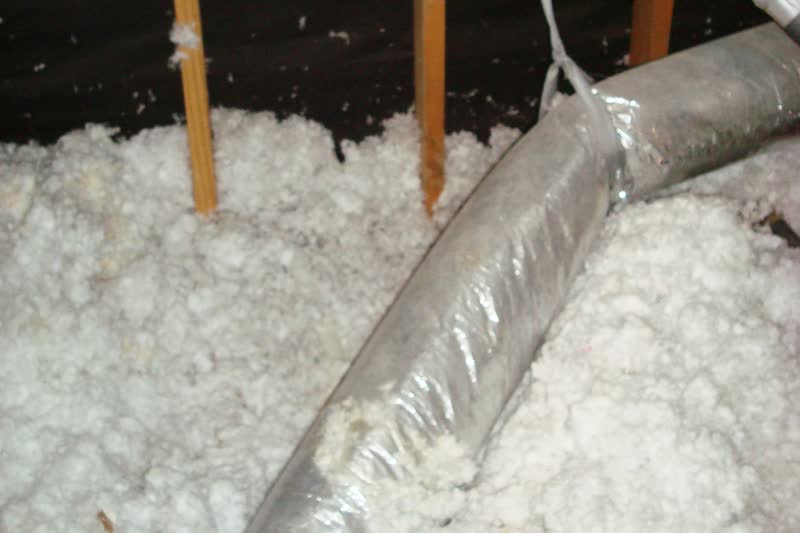
Blown-in fiberglass attic insulation, added to the depth your home needs, to even out hot and cold rooms and cut wasted heating and cooling.
Cold floors in a Durham winter and a stuffy upstairs in August often come from the same thin attic. We're an insulation contractor serving Durham, for houses from the tobacco-era neighborhoods to the newest subdivisions. We blow attic insulation in to depth, vacuum out insulation that's been spoiled, and seal the air and duct leaks. The estimate is free, and for most attics the square footage is all we need.
Durham's population was about 306,000 in the Census Bureau's 2025 estimate, roughly 24,000 more than in 2020. Its older neighborhoods grew up around the tobacco factories, the mills and the Trinity College campus that's now Duke's East Campus. Much of its housing is far newer. So a Durham attic can be anything from a tight space under a 1910s hipped roof to a deep attic full of ductwork over a house finished a few years ago.
The work is the same here as anywhere else in North Carolina. Ceiling leaks get sealed first. Insulation that's wet or moldy, smells, or has been fouled by animals gets vacuumed out. Then fresh loose-fill gets blown in, as deep as the house needs. We also do wall, garage and crawl space insulation, take on commercial work, and offer home energy audits as a paid service.
Insulation Pros is family owned, and we keep pricing plain. We price most Durham attics by the square foot, using the size you give us or one we work out from your home's footprint. Nobody needs to drive out for that. If an attic needs a closer look first, we'll make a special visit. And when the honest answer is that your attic is fine, that's the answer you'll get.
More for Durham homeowners: Attic insulation in Durham.

Monday to Friday 8:00 am to 5:00 pm. Saturday by appointment. Sunday closed.
Durham began as a railroad station on land given by Bartlett Durham, was incorporated in 1866 and grew on tobacco and textiles. Its older houses range from mill duplexes and trolley-line bungalows to the ranch houses of the 1950s, and each type hides a different kind of attic.
North of downtown, the 1985 nomination for the Pearl Mill Village Historic District counts 26 houses put up by the owners of Pearl Cotton Mills. It says 22 of them were built around 1905 as two-story duplexes, one room deep. Their upper floor is shorter than the ground floor, and its headroom rises into the gable roof. So the attic above those upper rooms is only a sliver, with a plain brick chimney through the middle of each house. The mill sold the houses off in 1945. Where that chimney passes up through the ceiling, ENERGY STAR's method applies. Light aluminum is bent over the gap and sealed with high-temperature caulk. A metal collar around the brick then keeps loose fill clear of it.
In 1902 the Durham Traction Company built an electric trolley line and, at its end on Chapel Hill Road, the Lakewood amusement park. A neighborhood grew up around it. The Lakewood Park Historic District's nomination puts about half of its houses between 1902 and 1920, mostly one-story Queen Anne cottages, followed by bungalows in the 1920s. Its inventory lists several side-gabled bungalows a story and a half tall, with dormers and interior chimneys. In a bungalow like that, the upper rooms are tucked under the roof slope, with low knee walls and small wedge-shaped attics beside them. ENERGY STAR's list of attic leaks includes the spaces behind and beneath knee walls. Those little side spaces need their open floor cavities blocked and their walls covered, along with the main attic above.
Hope Valley was laid out in 1926 around a Donald Ross golf course, several miles southwest of downtown. Its first houses, from the late 1920s and 1930s, were large period revival designs. After the war the ranch took over: the nomination calls it the most popular type there in the 1950s and again in the 1960s. A ranch sits under a low-pitched roof, so the attic gets shallow toward the outside walls. ENERGY STAR's guide notes that insulation can run thin along the eaves. A baffle in each rafter bay holds a path open over the soffit vent, so the blown insulation can go all the way out.
Attic insulation, removal, air sealing and more. Open one to see how the work goes.
Blown-in fiberglass attic insulation, added to the depth your home needs, to even out hot and cold rooms and cut wasted heating and cooling.
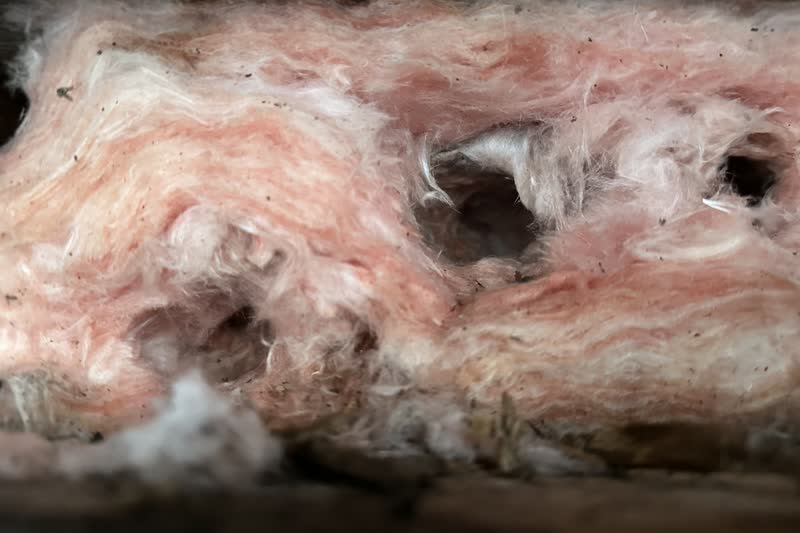
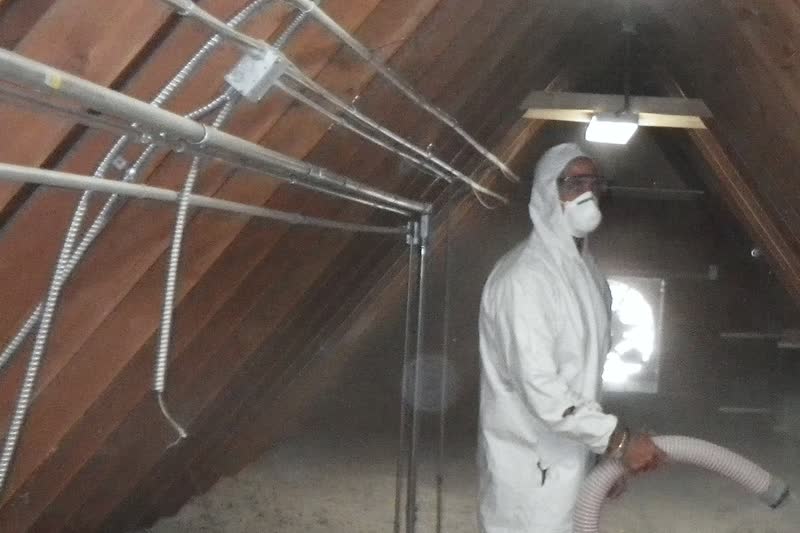
Old, wet, matted or animal-soiled attic insulation vacuumed out, so new insulation can go in on a clean, sealed attic floor.
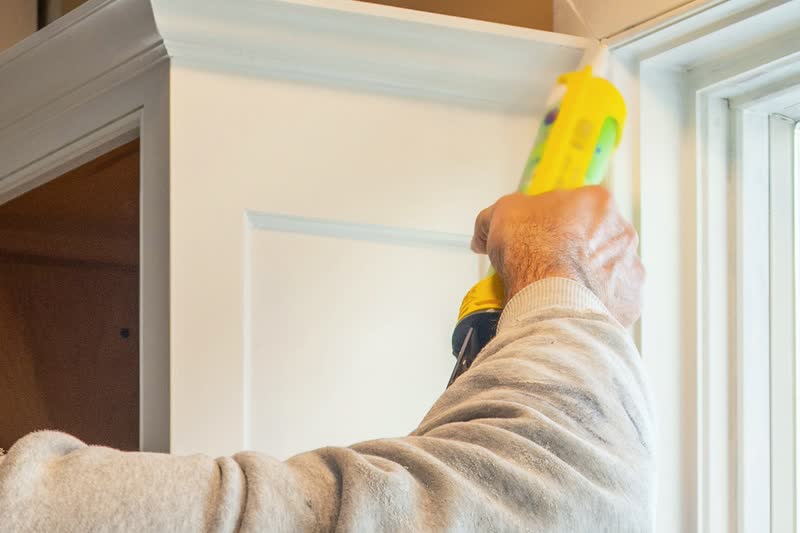
Sealing the gaps between your rooms and the attic, and leaky ductwork, so the air you pay to heat and cool stays inside.
Insulation blown into the closed walls of an existing house, batts in open walls for additions, remodels and new builds, and garage walls and ceilings.
Insulation for the garage ceiling under a bonus room, the wall shared with the house and the garage attic, with air leaks sealed first.
Floor insulation under the house: wet or fallen insulation pulled out, new batts between the floor joists, plastic over the dirt and the floor leaks sealed.
Durham County is zone 4 in North Carolina's energy code and zone 3 on the newer national map. That puts ENERGY STAR's figures for a Durham attic at R-49 to R-60 when the floor is bare, and R-38 to R-49 when 3 to 4 inches are already in place. Winter counts here. NOAA's 1991 to 2020 normals for the city's own Durham station put the average January low near 28 degrees, with about 84 nights a year at freezing or below.
For the targets, the blown-in materials and what goes into the price, read the page on attic insulation in Durham.
Durham's center sits about 400 feet above sea level, 5 miles from NOAA's Durham station, the best match for Durham. The station's 1991 to 2020 normals average about 3,750 heating and 1,350 cooling degree days a year, so at Durham's station, heating needs outweigh cooling.
Readings change over short distances around Durham: NOAA's Raleigh-Durham International Airport station, 10 miles away, averages about 3,150 heating degree days.
We vacuum old insulation out only when it has to go. ENERGY STAR's guidance says removing the old layer usually isn't necessary, and that contractors can add new insulation on top unless it's wet, has mold in it, smells or holds animal waste. If it's just thin, dusty or old, it stays where it is and gets covered, and you don't pay to have it hauled off.
When it does have to go, whatever caused the damage gets dealt with first. A roof leak is a roofer's repair, and animals still coming and going are a wildlife control company's job. After that the ruined insulation is vacuumed out, the bare ceiling is sealed while every opening is in view, and in most homes a new blown-in layer goes in. If you want the old layer out with nothing added yet, ask for that.
One old fill stays where it is. Vermiculite looks like small pebbles and is usually gray-brown or silver-gold. The EPA says to assume it contains asbestos and not to disturb it. If it turns up in a Durham attic we stop and tell you, and removing it becomes a job for a professional asbestos contractor.
Two of Durham's early suburbs show off its houses from the 1910s and 1920s. Trinity Park and Trinity Heights, next to the old Trinity College campus, hold houses from the late 1890s to about 1940. Their nomination counts the bungalow as the most common type, about a fifth of the housing, plus several dozen Foursquares, and it records sixteen bungalows the Liggett & Myers Tobacco Co. built as an investment right in the middle of Trinity Park. In Watts-Hillandale, along Club Boulevard near the old Watts Hospital, the main house types from 1912 to 1925 were the Foursquare, the Colonial Revival house and the bungalow.
A Foursquare is a two-story box under a hipped roof, so its attic is a low pyramid, tallest in the middle and tight along all four edges. Some have a small dormer lighting the attic. The eave work described above for the Hope Valley ranches runs around all four sides of a Foursquare, not just two. In a house this old, the crew also checks the ceiling from above for cracks and open wall tops on install day, before anything covers them.
Forest Hills, south of downtown, was designed by Earle Sumner Draper in 1917 and developed in 1923, and its nomination calls it Durham's first automobile suburb. It counts 244 contributing houses built between 1923 and 1955. The custom houses of the 1920s are mostly two-story brick Colonial Revival designs with side-gable roofs, chimneys at the gable ends and one-story porches or sunrooms on either side. There's also a sizeable number of brick Tudor Revival houses with stone trim.
That plan gives a Forest Hills house more than one attic. The main one over the second floor is usually easy to get into. The small, low attics over the side wings and sunrooms can be closed off, and a room with walls of windows can run hot in summer and cold in winter. A house like this may be one we'd rather see before we price it, and then we'll make a special visit. We'll tell you which sections can be insulated from above, and leave alone any that could only be reached by cutting into a ceiling.
Some 51 percent of Durham housing units are detached single-family houses.
In 2010 or later, 25 percent of Durham homes went up; check their air sealing as well as the depth.
About 30 percent of Durham's housing units predate 1980; nearly all predate the state's 1978 insulation rule too. Some 38 percent of Durham units sit in buildings of two or more homes, where the attic is often shared.
The year-built figures above show more Durham housing from the 2010s than from any other decade. A house that new was insulated to a recent code, so its attic is rarely empty. What matters is whether the insulation reaches the eaves at full depth, whether it got disturbed when cable or a new air handler went in, and whether the ceiling under it was sealed well in the first place.
Larger new houses also bring attic ductwork, recessed lights and bonus rooms, and each is an easy place to leave a ceiling unsealed. A recessed light without a rating for insulation contact needs either a cover that leaves at least 3 inches of clearance all around, as the Building America Solution Center describes, or a rated fixture in its place. The crew flags every one with you on install day.
Air sealing a Durham attic means closing the openings that connect the rooms to the attic: holes for wires and pipes, the gap around a flue or chimney, dropped soffits over kitchen cabinets that are open on top, and the hatch. Small gaps take caulk or sealant. A larger opening gets a rigid cover sealed in place. All of it happens from above, before the new insulation goes down.
Duct sealing does the same for the ductwork running through the attic. Leaky joints up there pull attic air in, or push heated and cooled air out before it reaches the rooms. Where we can reach them, the joints, seams and register boots get sealed with mastic, or foil tape rated for ducts. If a run is crushed, torn or disconnected, we'll show you and point you to a heating and cooling contractor.
Duke Energy serves most of Durham, Wake Electric its edges; your bill says which. For gas, Durham is in the Durham County franchise of Enbridge Gas North Carolina, and 39 percent of Durham homes heat with piped gas. Duke's free House Call fits many Durham homes: 59 percent heat with electricity.
Rebate to check in Durham: Smart $aver Insulate and Seal (Duke Energy; Insulation Pros is an approved trade ally). Before a Durham job, check its current terms; the Durham County page lists every program.
Search for insulation companies in Durham and you'll find several. The fairest comparison is on paper. ENERGY STAR suggests getting estimates from more than one contractor. Ask each one to write down the R-value they'll reach, the air sealing they'll do, whether any old insulation comes out, and how the eaves, the hatch and the ducts get handled.
A lower price that skips air sealing or baffles isn't the same job. A higher one padded with things your attic doesn't need isn't a better one, either. ENERGY STAR tells homeowners to make sure a contractor will seal attic holes before adding insulation, and to call another one if they won't. When the work is done, the Federal Trade Commission's R-value Rule entitles you to a signed receipt for blown-in insulation that lists the thickness, the R-value and the number of bags.
Each page has local notes on the homes and attics in that town.
Orange County, 9 miles southwest
Median home built 1988 (Durham: 1995)
Attic insulation in Chapel HillWake County, 10 miles south
Median home built 2007 (Durham: 1995)
Attic insulation in MorrisvilleOrange County, 13 miles northwest
Median home built 2001 (Durham: 1995)
Attic insulation in HillsboroughWake County, 18 miles southeast
Median home built 1997 (Durham: 1995)
Insulation contractor serving RaleighEvery town in Durham County. See all service areas.
Local service pages: Attic Insulation in Asheville, Attic Insulation in Charlotte, Attic Insulation in Durham, Attic Insulation in Fayetteville, Attic Insulation in Greensboro, Attic Insulation in Greenville, Attic Insulation in High Point, Attic Insulation in Lexington, Attic Insulation in Raleigh, Attic Insulation in Thomasville, Attic Insulation in Wilmington, Attic Insulation in Winston-Salem.
Yes. Insulation Pros serves homes across North Carolina, and that covers all of Durham, from the older neighborhoods near downtown and the Duke campuses to the newer subdivisions toward the edges of the county. Wherever the house is, the price gets figured the same way, from the size of the attic.
Durham's City-County Building & Safety Department provides permit, plan review and inspection services for both the City and the County of Durham. Whether a particular job that adds insulation or seals an attic needs a permit depends on what the work includes. Ask the department before work starts, especially if the job also touches ductwork, wiring or the roof.
Take a flashlight to the hatch. If the insulation sits level with or below the tops of the floor joists, so the joists are easy to see, ENERGY STAR says to add more. If an even layer covers them well, you may already have enough. Check toward the eaves as well as the middle, because the edges are where it tends to run short. A ruler down to the drywall tells you the depth, and that number helps us price the top-up.
It's one reason not to stop at the minimum. The state's code puts Durham County in zone 4, where ENERGY STAR's figures are R-60 for a bare attic and R-49 over 3 to 4 inches, while the newer national map puts it in zone 3, one step lower. With close to 84 freezing nights a year at the Durham station, the upper end deserves a look, most of all for an attic being filled from scratch. Your price explains the target we'd pick and why.
A written price for your attic, usually worked out from the square footage, with the target R-value, the air sealing and anything that has to come out. Send the size yourself, or the address and we'll figure it from the footprint. If the house sounds like it needs a closer look, we'll make a special visit. There's no charge, no pressure and nothing on it the attic doesn't need. On install day the crew checks the attic with you before they begin.
Yes. Closed walls in a finished house can take blown-in insulation, and we also insulate garages and the floors over crawl spaces and take on commercial insulation. Home energy audits are a paid service. Most Durham jobs still center on the attic: insulation, removal and air sealing.
No, not for work inside the house. The state's list of local commissions includes the Durham Historic Preservation Commission. North Carolina law gives such a commission a say over exterior changes in a local district or to a landmark, and none over how the interior is arranged. Being on the National Register, on its own, does not restrict an owner spending private money on the house. Adding vents to a roof or soffit is exterior work, though, so talk to the city first if the attic needs them.
An electrician does, and before we add anything. Durham's district nominations date many houses to that era: the Pearl Mill duplexes date from about 1905, and half of Lakewood Park's houses were up by 1920. A trolley-era house may never have lost its first wiring, the knob-and-tube kind used up to about 1930. Under insulation, ENERGY STAR lists that wiring as a fire hazard. Live runs get replaced or retired first, and only then is the attic sealed and filled.
Often the air slipping in around it. Going by the housing figures above, homes in this city are mostly 1970 or newer. If yours has a room over the garage, that room has unheated space below it and attic space beside it, behind its knee walls. Building America's guidance is to seal the air paths in the floor over a garage and keep that floor's insulation pressed up against the subfloor. We seal and insulate the floor and the knee walls, and garage insulation is one of our services.
Attic Insulation
The vent-area rule in North Carolina's residential code, worked through for a real attic size, plus how intake and exhaust share the job and why baffles keep new insulation from choking the soffit vents.
Attic Insulation
Most old attic insulation can stay under a fresh top-up. Wet, moldy, animal-soiled or smoke-damaged material cannot. Learn how to tell the difference, what removal involves and what to do about vermiculite.
Census Bureau figures for Durham, NOAA normals for the Durham station, NOAA monthly normals for the Durham station, Duke Energy, Trinity Historic District nomination (NC HPO), Watts-Hillandale Historic District nomination (NC HPO), Forest Hills Historic District nomination (NC HPO), ENERGY STAR recommended insulation R-values, ENERGY STAR Well-Insulated and Sealed Attic page, ENERGY STAR attic air sealing project, Building America Solution Center on non-IC recessed lights, EPA on vermiculite insulation, FTC R-value Rule (16 CFR 460.17), Durham City-County Building & Safety Department (October 2026). Compiled by Insulation Pros. How the town pages are made.
Sources for the Durham notes and questions (read October 2026):
Durham, NC
Open in Google Maps (opens in a new tab)Insulation Pros is an insulation contractor serving North Carolina, Durham and the rest of Durham County included. A free estimate here usually needs only the size of your attic.
Not sure what your Durham attic needs? Call or text us, or drop the attic's size in the contact form. You'll get a free price in writing, even when the honest answer is to leave it alone.
What You Can Count On
We serve homes across North Carolina. These are the largest towns we work in.
Alamance County
Buncombe County
Cabarrus County
Cumberland County
Durham County
Forsyth County
Gaston County
Guilford County
Mecklenburg County
New Hanover County
Onslow County
Orange County
Pitt County
Wake County