Can Insulation Touch Recessed Lights, Chimneys and Flues?
Insulation can touch a recessed can light only if the light is rated IC, for insulated ceilings. ENERGY STAR says to keep all insulation at least 3 inches from recessed can lights that are not IC rated, and never to lay it over them. Chimneys and metal flues need a gap too, held open by a sheet metal dam, because both get hot enough to scorch what leans on them. Everything else in the attic, from bath fans to junction boxes, has its own rule. Getting these right is part of every attic insulation job, whether the material is new or added on top.
Below: why clearance matters, how to read the label on your recessed lights, what to do with lights that cannot be covered, how chimneys and flues are handled, the smaller items under the insulation, and a checklist of what a careful job leaves behind. Most of this work happens during the air sealing that should come first.
Why Some Things in the Attic Need Clearance From Insulation
Insulation traps heat. That is what you want over a ceiling, and what you do not want around something that makes heat. A bulb in an open can, a furnace flue or a warm chimney sheds heat into the air around it. Bury it, and the heat has nowhere to go: temperatures climb until the fixture fails, old wiring breaks down or nearby wood, paper facing or cellulose starts to char.
The federal rule for cellulose spells out the risk on every bag. The Consumer Product Safety Commission requires a caution label that calls it a potential fire hazard, tells the installer to keep the insulation at least three inches from the sides of recessed light fixtures and not to place it over them, and to keep it away from the exhaust flues of furnaces, water heaters, space heaters and other heat-producing devices. The same label says to use a barrier that keeps that clearance permanently, and asks the installer to hand the label to the homeowner when the job is done.
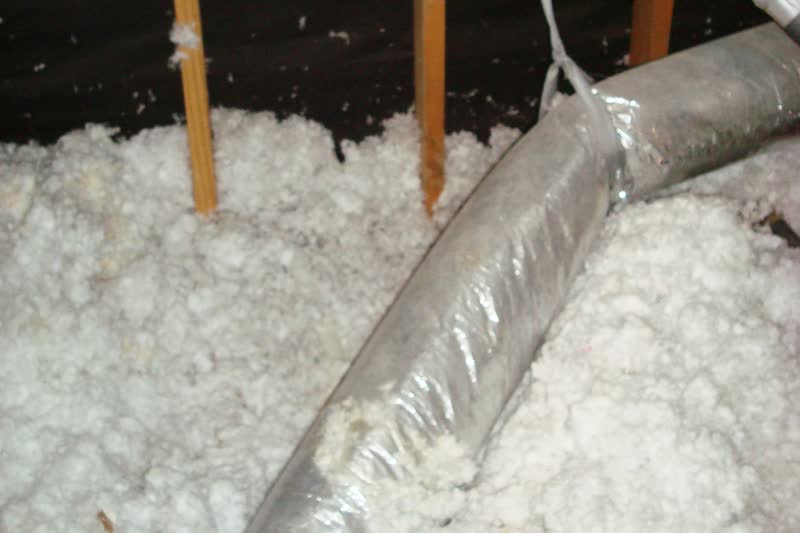
Fiberglass does not burn the way paper does, but the clearances still apply, because the fixture or the flue is the hazard. Blown-in insulation also drifts and settles against whatever it is not held away from. The answer is a barrier, not a careful aim with the hose.
Why North Carolina attics deserve an extra look
Two things make clearances worth checking in an older North Carolina house. It may have a brick chimney from a fireplace, and recessed lights that were cut in during a later remodel, so the attic can hold a mix of fixtures from different decades. And attics here spend long summers very warm, which is the setting a buried non-IC light or a crowded flue sits in for months. ENERGY STAR's advice for anyone heading into an attic is to start early on hot days, because the space heats up as the day goes on.
Recessed Lights: What IC, Non-IC and ICAT Ratings Mean
Recessed lights come in three kinds, and the label decides what insulation may do around them. The electrical code draws the line. As a code brief from the Pacific Northwest National Laboratory's Building America Solution Center summarizes it, the National Electrical Code does not allow thermal insulation above a recessed luminaire or within 3 inches of it, unless the fixture is identified for contact with insulation, Type IC. The same code wants the recessed parts of a non-IC fixture kept at least half an inch from combustible material such as wood framing.
| Rating | What it means | Insulation |
|---|---|---|
| Non-IC | Not built to be surrounded by insulation; runs hot | Keep it 3 inches away on all sides, never on top |
| IC | Rated for insulated ceilings, with a thermal cutoff | May touch it; seal it to the ceiling before covering |
| ICAT | IC rated and airtight, tested to ASTM E283 | May touch and cover it; still seal it to the ceiling |
What does IC rated mean on a can light?
ENERGY STAR spells IC as insulated ceiling, and you will also see it read as insulation contact. Either way it means the fixture is designed to sit in a ceiling with insulation against it. The PNNL guidance notes that IC fixtures carry a thermal safety switch that shuts the light off if it overheats. ENERGY STAR says no barrier is needed around an IC fixture. A light that keeps switching itself off is worth a look by an electrician, starting with the bulb and the label.
What does ICAT mean, and why does airtight matter?
ICAT stands for insulation contact and airtight. Building America's guidance says an ICAT fixture should carry a label showing it leaks no more than 2.0 cubic feet of air a minute from the room into the ceiling when tested to the ASTM E283 standard at 75 pascals of pressure. The model energy codes ask for that rating, and for a gasket or caulk between the housing and the ceiling, on recessed lights in an insulated ceiling.
Airtight matters because an ordinary can is a hole in the ceiling with a bulb in it. Room air rises through it into the attic all winter, and the same Building America page notes that some fixtures sold as airtight still leak, so the seal to the drywall still counts. Building America's contractor guidance goes further and says not to cover a recessed fixture unless it is rated ICAT, so an IC can that is not airtight should be sealed to the drywall, or swapped for an ICAT fixture, before it is buried.
Rather Talk It Through Than Read?
Call (336) 870-3893Monday to Friday 8:00 am to 5:00 pm. Saturday by appointment. Sunday closed.
How to Tell Which Recessed Lights You Have
The answer is on a label, and you can usually find it without going into the attic:
- Turn the light off at the switch and let it cool. Old incandescent and halogen bulbs stay hot for a while.
- Remove the bulb and the trim. Most trims pull down and are held by springs or clips. Some LED retrofit trims plug into the bulb socket.
- Look inside the can with a flashlight. The rating is printed on a label on the housing. Look for the words Type IC, Type Non-IC, Insulated Ceiling, or an airtight marking with ASTM E283.
- Check from the attic if the inside tells you nothing. The same label is often on the outside of the housing. Step only on joists or truss chords, as ENERGY STAR advises, never on the ceiling drywall.
- Write it down for each light. Houses often have more than one kind, especially where a kitchen or bonus room was redone.
What if the label is missing or unreadable?
Treat the light as non-IC. That is the safe assumption, and it is the one a careful installer makes too. A housing with a wide gap at the ceiling, open holes in the can, or a separate box that sits a few inches away from the can on a bracket is typical of older non-IC fixtures, but looks are no substitute for the label. An electrician can identify or replace a fixture you are unsure of.
If you see cloth-covered wires running on ceramic knobs near the lights, stop there. ENERGY STAR warns that knob and tube wiring, found in homes wired before about 1930, can be a fire hazard in contact with insulation, and it is a job for an electrician before any insulation goes in.
What to Do With Non-IC Can Lights Before Insulating
You have three honest options, and the best one is to replace the fixture. PNNL's Building America guidance prefers swapping a non-IC can for an ICAT fixture, or better still for a surface-mounted LED fixture that has no can reaching up into the attic at all. Once the light is IC rated, insulation can go right over it, and the ceiling stops leaking at that spot. Changing a fixture is electrical work, so it belongs to an electrician, and the best time is before the attic is insulated.
If the fixture stays, it needs a cover that keeps insulation away. Building America's guide describes the enclosure for an existing non-IC light. The box keeps at least 3 inches of clearance on every side. It is made of a material with a one-hour fire rating, such as five-eighths-inch fire-code drywall. It stands taller than the surrounding insulation, is sealed to the ceiling around its base, and has no insulation on top, so heat can escape. Before the box goes on, the guide says to swap any incandescent or halogen bulb for an LED.
Are foam can light covers safe?
Not over a non-IC light, by the standard in the Building America guide. It notes that rigid foam boxes are common in the field but do not meet the one-hour fire rating, and they can hold heat in. Store-bought covers vary, so read what the cover is rated for and which fixtures it is meant to go over. For a light that will stay non-IC, a fire-rated drywall box is the choice the guide describes.
Can a non-IC light just be fenced off?
For loose-fill, ENERGY STAR's minimum is a barrier of sheet metal or wire mesh around the light so the fibers cannot drift against it, with the 3-inch gap kept clear and nothing laid over the top. That keeps insulation off the fixture but does nothing about the air leaking through it, which is why the sealed box or a new fixture is the better fix.
One more caution from the same guide: older cable without the B in its type marking was rated for a lower temperature than modern cable, and an enclosure traps some heat. If the wiring to a light looks old, have an electrician look before it gets boxed in.
How Much Clearance a Brick Chimney Needs
A masonry chimney needs a gap to anything that can burn, and the gap around it is usually also one of the biggest air leaks in the attic. ENERGY STAR notes that building codes usually require 2 inches of clearance from a masonry chimney to combustible material, insulation included. The Department of Energy's weatherization job aid for chimneys and flues uses a larger figure: keep all combustible materials at least 3 inches away, or the clearance your local code official sets. A careful installer keeps the larger gap, even at a fireplace nobody uses: the next owner may light it, and the chimney may also carry a furnace flue.
The fix closes the air leak without closing the gap. The job aid shows it step by step. Clear the insulation away. Lay a continuous bead of high-temperature caulk that stays flexible, set sheet metal over the gap so no more than a quarter inch is left at the chimney, screw it to the framing, overlap a second piece, and caulk the joint where metal meets brick. Then build a fixed dam that keeps the insulation back.
Can insulation touch a brick chimney in the attic?
Not loose fiberglass or cellulose banked against it, and never paper-faced batts. The Building America do-it-yourself guide for flues and chimneys shows one more option: wrapping the chimney with unfaced mineral wool, which does not burn, so that no paper facing touches the warm brick, carried up to at least 4 inches above the finished insulation level. For the seal itself, ENERGY STAR calls for metal and high-temperature caulk.
Metal Flues From Gas Furnaces and Water Heaters
If a gas or oil furnace or water heater vents through the roof, its metal flue pipe passes through the attic, and it gets hot. ENERGY STAR cautions that furnace flues can be very hot and says building codes usually require 1 inch of clearance from a metal flue to combustible material. The Department of Energy job aid and the Building America flue guide both work to 3 inches, and the DOE checklist adds a rule worth knowing: the installer has to be able to tell a hot flue from other pipes, such as a bath fan duct, before deciding what gets a dam.
The method is the same as at a chimney: sheet metal or aluminum flashing over the gap, sealed with high-temperature caulk, then a dam. ENERGY STAR's attic air sealing project calls for 14-inch-wide aluminum flashing and an insulation dam so insulation cannot reach the pipe, and it says plainly not to use foam from a can there. The DOE job aid asks for a durable dam at least 2 inches taller than the final insulation; the Building America guide says 4 inches. Taller is safer, because blown insulation ends up deeper in some spots than the average.
How do I know which pipe is a flue?
Follow it. A flue starts at a gas or oil appliance and goes out through the roof, usually as metal pipe with a metal cap. A bath fan duct is usually flexible or thin metal, runs from the bathroom ceiling and may end at the roof or a wall. Plumbing vents are plastic or cast iron pipe and carry no heat. A house heated only by an electric heat pump, with an electric water heater, usually has no flue in the attic at all. If you are not sure, an HVAC contractor can tell you in a minute.
Why sealing around a flue calls for a safety check
Sealing the attic changes how air moves through the house. ENERGY STAR warns that it can cause naturally venting gas or oil appliances to back-draft exhaust into the home, and advises having those appliances tested to make sure they draft properly before and after the sealing. Working carbon monoxide alarms belong in any home with a fuel-burning appliance. If a flue pipe is rusted, separated or touching wood, call an HVAC contractor before any insulation work.
Bath Fans, Junction Boxes and Doorbell Transformers Under the Insulation
These are the items that usually end up buried, and most of them may be covered as long as they are handled first:
- Bath fans. Building America's guidance is to caulk the fan housing to the drywall, connect and seal the duct to the fan with metal tape or mastic, and run it outdoors, never into the attic. A rigid box over the housing then lets insulation go on top. The label inside the housing or the fan's instructions say whether insulation may touch it, so check models with a built-in heater or light.
- Junction boxes. ENERGY STAR says to caulk around electrical junction boxes and fill the holes in them. A box with a missing cover, loose wires or scorch marks is an electrician's job before anything is covered. Boxes should be easy to find again, so a careful installer marks each one with a flag that stands above the insulation.
- Doorbell and other transformers. A small transformer on a box in the attic gives off some heat and will need servicing someday. Leave it above the insulation or mark it, rather than burying it where nobody will look.
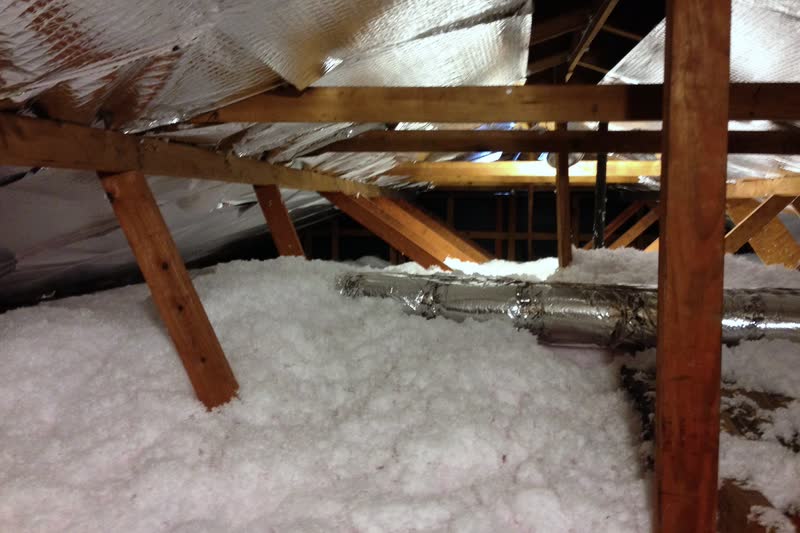
- Ducts and the air handler. Ducts can be covered once they are sealed. The air handler, its service panels and its condensate line need room for a technician to work, so keep insulation off and away from them.
- Soffit vents. Not a heat source, but on ENERGY STAR's list of things never to cover. Baffles at the eaves hold insulation back so outside air can still enter.
What a Careful Insulation Job Leaves Behind
When the work is done, you should be able to go up and see these things, or see them in photos from the installer:
- Every recessed light accounted for: IC or ICAT lights sealed to the ceiling and covered, and any non-IC light inside a fire-rated box or a barrier with its 3-inch gap clear and its top open.
- A sheet metal seal and a fixed dam around every flue and chimney, standing above the insulation, with high-temperature caulk at the metal and no foam touching the pipe or the brick.
- Junction boxes and transformers flagged or left above the insulation, and no open boxes or loose wires under it.
- Bath fans ducted outdoors, with sealed joints.
- Baffles at the eaves and clear soffit vents.
- A dam around the attic hatch or stairs so insulation does not spill when the door opens.
- For cellulose, the caution label from the bag, which the federal rule asks the installer to hand to you.
Who handles which part of the job
Clearances, dams, barriers and sealing around these items are part of our attic insulation and air sealing work. Tell us roughly how many recessed lights you have and what runs up through the attic, and the written estimate says which ones your attic needs. Some things are not ours, and we will say so when we see them: replacing light fixtures, repairing wiring or moving a transformer is for an electrician, a damaged flue or appliance venting is for an HVAC contractor, and a cracked chimney is for a chimney professional. Those come first, then the insulation.
If the attic already has a deep layer that was blown over unrated lights or right up to a flue, it can be pulled back and fixed. Where the old material is soiled or too far gone to keep, we vacuum out the old insulation first, and a bare ceiling is the easiest place to deal with every light and flue. Our guide on why air sealing comes before insulation explains the order of work in more detail.
Get a Free Estimate
Can lights, a chimney or a furnace flue in the attic? Tell us the attic's size and what runs through it, and we'll price the dams, the sealing and the insulation. On install day the crew checks every light and flue with you before the hose comes out.

Prefer to talk? Call (336) 870-3893.