Why Is My Electric Bill So High in Summer? A North Carolina Checklist
Why is my electric bill so high in the summer? In most North Carolina homes it comes down to three things at once: hot weather that keeps the air conditioner running for more hours, a higher price for each kilowatt-hour, and a house that lets attic heat and outdoor air in faster than it should. You cannot change the first two. The third is where attic insulation, air leaks and leaky ducts come in, and it is worth checking once you know how much of the jump the weather and the price already explain.
This checklist goes in that order. It starts with the bill itself, then the weather and the rates, then the house and the equipment, and it ends with the fixes that usually pay back first. Insulation Pros works on the attic side of the problem: insulation, air sealing and duct sealing. We do not repair air conditioners, and when the clues point to the equipment, this guide says so.
Start With Your Bill: Kilowatt-Hours, Not Dollars
The dollar total mixes two things: how much electricity you used and what each unit cost. To see whether your home actually used more, find the kilowatt-hours, shown as kWh, and compare them with the same month a year earlier. If the kWh barely moved but the dollars went up, the price changed, not the house. If the kWh jumped, something in the home ran more.
Three details on the bill change how you read it:
- Days in the billing period. A 34-day bill covers five more days than a 29-day bill. Divide the kWh by the number of days to get a daily figure you can compare fairly.
- Actual or estimated reading. If the bill marks the meter reading as estimated, the next actual reading can catch up all at once. Ask your utility how the reading was taken.
- Charges that are not energy. Bills usually list a basic monthly charge and other line items apart from the charge for the kWh themselves. Those can move the total with no change in your usage.
Where do I find last year's usage?
Many utilities print a usage chart on the bill or keep a usage history in the online account. If yours does not, ask the utility for it. A full year of history also shows your normal summer peak, so you can tell an unusual month from an ordinary August.
Hotter Weather and Longer Air Conditioner Run Times
Cooling follows the heat. The U.S. Energy Information Administration (EIA) tracks this with cooling degree days: for each day, the number of degrees the average temperature sits above 65 degrees Fahrenheit. EIA describes them as a measure of how much air conditioning a building needs to stay cool. A month with more of them means more hours of run time, even with the thermostat left exactly where it was last year.
Summer 2026 was a hot one here. NOAA's quarterly climate report for the Southeast, published in September 2026, says North Carolina recorded one of its five warmest summers on record. It notes that Raleigh-Durham reached 100 degrees during the July 4th holiday, and that Wilmington hit 100 degrees on three straight days, July 8 to 10, tying its longest such streak on record.
The heat also works on the house after dark. The sun heats the roof all afternoon, and the attic under it stays warm into the evening, so the ceiling below keeps passing heat into the rooms. The hotter the attic, the more a thin layer of insulation or a leaking duct costs you. The same weak spot that seems harmless in May can be expensive in August.
Other summer loads add up too. Children home from school, more laundry, a pool pump, a dehumidifier, a freezer in a hot garage or a houseful of guests all raise usage. Write down anything like that before you blame the house.
Rather Talk It Through Than Read?
Call (336) 870-3893Monday to Friday 8:00 am to 5:00 pm. Saturday by appointment. Sunday closed.
Electricity Rates in North Carolina: What Changed Since Last Summer
The price went up. EIA's Electric Power Monthly, released September 24, 2026, puts the average North Carolina residential price at 15.16 cents per kWh in July 2026, up from 13.37 cents in July 2025. That is about 13 percent more for every kWh, so a home that used exactly the same electricity in both months would see a bill about 13 percent higher without using a single extra kWh.
Savings vary. Find out why in the seller's fact sheet on R-values. Higher R-values mean greater insulating power.
North Carolina homes still pay less than the national average. The same EIA table shows 18.31 cents for the United States in July 2026. Over the first seven months of the year, EIA's average for North Carolina homes was 14.94 cents, compared with 13.71 cents for the same months of 2025.
Your own price will differ. EIA's figure is an average across every utility in the state. Who sets your rate depends on who serves your address. The North Carolina Utilities Commission regulates the investor-owned utilities, such as Duke Energy and Dominion Energy North Carolina, but it says it does not regulate the retail rates of electric membership corporations or town-owned electric systems. If a co-op or your town supplies your power, look to that utility's own rate notices.
The table shows the EIA averages, in cents per kWh, for North Carolina homes and for the country:
| Period | North Carolina | United States |
|---|---|---|
| July 2025 | 13.37 | 17.45 |
| July 2026 | 15.16 | 18.31 |
| January to July 2025 | 13.71 | 17.01 |
| January to July 2026 | 14.94 | 18.19 |
How do I work out my own price per kilowatt-hour?
Take the electricity charges on the bill, including the basic charge, and divide by the kWh. Do the same for the same month last year. If your price rose by about the same share as the bill did, the house is probably not the cause. Rate changes from the investor-owned utilities go through public cases at the Utilities Commission, and your utility announces changes on its website and with your bill.
The House: Attic Insulation, Air Leaks and Attic Ducts
If your daily kWh rose more than the weather and the price can explain, look at the house, starting above the ceiling. In summer, the top-floor ceiling sits between your rooms and an attic that can be far hotter than the outdoors. ENERGY STAR lists high summer and winter utility bills as one possible sign of duct problems, and ducts located in an attic as another. If the heat seems to pool in the bedrooms, our guide on why the upstairs is so hot takes the second floor cause by cause. Three things in the attic decide how much of that heat reaches you.
Thin or uneven insulation on the attic floor
Insulation slows heat moving from the hot attic down through the ceiling. From the hatch, if the tops of the ceiling joists show, the layer is probably thin. ENERGY STAR's recommended levels use the 2021 International Energy Conservation Code map, which puts nearly all of North Carolina outside the mountains in climate zone 3: R-49 for an uninsulated attic there, and R-60 in zones 4 and 5, the mountains and a few northern foothill counties. Our guide on how to tell if your attic needs more insulation shows how to check the depth safely, and the R-value guide explains the targets in inches.
Air leaks between the attic and the rooms below
Insulation does not stop moving air. Gaps around ceiling lights, wire and pipe holes, the attic hatch and the chases around flues and ducts let hot attic air into the house and let cooled air escape. The Department of Energy's Energy Saver guide calls air leaks among the greatest sources of energy loss in a home, and it puts the payoff from sealing uncontrolled leaks at 10 to 20 percent of heating and cooling costs.
Sealing comes before new insulation, because the holes are hard to reach once they are buried. Our article on why air sealing comes before insulation explains the order of work.
Leaky or bare ducts in a hot attic
If your air handler or supply ducts are in the attic, that is where your cooled air travels. ENERGY STAR says that in a typical house about 20 to 30 percent of the air that moves through the duct system is lost through leaks, holes and poor connections. In August, that lost air is cooled air spilling into a hot attic, and the Energy Saver guide notes that unsealed return joints can draw unconditioned air in.
ENERGY STAR's heating and cooling page says sealing ducts can improve the efficiency of a system by as much as 20 percent. It also says to wrap ducts in unconditioned spaces with insulation once they are sealed, and to seal with mastic or metal tape, never duct tape. Duct sealing on the runs you can reach is attic work we do. Resizing or replacing a duct system is a job for an HVAC contractor.
The Equipment: AC Age, Filters and Thermostat Settings
An air conditioner that has lost efficiency runs longer for the same cooling, and the meter counts every extra minute. ENERGY STAR's maintenance checklist says dirty coils reduce a system's ability to cool the home, so it runs longer and costs more to operate. It says too much or too little refrigerant makes a system less efficient, and that airflow problems can cut efficiency by up to 15 percent. Those are jobs for an HVAC technician, not an insulation contractor.
How often should the filter be changed?
ENERGY STAR advises looking at the filter monthly in peak seasons and replacing it when it is dirty, and at least every three months either way. A clogged filter starves the system of air, and its maintenance checklist says a dirty filter raises energy costs and can damage the equipment.
Is an older air conditioner costing me money?
Possibly. ENERGY STAR suggests having a professional evaluate heating and cooling equipment that is more than 10 years old. Age alone is not a reason to replace it, but an older system that runs without stopping on hot afternoons deserves a technician's look. If you do replace it, ENERGY STAR warns that poor installation can cut efficiency by up to 30 percent, so ask how the new system will be sized. Doing the attic work first lets the contractor size it for the house as it will be.
Thermostat habits that raise a summer bill
The Department of Energy's Energy Saver guide says to set the thermostat as high as is comfortable when you are home and awake, and higher when you are asleep or away. It says adjusting the setting by 7 to 10 degrees for 8 hours a day can save as much as 10 percent a year on heating and cooling, turning it up in spring and summer. With a heat pump, it says not to do this without a smart or programmable thermostat made for heat pumps.
Fans help only people in the room. The same guide says a ceiling fan lets you turn the setting up about 4 degrees with no loss in comfort, and to switch it off when you leave. Closing blinds on sunny summer days also blocks some of the sun's heat.
A 20-Minute Checklist for a High Summer Bill
Work through this with this summer's bill and last summer's in hand. Each step either explains the bill or narrows down where to look next:
- 1. Compare daily kWh. Divide the kWh by the days in the billing period, for this bill and for the same month last year.
- 2. Work out your price. Divide the electricity charges by the kWh on each bill. A higher price explains a higher bill at the same usage.
- 3. Note the weather. Was this month hotter than the same month last year? More hot days mean more cooling hours.
- 4. List anything new. A pool pump, a dehumidifier, a garage freezer, a hot tub, an electric car or more people at home.
- 5. Check the filter. Replace it if it looks gray or clogged.
- 6. Check the thermostat. Confirm the schedule and the cooling setting, and that the fan switch is on Auto unless your HVAC contractor set it up to run all the time.
- 7. Watch the system run. If it runs almost nonstop on a mild evening, or the air from the registers does not feel cool, call an HVAC technician.
- 8. Feel the top-floor ceilings. A ceiling that is warm to the touch on a summer afternoon points to the attic above it.
- 9. Look from the attic hatch. Can you see the joist tops? Are there bare spots, dark dirty patches in the insulation or loose ducts? Take photos, stay on the joists and keep summer trips short. If you see loose gray-brown or silver-gold granules, back out and leave them alone, since that can be vermiculite.
Still Cannot Explain the Bill? Have the House Tested
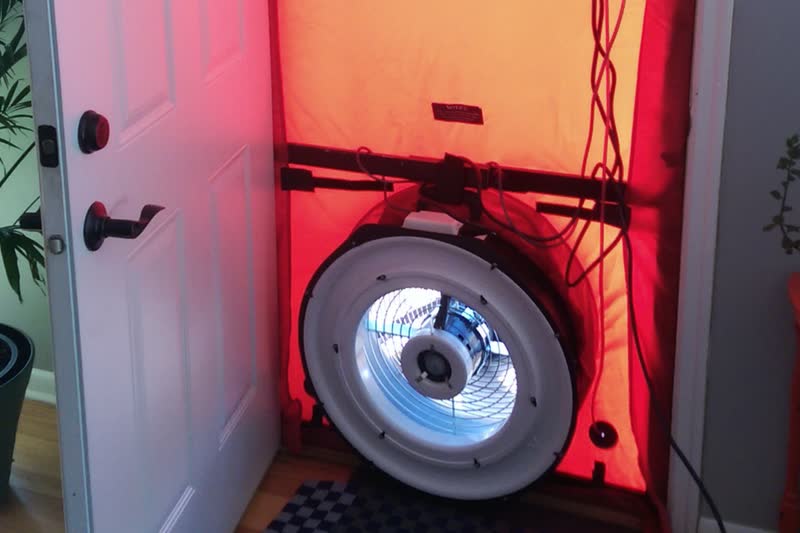
If the bill is high, the weather and the price do not explain it, and you cannot tell whether the cause is the house or the equipment, a home energy audit is the next step. The Department of Energy's Energy Saver guide says a detailed assessment includes diagnostic tests such as a house air leakage test, a duct air leakage test or an infrared scan, and that the professional compares the findings with your utility bills. Our guide on whether a home energy audit is worth it walks through the visit and the report.
Look for a free option first. Duke Energy's Home Energy House Call, for example, is a free in-home assessment for qualified homeowners, and Duke says it comes with a detailed report and free energy-saving products. Many co-ops and town utilities have programs of their own, so check your utility's website.
Our audits are a paid service, so ask what one would include for your house. If a look from the hatch already shows bare joists and open holes, you probably don't need an audit to know where to start. Tell us the attic's square footage and we'll price the attic work instead. That estimate is free.
Which Fixes Usually Pay Back First
Start free and cheap, fix the attic next, and replace equipment last. The Department of Energy says radiant barriers work better in hot climates than in cool ones, especially when cooling ducts run through the attic, which is why they come after the floor is sealed and insulated.
Nobody can promise a number for your house. ENERGY STAR says sealing and insulating can provide up to 10 percent savings on the whole annual energy bill, not just the heating and cooling part. The Department of Energy's guide says new efficient equipment alone can cut energy use by 20 percent or more, and that pairing a new system with the recommended insulation, sealing and thermostat habits brings heating and cooling bills down by about 30 percent. Those are national benchmarks, not a promise for one house.
In practice, the order that usually makes sense looks like this:
- 1. Free changes. Thermostat schedule, blinds closed on sunny afternoons, fans only in occupied rooms, a fresh filter.
- 2. An HVAC tune-up if one is due. Coils, refrigerant and airflow, checked by a technician.
- 3. Seal the attic floor and the ducts. Close the holes between the attic and the rooms, and seal the duct joints you can reach.
- 4. Bring the insulation up to depth. An even layer over the sealed floor, with the soffit vents kept clear.
- 5. Consider a radiant barrier. Most useful when ducts run through a hot attic and the floor is already sealed and insulated.
- 6. Replace equipment last. Sized for the house after the attic work, with a proper load calculation.
How long does attic work take to pay for itself?
It depends on how thin the attic is now, how leaky the ceiling is, whether the ducts run through the attic, what you pay per kWh and how many hours your system runs. A bare attic over a leaky ceiling has the most room to improve, and one that is already well insulated has the least. Rebates can shorten the wait, and our guide to attic insulation cost covers the North Carolina rebate programs.
Get a Free Estimate
Summer bill climbing while the upstairs stays warm? Tell us how big the attic is and we'll price the sealing and insulation, with no visit needed for most homes. If it looks like an AC problem, we'll say so.

Prefer to talk? Call (336) 870-3893.