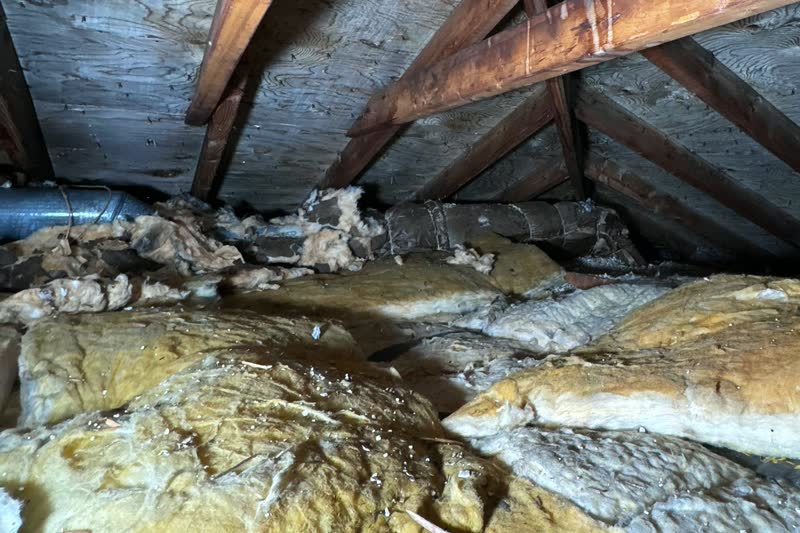
Attic Insulation R-Value in North Carolina: How Much Do You Need?
The attic insulation R-value North Carolina requires and the R-value worth aiming for are two different numbers. The state energy code sets R-38 as the minimum for the ceiling of a new home in every county. ENERGY STAR's chart for existing homes goes further in every part of the state: R-49 to R-60 for an attic with no insulation, and R-38 to R-49 added over the 3 or 4 inches many older attics already have.
Which end of each range fits your house depends on your county's climate zone. North Carolina has three, zones 3, 4 and 5, and two maps that draw them: the older one in the state's energy code and a newer national map, on which 34 of the state's 100 counties sit in a different zone. This guide lists every county's zone on both maps, then covers what R-value means, how many inches each target takes, how to measure what you have and why air sealing comes first.
What Does R-Value Mean?
R-value measures how well insulation resists heat moving through it. The higher the number, the greater the resistance. It depends on the type of material and how thick it is, which is why the same R-value can be 10 inches of one product and 15 of another.
Two details matter in an attic. R-values add up, so new insulation over a sound older layer counts on top of what is there, and a top-up does not have to supply the whole target. And the number on a label is a laboratory rating of the material by itself: federal labeling rules make every package say that the marked R-value depends on proper installation. Insulation that is compressed, damp, patchy or bypassed by moving air delivers less.
What Attic Insulation R-Value Does North Carolina Code Require?
R-38, in every county. The edition in force is the 2018 North Carolina Energy Conservation Code, and its residential table lists a ceiling R-value of 38 in all three of the state's climate zones. That one line is the NC attic insulation requirement for a new house.
The table has some give. R-30 is accepted where the full, uncompressed depth carries out over the tops of the exterior walls, and at the eaves, where the roof pitch squeezes the space, insulation only has to fill up to the air baffle.
Does the code apply to an existing attic?
Not unless you are building or altering. The code governs new homes, additions and alterations, and it states that it cannot be used to require changes to an existing building that was lawful when the code was adopted. An older attic does not become a violation because the number went up.
Editions change. A 2024 edition has been adopted, but when we wrote this in October 2026 the Office of State Fire Marshal still listed the 2018 codes as the ones in effect. For a project that needs a permit, your city or county inspections office has the number that applies.
Rather Talk It Through Than Read?
Call (336) 870-3893Monday to Friday 8:00 am to 5:00 pm. Saturday by appointment. Sunday closed.
Attic Insulation by Climate Zone: Which Zone Is Your County In?
North Carolina has three climate zones, and every county falls in one of them. Which one depends on the map. The state's energy code uses the older national map, which the model codes used from 2004 through 2018. That map was redrawn with newer weather data for the 2021 International Energy Conservation Code, the national model that state codes are built from, and 34 North Carolina counties changed zone. Each moved one step warmer: 33 from zone 4 to zone 3, and Mitchell County from zone 5 to zone 4. The map with this section shows the 2021 zones.
The zone matters because ENERGY STAR lists its recommendations for existing homes by zone, and its chart is based on the 2021 map. Under the heading Add Insulation to Attic, it reads:
- Zone 3: R-49 if the attic is uninsulated, R-38 if it already has 3 to 4 inches of insulation.
- Zones 4 and 5: R-60 if the attic is uninsulated, R-49 if it already has 3 to 4 inches.
Which counties are in each zone?
Every county is in one of the four groups below. The state's code gives each county's zone in its Table R301.1, and the Pacific Northwest National Laboratory publishes each county's zone on the newer map for the U.S. Department of Energy:
- Zone 5 on both maps: Alleghany, Ashe, Avery, Watauga and Yancey. Mitchell is zone 5 in the state's code and zone 4 on the newer map.
- Zone 4 on both maps: Buncombe, Burke, Caldwell, Graham, Haywood, Henderson, Jackson, Macon, Madison, McDowell, Stokes, Surry, Swain, Transylvania and Yadkin.
- Zone 4 in the state's code and zone 3 on the newer map: Alamance, Alexander, Bertie, Caswell, Catawba, Chatham, Cherokee, Clay, Cleveland, Davie, Durham, Forsyth, Franklin, Gates, Granville, Guilford, Halifax, Harnett, Hertford, Iredell, Lee, Lincoln, Nash, Northampton, Orange, Person, Polk, Rockingham, Rutherford, Vance, Wake, Warren and Wilkes.
- Zone 3 on both maps: the other 46 counties, which take in Charlotte, Fayetteville, Greenville, Wilmington and the Outer Banks.
Code minimum versus recommendation
A code minimum is the least a builder may put in new work. ENERGY STAR's figures are recommendations for adding insulation to a house that is already standing, and in North Carolina they ask for more than the code does.
So for a North Carolina attic, the honest answer is a range. R-38 is the floor for a new ceiling in every county, R-60 is the top of ENERGY STAR's chart, and R-49 turns up in every zone's figures in between.
How Many Inches of Attic Insulation Is R-38, R-49 or R-60?
A target is an R-value, and the depth it takes depends on the material. As a general guide, ENERGY STAR puts R-38 at about 10 to 14 inches, depending on the type of insulation. Its worksheet for sizing up existing insulation is more specific: it credits cellulose with about R-3.7 per inch and loose-fill fiberglass with about R-2.5. By those figures:
- R-38: about 10 inches of cellulose or 15 inches of loose-fill fiberglass.
- R-49: about 13 inches of cellulose or 20 inches of loose-fill fiberglass.
- R-60: about 16 inches of cellulose or 24 inches of loose-fill fiberglass.
How much blown-in insulation for R-38? Read the bag
Treat each depth as a rough guide. Blown-in insulation settles after it goes in, and products differ. Federal labeling rules require every bag of loose-fill to carry a coverage chart that lists, for R-38 and R-49 among other levels, the minimum settled thickness, the initial installed thickness and the number of bags per 1,000 square feet. That chart, not a rule of thumb, decides how much material an attic takes. North Carolina's code works the same way: for blown insulation it counts the manufacturer's settled R-value.
Can attic insulation be too thick?
Past a point, more depth buys very little. ENERGY STAR's own check says that when the insulation already sits well above the joists you probably have enough, and adding more may not be cost-effective. ENERGY STAR's chart stops at R-49 in zone 3 and at R-60 in zones 4 and 5.
Depth causes trouble only when it ends up in the wrong place:
- Over the soffit vents. ENERGY STAR says never to lay insulation over them, which is the reason for baffles at the eaves.
- Against heat. Insulation stays at least 3 inches from recessed lights unless they are rated for contact with insulation, and clear of flues.
- On top of a lighter layer. A U.S. Department of Energy fact sheet warns that a denser material laid over a fluffier one squeezes it and lowers its R-value, so the new layer is chosen with the old one in mind.
Is R-19 or R-30 enough in an attic?
Not by the standards that apply in North Carolina. Both fall short of the R-38 that the state's energy code sets for the ceiling of a new home in every county, and ENERGY STAR's chart for existing homes goes higher still in all three of the state's zones. The code accepts R-30 only in the limited cases described above, where the full depth carries out over the exterior walls.
An attic at R-19 or R-30 today does not have to be emptied. If the insulation is dry, clean and free of pests, new blown-in insulation can go on top of it, after the air leaks in the ceiling are sealed, until the depth matches the coverage chart on the bag for the R-value you are aiming for.
- 1Ceiling joists. Insulation level with or below the tops of the joists usually means the attic needs more.
- 2Existing insulation. Many older attics have only 3 or 4 inches.
- 3Loose-fill on top. R-values add up: new insulation over a sound older layer counts on top of it.
- 4R-38. About 15 inches of loose-fill fiberglass or 10 inches of cellulose. North Carolina's code minimum for the ceiling of a new home.
- 5R-49. About 20 inches of loose-fill fiberglass or 13 inches of cellulose.
- 6R-60. About 24 inches of loose-fill fiberglass or 16 inches of cellulose.
The marker shows depths for loose-fill fiberglass. Every depth is a rough guide: blown-in insulation settles and products differ, so the coverage chart on the bag has the real numbers.
Attic Insulation R-Value Chart for North Carolina
Here are the last two sections in one chart. The first six rows are ENERGY STAR's recommendations for an existing home, which it lists as insulation to add to the attic. The last row is the state code's minimum for the ceiling of a new house. The inches are estimates from ENERGY STAR's figures of about R-3.7 per inch for cellulose and about R-2.5 for loose-fill fiberglass.
| Your attic | R-value | About how deep |
|---|---|---|
| Zone 3, no insulation | Add R-49 | 13 inches of cellulose or 20 of loose-fill fiberglass |
| Zone 3, 3 to 4 inches already there | Add R-38 | 10 inches of cellulose or 15 of loose-fill fiberglass |
| Zone 4, no insulation | Add R-60 | 16 inches of cellulose or 24 of loose-fill fiberglass |
| Zone 4, 3 to 4 inches already there | Add R-49 | 13 inches of cellulose or 20 of loose-fill fiberglass |
| Zone 5, no insulation | Add R-60 | 16 inches of cellulose or 24 of loose-fill fiberglass |
| Zone 5, 3 to 4 inches already there | Add R-49 | 13 inches of cellulose or 20 of loose-fill fiberglass |
| New ceiling, North Carolina code | R-38 minimum | 10 inches of cellulose or 15 of loose-fill fiberglass |
- Which zone is yours: ENERGY STAR's chart follows the newer national map, so use your county's zone on that map. The county lists above give it.
- Add means on top of what is there. The 3 or 4 inches already in the attic keep their own R-value.
- The depths are a guide, not a specification. The coverage chart on the bag gives the settled thickness for the product that is going in.
How to Measure the R-Value You Already Have
ENERGY STAR's quick check takes one look from the hatch. If the insulation is level with or below the tops of the joists, you probably need more. If it sits well above them, you may have enough. For a number, measure the depth in several places, including near the eaves where it is often thinnest, then multiply by the figure for what you see:
- Loose, lightweight fibers in yellow, pink or white (fiberglass): depth in inches times 2.5.
- Small gray flat pieces or fibers, like shredded newsprint (cellulose): depth times 3.7.
- Dense gray or near-white fibers, sometimes with black specks (rock wool): depth times 2.8.
- Lightweight batts in yellow, pink or white (fiberglass): depth times 3.2, or read the R-value printed on the batt.
A worked example
Six inches of loose fiberglass works out to about R-15, and six inches of cellulose to about R-22. Either is well short of R-38, and the gap is what a top-up has to supply. If the attic was insulated under a recent code, look for depth markers on the trusses or joists: the energy code calls for at least one for every 300 square feet, facing the attic access.
Lightweight, pebble-like granules may be vermiculite, which can contain asbestos, so leave them undisturbed. Our guide on how to tell if your attic needs more insulation covers attic safety.
Why Air Sealing Comes Before Any R-Value Target
R-value rates resistance to heat passing through a material. It says nothing about air moving past it, and loose-fill insulation does not stop air. An attic can reach R-49 on paper and still leak conditioned air through open gaps around lights, wires, pipes and the hatch. The EPA recommends air sealing the attic before adding insulation, and once a deep layer is down, the leaks beneath it are buried. Our guide on why air sealing comes before insulation shows where they hide.
Does attic or blown-in insulation need a vapor barrier?
In a vented attic in most of North Carolina, no, and that holds for blown-in insulation as much as for batts. A U.S. Department of Energy guide for contractors says the researchers behind its Building America program advise against vapor retarders in a vented attic in climate zones 1 through 4, which takes in every county in zones 3 and 4 on either map. Zone 5 is the one exception. For batts laid on a bare attic floor there, the same guide calls for the faced kind, with the facing against the floor.
Adding one can do harm. The Department of Energy's insulation fact sheet is blunt about a top-up: do not put a vapor retarder between the old layer and the new one. The contractor guide gives the reason: a facing sandwiched in the middle acts as a vapor retarder and can lead to moisture and mold problems.
What keeps an attic dry is control of air. The same fact sheet reports that air leaking into an attic carries significant amounts of moisture. So the working parts are sealed ceiling leaks, bath and kitchen fans that vent outdoors and soffit vents left open. A blown-in top-up goes on bare, with no sheet under or over it.
An unvented attic insulated with spray foam under the roof deck follows its own rules. We do not install spray foam, so that quote would come from another contractor. Ask how it handles moisture.
What to Ask an Insulation Contractor to Put in Writing
Because inches mean different things for different materials, compare estimates by R-value. Ask any insulation contractor, including us, for the finished R-value, the material, the settled depth and the number of bags.
Much of that is yours by right. A Federal Trade Commission rule requires an insulation installer to give you a contract or receipt, and for loose-fill it must show the coverage area, the initial installed thickness, the minimum settled thickness, the R-value and the number of bags used. A quote that names only inches leaves out the number that matters.
We price most attics from the square footage, and we'll tell you which target fits yours and why, even when the answer is to add less. On install day the crew measures your insulation with you before any more goes in.
Get a Free Estimate
Not sure whether your attic sits closer to R-19 or R-38? Tell us its size and roughly how deep the insulation is, and we'll price the job to the target that fits it. Most attics don't need a visit.

Prefer to talk? Call (336) 870-3893.