How Old Are Homes in North Carolina? Census Figures by County
About a third of North Carolina's housing was built before 1980, and in the counties around Winston-Salem, Greensboro and High Point the share runs higher. By the Census Bureau's American Community Survey estimates for 2020 to 2024, 43 percent of the housing units in Davidson County were built before 1980. In Forsyth County the share is 44 percent, and in Guilford and Randolph counties it is 41 percent. Statewide it is 34 percent.
This guide sets those figures side by side for ten counties and eight cities in the middle of the state, with their margins of error, and explains how to read and cite them. It ends with what a house's age can mean for the attic and the checks worth making in an older house. Every figure comes from the Census Bureau's table B25034, Year Structure Built, and the county figures are the same ones our county pages print.

County by County: Homes Built Before 1980
The table covers Forsyth, Guilford and Davidson counties and the seven counties around them. It gives each county's share of housing units built before 1980 and its median year built, the year that splits its housing into an older half and a newer half, with North Carolina on the last line for comparison. The Census Bureau counts every kind of housing unit, occupied or empty, so the figures include apartments and manufactured homes as well as houses.

The survey is a sample, so each share has a margin of error, shown in parentheses in percentage points. The Census Bureau publishes its margins at the 90 percent confidence level. Housing units are rounded to the nearest hundred, and each of our county pages prints the same share for its own county:
| County | Housing units | Built before 1980 | Median year built |
|---|---|---|---|
| Alamance County | 77,100 | 42% (±2) | 1988 |
| Davidson County | 76,400 | 43% (±2) | 1985 |
| Davie County | 19,300 | 36% (±3) | 1990 |
| Forsyth County | 175,600 | 44% (±1) | 1984 |
| Guilford County | 238,000 | 41% (±1) | 1987 |
| Randolph County | 62,900 | 41% (±2) | 1985 |
| Rockingham County | 43,900 | 53% (±3) | 1978 |
| Rowan County | 65,000 | 47% (±2) | 1983 |
| Stokes County | 21,500 | 45% (±4) | 1983 |
| Yadkin County | 17,300 | 46% (±4) | 1983 |
| North Carolina | 4,895,700 | 34% (±1) | 1991 |
What the County Figures Show
Nine of the ten counties have a clearly larger share of pre-1980 housing than the state's 34 percent, from 41 percent in Guilford and Randolph counties to 53 percent in Rockingham County. Davie County, at 36 percent, is close enough to the state figure that the survey's margins cannot tell the two apart.

Rockingham County's housing is the oldest of the ten. Just over half of its housing units were built before 1980, and its median year built is 1978. Davie County's housing is the newest, with a median year built of 1990, next to 1991 for the state.
In Davidson County, 43 percent works out to about 33,100 of the county's 76,400 housing units. Take everything built before 1990 and the estimate passes half in nine of the ten counties, against 48 percent statewide.
Why 1980? The survey groups homes by decade, so 1978 itself cannot be split out, and 1980 is the closest line it draws to the date that matters most for insulation in North Carolina. The state's insulation inspection requirement applies to homes started on or after January 1, 1978, in counties and cities that elect to enforce it.
Rather Talk It Through Than Read?
Call (336) 780-7227Monday to Sunday 8:00 am to 5:00 pm.
City by City: Homes Built Before 1980
City figures rest on smaller samples than county figures, so their margins are wider: Thomasville's 47 percent could be anywhere from about 42 to 52 percent. Each city's name links to our page about attics in that city, which looks at what those building years mean for them. Each figure covers the whole city, including any part that reaches into a neighboring county:
| City | County | Built before 1980 | Median year built |
|---|---|---|---|
| Archdale | Randolph | 39% (±7) | 1986 |
| Asheboro | Randolph | 48% (±5) | 1981 |
| Greensboro | Guilford | 43% (±1) | 1985 |
| High Point | Guilford | 40% (±3) | 1989 |
| Kernersville | Forsyth | 26% (±4) | 1995 |
| Lexington | Davidson | 68% (±6) | 1969 |
| Thomasville | Davidson | 47% (±5) | 1983 |
| Winston-Salem | Forsyth | 48% (±2) | 1981 |

Lexington's Housing Is the Oldest of the Eight
About two of every three housing units in Lexington were built before 1980 (68 percent, give or take 6 points), and its median year built is 1969, earlier than any of the ten counties. Kernersville is at the other end: about a quarter of its housing predates 1980, and its median year built is 1995.
The three largest cities have the tightest margins. In Greensboro 43 percent of housing units were built before 1980, in Winston-Salem 48 percent and in High Point 40 percent.
How to Read and Cite These Figures
The American Community Survey is the Census Bureau's ongoing survey of households. Its 5-year estimates pool the answers collected from 2020 through 2024, which gives samples large enough for counties and cities, and they describe that whole period rather than a single year.

Each share built before 1980 adds up the survey's decade groups, from 1939 or earlier through the 1970s. Its margin of error was worked out from the published margins of those groups with the Census Bureau's formulas for sums and proportions, the same method our town and county pages use. Shares are rounded to whole percentages and margins to whole points, with 1 point the smallest shown.
Reporters, real estate agents, home inspectors and anyone else are welcome to quote these figures. Please credit the U.S. Census Bureau's American Community Survey, 2020-2024 5-year estimates, table B25034, and link to this page if it helped. The Census tables behind every number are linked under Sources.
What an Older House Usually Means for the Attic
A house's age is a clue, not a diagnosis. Many older houses have had insulation added over the years, and an addition or a remodel can leave two parts of one house completely different. Still, age tells you where to look first.

A house started before 1978 went up when the state's insulation rules were new, thinly inspected or absent. A Building America guide prepared for the U.S. Department of Energy says the vast majority of homes built before 1980 are poorly insulated, and notes that many homes built after 1980 can have inadequate insulation too. Walls are part of that, and for closed walls our drill-and-fill guide explains how insulation is blown in through small holes.
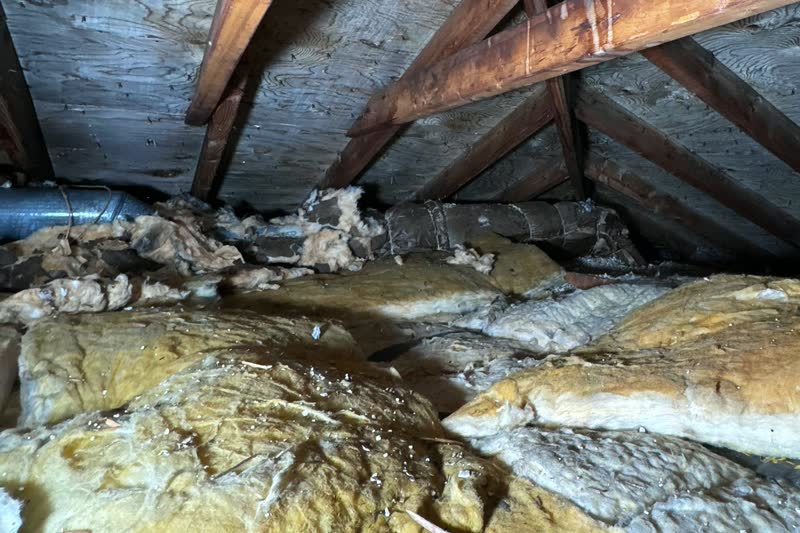
Decades also give an attic time to change. Insulation can settle, be pushed aside during wiring, plumbing or heating work, be soaked by an old roof leak or fouled by mice, or be added to a little at a time. And ENERGY STAR says many of a home's most significant air leaks are hidden in the attic, often under the insulation: around wiring, plumbing vents and chimneys, and where walls meet the attic floor.
If your house is one of the older ones in these figures, these checks come first:
- From the hatch, with a flashlight, look across the attic floor. ENERGY STAR's quick test: if the insulation is level with or below the floor joists, so you can easily see them, you should add more. Look at the eaves too, which can have very little even when the middle has enough.
- Look at what the material is. A pebble-like fill that is gray-brown or silver-gold may be vermiculite, which can contain asbestos. Leave it undisturbed and have an asbestos professional assess it.
- Look for dark, dirty patches in the insulation. ENERGY STAR explains that they come from air moving through it, so each one marks a leak to seal.
- Note anything wet, fouled by animals or damaged by smoke. That insulation should come out rather than be buried under a new layer, once the roof leak is fixed or the mice are gone.
- Check the hatch or pull-down stair. A lid with no insulation or weatherstripping is an air leak of its own.
Our Guides for Each Step
Our guide on how to tell if your attic needs more insulation walks through these checks in more detail, and the vermiculite guide covers what to do if you find it.
For how much to add, our guide to attic insulation R-value in North Carolina has the target for every county. When the old layer is ruined, our guide on whether to remove old attic insulation or top it up explains when it should come out and what happens next.
Whatever the attic holds, sealing comes before any new insulation, because a deep new layer buries the leaks. Our guide on why air sealing comes before insulation explains the order.
Get a Free Estimate
Own one of the older houses in these tables? Tell us the attic's square footage and roughly when the house was built, and we'll price the air sealing and insulation it needs. If old wiring or old fill needs another trade first, we'll say so.

Prefer to talk? Call (336) 780-7227.