Duct Sealing: Is It Worth It for Ductwork in a Hot Attic?
Is duct sealing worth it? For ductwork that runs through a hot North Carolina attic, usually yes. ENERGY STAR says that in a typical house about 20 to 30 percent of the air moving through the ducts is lost to leaks, holes and poorly connected sections. When those ducts sit in the attic, the lost air goes into the hottest space in the house all summer, and a leaky return pulls that attic air back in. Duct sealing pays off least when the ducts are already inside the living space, or when they are crushed, undersized or worn out and need an HVAC contractor instead.
Duct sealing is part of our air sealing work: we fasten and seal the joints you can reach in the attic and seal the boots to the ceiling. Crushed, undersized or worn-out ducts, and the air conditioner itself, are HVAC work, and this guide says where that line falls.
How Much Air Do Leaky Ducts Lose in a Typical House?
More than most people expect. ENERGY STAR puts the loss at about 20 to 30 percent of the air the system moves, through leaks, holes and poor connections. Its duct sealing flyer adds that leaky ducts can cut the efficiency of a heating and cooling system by as much as 20 percent. Your system still runs the same hours. A share of what it makes simply never reaches a room.
Savings vary. Find out why in the seller's fact sheet on R-values. Higher R-values mean greater insulating power.
There are two kinds of leaks, and they do different damage. A supply leak sits on the side that carries cooled or heated air toward the registers, so it blows air you paid for into the attic. A return leak sits on the side that carries house air back to the air handler. Returns run under suction, so a hole there draws in whatever surrounds it: hot attic air in July, cold attic air in January, plus dust and insulation fibers.
Where do attic ducts usually leak?
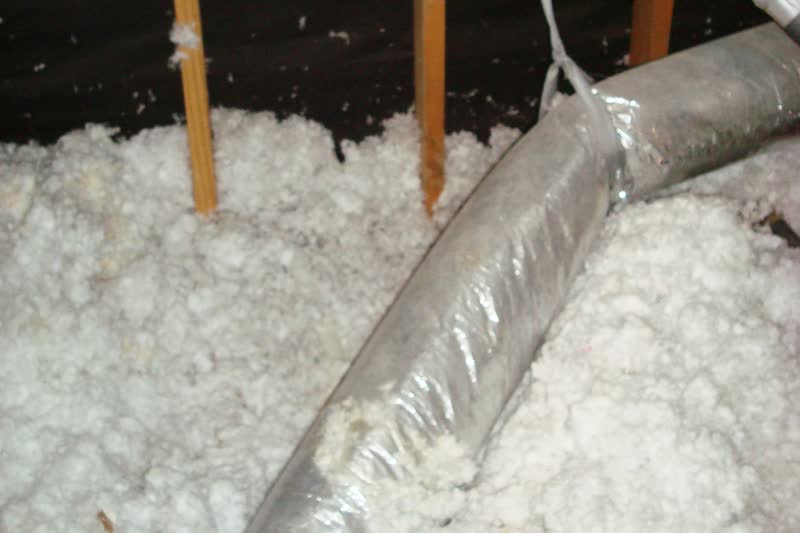
At the joints. The common spots are where a flexible duct slips over a metal collar, where branch takeoffs leave the main trunk, at the seams of the supply and return plenums next to the air handler, at the filter slot and where the register boots meet the ceiling drywall. ENERGY STAR's flyer also names kinked flexible duct, which chokes the airflow even when every joint is tight.
Why Attic Ductwork Costs More in a North Carolina Summer
A leak matters most when the air around the duct is far from the air inside it. A Department of Energy Building America research summary describes attic ducts as running through attics of 130 degrees in summer and 10 degrees in winter. In a North Carolina summer, the air in the supply ducts is much colder than the attic around it, so every leak and every thin spot in the duct insulation works against the air conditioner.
North Carolina's cooling season is long. NOAA's 1991 to 2020 climate normals show the coast needing the most cooling, Raleigh and Charlotte close behind, and Asheville and Boone far less. So ducts in an attic anywhere east of the mountains spend months working against that heat, while a mountain attic is more of a winter problem.
Humidity adds a second cost. A return leak in July pulls in hot, damp attic air that the air conditioner has to cool and dry, which is why leaky attic returns often show up as clammy rooms, not just a high bill.
Rather Talk It Through Than Read?
Call (336) 870-3893Monday to Friday 8:00 am to 5:00 pm. Saturday by appointment. Sunday closed.
Signs Your Attic Ducts Are Leaking
No single sign proves the ducts are at fault, because undersized ducts, a dirty filter or tired equipment cause some of the same symptoms. Several together are worth a look. ENERGY STAR and the Department of Energy's Building America Solution Center point to these:
- High utility bills in both summer and winter.
- A room, often at the far end of a duct run or over the garage, that never reaches the thermostat setting.
- Rooms that feel stuffy no matter how the thermostat is set.
- Weak airflow at some registers compared with others.
- Dust that comes back quickly, or a musty smell when the system starts.
- Ductwork in the attic or the garage. ENERGY STAR lists the location itself as a warning sign.
- Flexible ducts in the attic that are tangled, kinked, crushed, sagging or pulled loose.
What can you check yourself from the attic hatch?
Start in the house. The Building America Solution Center notes that registers in the ceiling usually mean the ducts run through the attic. With the system running, hold a hand at each register and compare the airflow. A weak one is a clue to the run that feeds it.
Then look from the hatch with a strong flashlight, on a mild morning rather than a summer afternoon. ENERGY STAR's own checklist asks three things: are there obvious holes, gaps or disconnections, are the connections at the registers sealed where they meet the ceiling, and are the flexible ducts straight, with gentle curves, and not torn, squashed or disconnected? Old cloth tape hanging loose at a joint is a common find. Step only on the framing and wear a dust mask.
How Duct Leakage Gets Tested
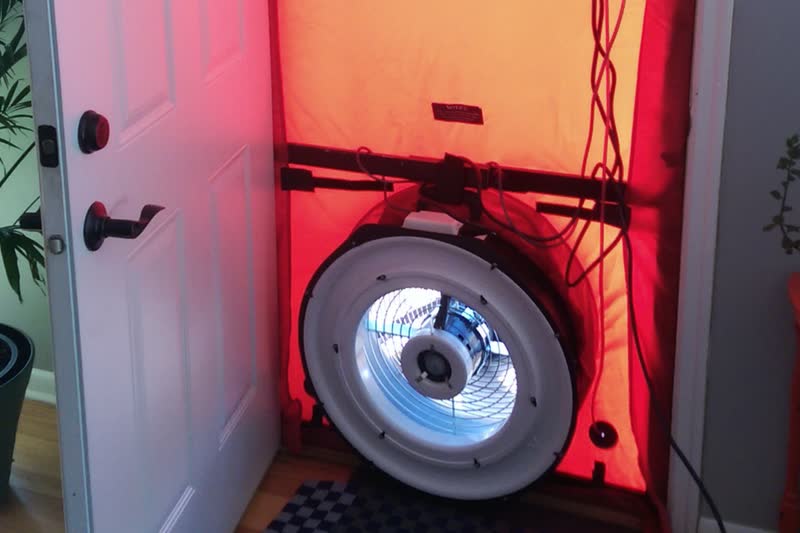
A look in the attic finds the obvious leaks. A test measures the total. The usual tool is a duct leakage tester, often called a duct blaster: a calibrated fan connected to the duct system, with the registers taped over, that pressurizes the ducts and reads how much air it takes to hold that pressure. The Building America Solution Center describes contractors using one when ducts are hidden or leaks are suspected, and it recommends testing before and after sealing to confirm the work and measure the improvement.
A blower door is a different test. It depressurizes the whole house to measure how leaky the building is, ceiling, walls and all. Some contractors run both, because a duct test alone cannot tell you how much of a leak goes outdoors and how much stays inside the house.
Whoever you hire, the question to ask is simple: will there be a measured number before and after, or only a visual check? Both have value. Just know which one you are paying for.
Do you need a duct test before sealing?
Not always. When the attic shows disconnected runs, gaping joints and boots pulling away from the drywall, the fix is clear without a gauge. A test earns its place when the ducts look fine but the symptoms persist, when most of the duct system is hidden in walls and ceilings, or when a rebate program asks for numbers. Duke Energy's Insulate and Seal program for North Carolina, for example, lists a duct sealing rebate paid once per duct system through its own participating contractors (Insulation Pros is an approved Duke Energy trade ally), so check the program's terms before any work starts. A home energy audit can also include a duct test, so ask whether one is part of yours when you book.
Mastic, Foil Tape or Sealing From the Inside: Comparing the Methods
Three methods do most of the work, and a good job often uses two of them. The table compares them as methods, using what ENERGY STAR and the Building America Solution Center say about each:
| Method | Best for | Limits |
|---|---|---|
| Mastic | Seams, collars, plenums and boots you can reach. Spread to about the thickness of a nickel. | Wide gaps need mesh or foil tape under it. Messy, and slow to cure. |
| Foil tape | Joints that may be opened again, and holding a flex duct to its collar before mastic. | Use foil tape marked UL 181 for ducts. Needs clean, dry metal to stick. |
| Sealing from inside | Leaks hidden in walls, floors and ceilings that no one can reach by hand. | An HVAC specialty. Does not seal the air handler or where registers meet the ceiling. |
Mastic and foil tape: sealing by hand
Mastic is a thick, fiber-reinforced paste that stays flexible after it dries. The Building America Solution Center's duct repair guide calls for mastic and foil tape rated to the UL 181 standard, and for mechanical fastening first: loose metal takeoffs get sheet metal screws, and a flexible duct's inner core is taped to its collar and held with a tie before the mastic goes over it. Sealant is not a fastener.
Gray cloth duct tape is the one thing not to use. ENERGY STAR says never to use it because it does not last, and the same guide shows a joint that came apart when the tape's adhesive failed. In a 130-degree attic that failure comes sooner.
What is aerosol duct sealing?
It seals the ducts from the inside. The registers and the air handler are blocked off, a machine pressurizes the duct system, and a fine acrylic sealant is blown in. The Building America Solution Center explains that the particles collect at the leaks and gradually close them, while the machine tracks the leakage and stops at the target.
The same guide says gaps larger than about five-eighths of an inch should be sealed by hand first, that the process does not seal the air handler or the joint between a register and the ceiling, and that it is less suited to ducts that are already fairly tight. It is equipment-heavy work done by HVAC contractors. We do not offer it. In an attic where the ducts can be reached, hand sealing covers the same joints, and it lets you see each one.
Sweating Ducts in the Attic: Leaks, Insulation and Humid Air
Ducts sweat when their outer surface drops below the dew point of the air around them. A Department of Energy Building America report on attic ducts states the rule plainly: condensation happens only when the surface temperature of the duct falls below the dew point of the surrounding air. In a humid Carolina summer, attic air holds a lot of moisture, and a duct carrying cold air is a ready condensing surface wherever its insulation is thin, torn or squeezed. Our guide to attic condensation and mold covers the other moisture sources in an attic, from bath fans to ceiling leaks.
The usual causes are physical, and most can be seen from the attic floor:
- Torn or gapped outer jackets on flexible duct, which let damp attic air reach the cold inner core.
- Insulation compressed by a tight strap or a cinched tie. The duct repair guide warns that a cinched tie can cause cold spots and condensation.
- Bare metal boots, plenums or collars with no insulation, or with unfaced batts laid over them, which the same guide says not to do because humidity can condense on the metal.
- Duct insulation that was thin to begin with, or has been crushed by storage or foot traffic.
Why do ducts in the attic sweat in summer?
Because the vapor jacket is not continuous. The Building America Solution Center notes that in humid climates, duct sweating can become a significant problem when the duct's thermal and vapor barriers are not properly aligned along the whole length of the duct. Water drips onto the insulation and the ceiling drywall below, and the first sign indoors is often a stain on the ceiling near a register.
The fix starts with sealing the leaks and repairing the jacket, then bringing the insulation up to level. The Solution Center gives R-8 as the modern minimum for duct insulation in an attic. ENERGY STAR's flyer asks for R-6 or higher on ducts in unconditioned areas. If a flexible duct's jacket is badly damaged, the same guide says replacing it with new insulated flex is usually more economical than trying to re-wrap it. If the stains have already spread or the drywall has softened, have the moisture and any damage looked at before new insulation goes over it.
Should Attic Ducts Be Buried in Insulation?
Burying ducts under deep loose-fill insulation can raise their effective R-value a great deal, and the Building America research found big gains in dry climates. North Carolina is not a dry climate, and that changes the answer. The Building America Solution Center says buried ducts can be used in dry climates, but in humid climates the ducts must first be encapsulated in at least an inch and a half of closed-cell spray foam before the blown insulation goes over them, to keep the duct surface above the dew point.
The model energy code takes the same line. Its 2018 edition added rules for buried ducts, and in humid zones such as 3A it asks for more duct insulation, full burial and a vapor retarder. Building America's own monitoring of buried ducts in a humid Florida house found that condensation did occur for brief periods.
We do not install spray foam, so encapsulation is not something we sell. For an existing NC attic, the sensible default is ducts that are sealed, properly insulated, supported off the attic floor where they can be, and left accessible for service. Where ducts already lie on the ceiling and the attic is getting new insulation, that is a decision to make on purpose. Whoever insulates your attic, ask how the ducts will be handled and why, and get the answer in writing.
Is Duct Sealing Worth It for Your House?
It depends on where the ducts are and what shape they are in. ENERGY STAR's flyer says sealing and insulating ducts can often pay for itself in energy savings, and it lists comfort, indoor air quality and safety among the benefits. Nobody can promise a saving for a particular house, and we will not. Here is how the answer usually breaks down:
- Usually worth it. Ducts in the attic or garage, joints you can see are gapped or taped with failing cloth tape, rooms that lag behind the thermostat, and a return in the attic.
- Worth doing in the same job. When the attic is getting new insulation anyway, or old insulation is coming out. The ducts and boots are easiest to reach before the new layer goes down.
- Less to gain. Ducts that run entirely inside the heated and cooled part of the house. Air that leaks there still ends up in the living space.
- Not the right fix. Ducts that are crushed, disconnected, badly undersized or worn out, or an air conditioner that is failing. Those are jobs for an HVAC contractor.
Does duct sealing help indoor air quality?
It can. ENERGY STAR's flyer says sealing ducts reduces the risk of pollutants getting into them from dusty attics and circulating through the house, and that insulation dust or smells from damp spaces can aggravate asthma and allergy problems. A sealed return stops pulling attic dust into the system. Sealing is not a substitute for changing the filter, which ENERGY STAR also recommends as part of any duct improvement.
Is duct sealing safe with a gas furnace or water heater?
Yes, with one check. ENERGY STAR explains that leaky ductwork can cause backdrafting, where combustion gases from a gas water heater, dryer or furnace are drawn back into the house instead of venting outdoors, and that sealing leaks can reduce that risk. Its flyer also says a combustion safety test should be done after ducts are sealed, and that a professional should check that the system is balanced. If your home has fuel-burning equipment, say so before work begins, and keep working carbon monoxide alarms.
What Duct Sealing With Us Covers
Tell us which rooms run hot or cold and roughly how big the attic is, and we'll price the sealing from that. Most homes don't need a visit first. On install day, before any work starts, the crew goes over the ducts with you: the joints, the collars, the plenum connections, the boots at the ceiling and the condition of the duct insulation. Anything that isn't ours to fix, they'll point out in plain language.
Duct sealing is part of our air sealing work. Loose connections get fastened first, then the seams and joints are sealed with mastic or foil tape rated for ducts, and the boots are sealed to the ceiling drywall. A run that is crushed or disconnected gets flagged for repair rather than taped over. ENERGY STAR also suggests having the system's balance checked after the ducts are sealed, and that is a job for your HVAC contractor.
Most attics with leaky ducts have leaky ceilings too, and often thin insulation, so the estimate usually covers all three. If yours only needs the ducts, that's all we'll price. Our guide on why air sealing comes before insulation explains the order. For measured numbers, we offer home energy audits as a separate paid service. Ask when you book whether a duct test is included. Whoever you hire, get the scope in writing, joint by joint, so estimates compare fairly.
Get a Free Estimate
Rooms at the end of the duct run never cool off? Tell us which ones and how big the attic is, and we'll price the duct sealing, plus the ceiling if it leaks too. Crushed or undersized ducts are HVAC work, and we'll say so.

Prefer to talk? Call (336) 870-3893.