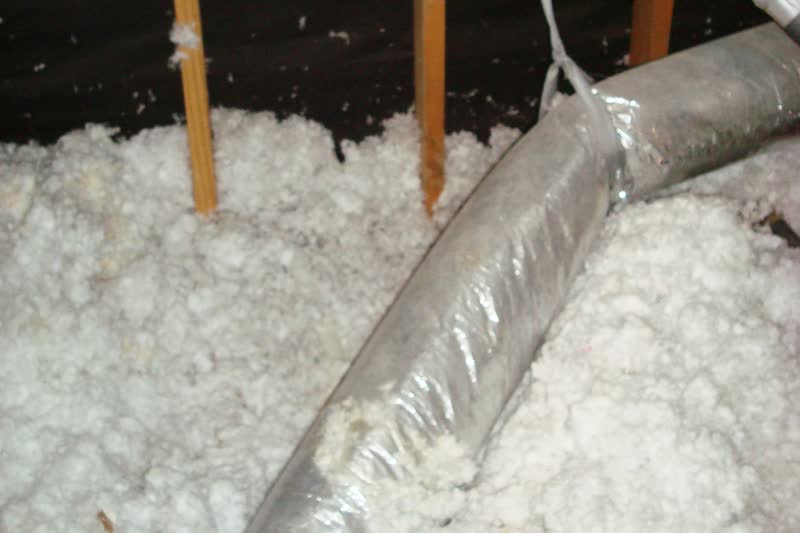
Blown-In Insulation: How It Works and Where It Fits
Blown-in insulation is loose-fill fiberglass or cellulose that an installer blows across the attic floor through a long hose until it reaches a set depth. Instead of being cut to fit like a batt, it fills in around every joist, wire and pipe, which makes it the usual choice for an open attic. It does its job when air sealing comes first and the depth is even, and it is the wrong pick for knee walls, rooflines or anywhere damp.
Below you will find what loose-fill is made of, how blown-in attic insulation is installed, how it compares with batts and rolls, what R-value, depth and settling mean, and what the cost depends on. A word on scope: this guide is about attics, which is where most blown-in insulation goes. Insulation Pros installs it in attics across North Carolina, and the material our crews blow is fiberglass. Insulation blown into the closed walls of a house is a separate job, and we do that too: our wall insulation page covers it.
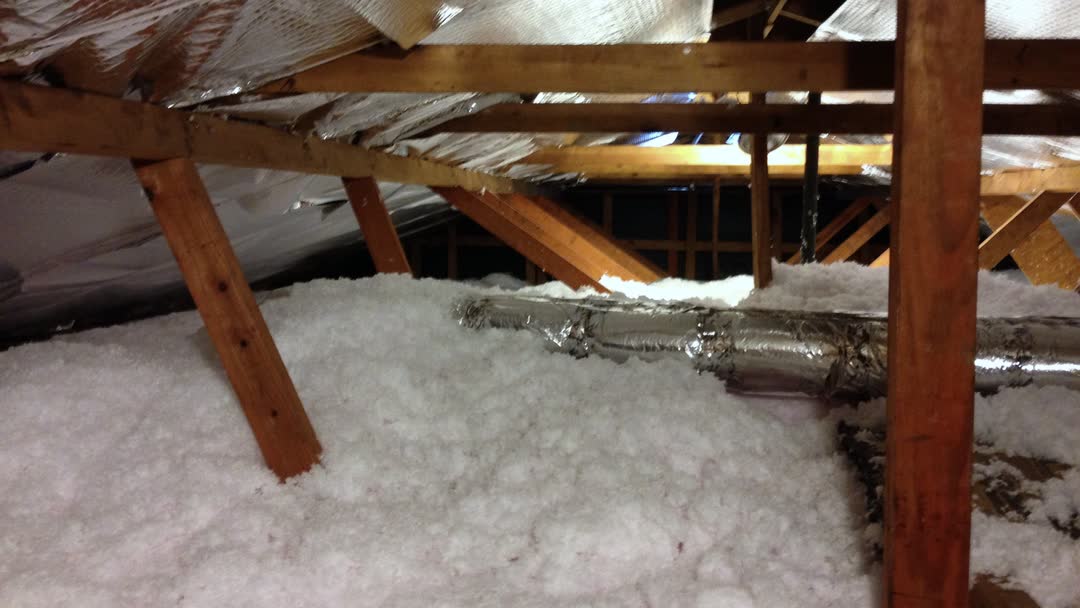
What Is Blown-In Insulation?
Blown-in insulation, also called loose-fill, comes as loose fibers packed into bags instead of blankets on a roll. A blowing machine loosens the fibers and pushes them through a hose, and the installer lays them over the attic floor like a deep, even snowfall.
ENERGY STAR notes that most contractors use it for attic floors. The two usual materials are fiberglass and cellulose, which it describes as safe and as containing some recycled content, glass in one and paper in the other. Mineral wool is a less common third. Either of the main two works in an open attic when the prep and the depth are right, so ask which is being quoted and why.
Fiberglass loose-fill
Fiberglass loose-fill is spun glass, usually white, pink or yellow, and very light. It does not take on water as readily as cellulose, and it needs more depth to reach the same R-value.
Cellulose loose-fill
Cellulose is recycled newsprint, shredded and treated to resist fire. It is gray, denser and heavier, and an inch of it insulates more than an inch of fiberglass. Its weak point is water: wetted cellulose can soak up a large amount and lose insulating value, so roof and plumbing leaks have to be fixed before it goes in.
Is cellulose attic insulation safe?
ENERGY STAR's answer is yes: it describes fiberglass and cellulose, the two usual loose-fill materials, as inexpensive and safe. Cellulose is mostly paper. A U.S. Department of Energy guide for contractors describes it as recycled newsprint, finely shredded and chemically treated to resist fire, corrosion, fungal growth and vermin, with at least 70 percent recycled paper in it.
Because it is paper, it has federal rules of its own. The Consumer Product Safety Commission's standard for cellulose insulation sets flame resistance and corrosiveness tests, and every bag has to state that the product meets that standard. A second rule puts a fire warning on the bag: keep the insulation at least three inches from the sides of recessed light fixtures, do not lay it over them, and keep it away from the flues of furnaces, water heaters and space heaters. The label ends with a request to the installer to hand it to you when the job is done, so ask for it.
Three cautions keep that answer honest. The Department of Energy guide notes that treated cellulose may still smolder if it gets hot enough, which is why those clearances matter. The guide lists dust among the drawbacks of blown-in fiber, so the attic is no place to be while the work is going on, and it has any ducts up there sealed first, to keep loose fibers out of the air the system blows into your rooms. And water is its weak point: wetted cellulose soaks it up and insulates less, which the answer on wet insulation further down covers.
Blown-in attic insulation: cellulose vs. fiberglass, which is better?
Neither wins outright. Blown to the same R-value over a sealed attic floor, the two do the same job, and both ENERGY STAR and the U.S. Department of Energy list them as loose-fill materials for attic floors. Cost rarely settles it either, because a Department of Energy guide for contractors puts both in its lowest cost bracket.
What separates them is how each one suits a particular attic:
- Headroom. By ENERGY STAR's per-inch figures, cellulose reaches a given R-value in fewer inches, which helps under a low roof. Fiberglass needs the extra depth.
- Leak history. Water is harder on cellulose, and the Department of Energy guide warns that wetting can also drain its fire retardant. An attic with a history of roof leaks leans toward fiberglass once the leak is fixed.
- Fire. The Department of Energy guide calls blown-in fiberglass non-flammable. Cellulose is paper, so the Consumer Product Safety Commission requires it to meet a flame resistance standard and to carry a label about keeping it clear of recessed lights and flues.
- The layer underneath. New insulation presses down on old, and the Department of Energy's insulation fact sheet says that matters most when the new material is the denser of the two. To make up for it, the fact sheet suggests about one extra inch of new material over old fiberglass and about half an inch over old cellulose or rock wool.
How Blown-In Attic Insulation Is Installed
The blowing is the quick part. Most of the care goes into the steps before the hose comes out, because everything on the attic floor is about to be buried. A careful job runs in this order:
- Inspect what is there, looking for damp or soiled insulation, old wiring and anything else that should not be covered.
- Seal the air leaks in the attic floor. Air moves straight through loose-fill, and the EPA recommends sealing before insulating.
- Fit baffles at the eaves so the new material cannot block the soffit vents.
- Build dams around the hatch and flues, and guard any recessed lights that are not rated for contact with insulation.
- Fasten depth rulers to the framing in several places so the depth can be read as the material goes in.
- Blow the insulation to one even depth, working from the far edges back toward the hatch.
- Insulate and weatherstrip the hatch, then clean up.
Can blown-in insulation cover recessed lights?
Only lights built for it. ENERGY STAR's rule is to keep all insulation at least 3 inches away from recessed can lights unless they carry an IC rating, which means the fixture is made to touch insulation. For loose-fill it says to build a barrier of sheet metal or wire mesh around each unrated light, so the fibers cannot drift against it.
A guide for contractors written for the U.S. Department of Energy's Building America program is stricter: do not cover a recessed fixture unless it is rated ICAT. The same guide shows attic air leaking into a house around a can light, which is why these fixtures get attention before the blowing starts and not after. Our guide to insulation around recessed lights that are not IC rated covers the labels, boxes and clearances in full.
Does blown-in insulation block attic ventilation?
It should not, and baffles are the reason. ENERGY STAR says any project estimate should include insulation baffles, also called rafter vents, so that added insulation cannot block the soffit vents that let outside air into the attic. A U.S. Department of Energy fact sheet describes attic ventilation as a planned escape path for moisture that has traveled up from the house. So the vents stay open, and the insulation stops at the baffle.
What you should have at the end
Paperwork, and a depth you can check. ENERGY STAR notes that a contractor has to hand over paperwork when the job is finished, stating how much insulation went in and the R-value the attic now has. Ask for the depth and the bag count on it as well. The rulers stay in place, so you can check the depth from the hatch yourself. As for time, ENERGY STAR estimates one to two days for a contractor to insulate an attic.
Rather Talk It Through Than Read?
Call (336) 870-3893Monday to Friday 8:00 am to 5:00 pm. Saturday by appointment. Sunday closed.
Blown-In Insulation vs. Batts and Rolls: Which Covers an Attic Better?
Batts and rolls are one product in two packages. The U.S. Department of Energy groups both as blanket insulation: batts come precut, rolls come as one long strip, and both are sized to fit between framing. On paper, a blanket and blown-in insulation can reach the same R-value. In a real attic the difference is coverage. A batt or a length of roll has to be trimmed around every wire, pipe and brace, and each small gap it leaves works like a hole in a blanket. Loose-fill flows into those spots without any cutting. A U.S. Department of Energy guide for contractors puts it plainly: loose-fill usually costs less than batts and gives better coverage, because it conforms to the space it is blown into.
Batts still earn a place. They stay put on vertical surfaces such as knee walls, where loose fibers would slide off, and rolls need no machine, which suits a small do-it-yourself top-up. The two also work together: loose-fill is routinely blown right over sound, dry batts. When the old layer is wet, moldy or soiled, it has to come out first, and our guide to attic insulation removal and replacement covers those cases.
Faced or unfaced insulation: which goes in an attic?
Facing is the kraft paper or foil attached to one side of some batts. The U.S. Department of Energy describes it as a vapor retarder, a layer that slows moisture passing through. Loose-fill has no facing, so the question only comes up with batts and rolls.
In most of North Carolina the answer is unfaced. A U.S. Department of Energy guide for contractors says to use unfaced batts in climate zones 1 through 4, which takes in every county in zones 3 and 4 on either climate map. Zone 5 is the exception. It covers Alleghany, Ashe, Avery, Watauga and Yancey counties on both maps, and Mitchell County on the map in the state's energy code. There the same guide calls for faced batts, laid with the facing against the attic floor. The Department of Energy and ENERGY STAR add three rules:
- Anything laid over existing insulation has to be unfaced. Facing caught between two layers can trap moisture and lead to mold.
- If the batts already in your attic have their paper facing up, do not bury them. Have them looked at first.
- Kraft paper burns, so it must not touch a chimney, a flue pipe or a recessed light.
Can you put a vapor barrier over faced insulation?
No. The facing already is one. The U.S. Department of Energy describes the kraft paper or foil on a faced batt as a vapor retarder, so a sheet of plastic laid over faced insulation would be a second barrier, with the insulation caught between the two.
None of the federal guides we read takes up that exact case, so here is what they do say. The Department of Energy's insulation fact sheet says that when insulation is added over existing insulation, no vapor retarder goes between the two layers. Its guide for contractors gives the reason: a facing left between layers acts as a vapor retarder and can cause problems with moisture and mold. ENERGY STAR's instructions for a second layer call for unfaced material, with no vapor retarder. All three point the same way: one vapor retarder at most, never two, and nothing that shuts moisture inside the insulation.
In zones 3 and 4, which take in most of the state, even one is more than that contractor guide asks for, as the answer above explains. In zone 5 it calls for exactly one: the facing on batts laid against the attic floor. Either way, if your attic has faced batts and you want more insulation, the usual route is unfaced batts or loose-fill on top, with no sheet anywhere. Batts lying with the paper side up are the exception: have them looked at before anything covers them.
Blown-In Insulation R-Value per Inch, Depth and Settling
R-value is a material's resistance to heat flow, and it is the number an estimate should aim for. Inches are only how you get there, and the two blown-in materials get there at different rates. For estimating, ENERGY STAR's attic worksheet credits loose-fill fiberglass with about R-2.5 per inch and cellulose with about R-3.7.
Blown-in fiberglass therefore needs noticeably more depth than cellulose to reach the same R-value, and two honest quotes for one attic can list different inches. For scale, ENERGY STAR puts R-38 at about 10 to 14 inches, depending on the type of insulation. Our guide to attic insulation R-value in North Carolina covers the targets for each of the state's three climate zones and the depth each one takes.
Depth has to be even, too. ENERGY STAR points out that the middle of an attic can be deep enough while the eaves have next to nothing.
Does blown-in insulation settle, and how long does it last?
Yes, it settles somewhat after it goes in. That is expected, and installing it at the manufacturer's recommended density keeps it in check. The trouble is a layer blown too airy, which installers call fluffing: it settles too much and ends up with a lower R-value. That is why the bag count matters as much as the depth.
The label plans for it as well. Under the Federal Trade Commission's insulation rule, every bag of loose-fill lists two depths for each R-value: the thickness as blown and the minimum thickness once the material has settled. The settled figure is the one to hold a quote to.
As for how long it lasts, there is no expiry date on it, and we will not quote a number of years, because the attic decides. Kept dry and left undisturbed, loose-fill goes on working. Roof leaks, bath fans venting into the attic, rodents and stored boxes are what wear it out. If the depth has dropped, a top-up restores it. Only wet or contaminated material has to come out.
Can blown-in insulation get wet, and does it cause mold?
It can get wet, and the two materials take it differently. Fiberglass is spun glass, and a U.S. Department of Energy guide for contractors credits fiberglass batts with excellent moisture resistance and with resisting mold. Of cellulose the same guide says that accidental wetting and high humidity can make it absorb large quantities of water, which lowers its insulating value, drains its fire retardant and puts the building around it at risk of mold and moisture damage.
Either kind stops doing its job while it is wet, and what happens next depends on how wet and for how long. The EPA's table for water-damaged building materials gives fiberglass insulation and cellulose insulation the same line: discard and replace. Its mold guide adds the clock: materials dried within 24 to 48 hours of a leak will in most cases not grow mold. So a small patch that was only dampened, and found quickly, may dry out and stay. Anything that was soaked through, sat wet for days, or has since gone flat, discolored or musty comes out once the leak behind it is repaired.
Does the insulation itself cause mold? Not when the attic around it is right. Mold needs moisture, and in an attic the moisture arrives with air or water from somewhere else: house air leaking up through the ceiling, a bath fan that empties into the attic, a roof leak. Insulation blown over a sealed ceiling, with the fans ducted outdoors and the soffit vents open behind their baffles, gives mold nothing to work with. Blown over an unsealed ceiling or an unfixed leak, it hides the problem and holds the damp against the wood.
Does blown-in insulation keep mice out?
No. Insulation slows heat and does nothing to stop an animal. Mice and squirrels tunnel through loose-fill and nest in it, and a Building America guide written for the U.S. Department of Energy lists batts as nesting material for rodents too. What keeps them out is closing the holes they use. The CDC says to seal any holes you find and notes that a mouse can fit through one the width of a pencil. Pest control is a separate trade from ours, so if you have seen droppings, have the animals dealt with before new insulation goes in.
Where Loose-Fill Fits, and Where Something Else Is Better
Loose fibers need a flat surface to rest on and room to pile up. That makes blown-in insulation a natural fit for three jobs:
- Open attic floors, the standard case.
- Top-ups, where the layer already there is dry and clean.
- Attics crowded with truss webs, wiring and pipes that batts would have to be cut around.
Is blown-in attic insulation worth it?
For an open attic floor, yes. It is what most contractors use there, and it covers evenly around framing, wiring and pipes. It is only as good as the prep, though: air leaks sealed first, soffit vents kept clear and an even depth. On knee walls, rooflines or damp areas, another material is the better choice.
Whether it pays depends on what is up there now. A U.S. Department of Energy guide says a house with little or no attic insulation is where adding it is likely to pay for itself within a few years, and that more insulation in an attic that is already adequate may never earn back its cost. The material helps the sums: the same guide counts loose-fill among the least expensive kinds of insulation and a good choice for the floor of a vented attic.
Types of attic insulation and where each one goes
No single type suits every part of an attic, and a finished attic can hold two or three of them. Blown-in is one of four types you are likely to see on a quote. ENERGY STAR's guide to insulation types covers all of them, and each has its own place:
- Loose-fill, blown in. Cellulose, fiberglass or mineral wool for open attic floors and hard-to-reach spots.
- Batts and rolls. Blankets of fiberglass or mineral wool sized to fit between framing, used on knee walls and for small do-it-yourself jobs.
- Spray foam. Sprayed in place by trained installers, for rooflines and for leaky, awkward gaps where one material has to seal and insulate. Insulation Pros does not install it.
- Rigid insulation board. Stiff panels used to close off dropped soffits and the open joist spaces under knee walls before insulation goes over them.
Blown-in insulation pros and cons
On an open attic floor the case for blown-in is strong, and its weak points are well known. A guide for contractors written for the U.S. Department of Energy's Building America program lists both:
- Pro: it is inexpensive. The guide puts loose-fill fiberglass and cellulose in its lowest cost bracket.
- Pro: the small particles conform to the space, filling in behind and around wiring, plumbing and other obstacles.
- Pro: it is well suited to a house that is already built, since it goes in over what is there.
- Con: it takes a blowing machine and it is dusty, so it is typically a job for a professional.
- Con: it can settle too much if it is not installed properly.
- Con: some types absorb water readily, so a roof leak has to be fixed before the material goes in.
Where it is the wrong tool
Knee walls, rooflines and rim joists give loose fibers nothing to rest on. The tight wedge at the eaves is another weak spot: there is often too little room to reach the full R-value with fiber insulation, and spray foam around the attic perimeter is one way some contractors make up for it. We do not install spray foam. An attic floor used for storage is a poor match too. Deep loose-fill buries the joists and should not be walked on or stacked with boxes, so a raised platform has to come first.
Our guide comparing spray foam with blown-in insulation goes through those cases job by job and says what we do at each one.
What about walls?
Blown-in insulation goes into walls too. In a house that is already built, the fibers are blown into the closed wall cavities through small holes and packed more densely than on an attic floor. It is a different job with its own checks, and it is one we do. Our wall insulation page explains how the work is done, which walls should not be filled and what drives the cost. The rest of this guide stays in the attic.
What Drives Blown-In Insulation Cost?
A guide cannot price your attic, so there are no figures here. For blown-in insulation, three things move the number most. The first is how much floor there is to cover. The second is how far the existing layer sits below the target R-value, which sets the number of bags. The third is how much has to happen first: sealing air leaks, fitting baffles, building dams and, in some attics, taking out damaged material.
The material itself is among the least expensive kinds of insulation. Our guide to attic insulation cost goes through each factor and shows how to compare two estimates line by line. For a number that fits your attic, tell us its square footage and we'll price it.
Why a per-square-foot number misleads
No one price per square foot fits every attic, so we don't print one. We do start from your square footage. What a flat rate misses is the bag count. Floor area tells you how wide the job is, not how deep. The Federal Trade Commission's insulation rule puts a coverage chart on every bag of loose-fill, and for each R-value the chart says how many bags 1,000 square feet will take. An attic that is already half full takes far fewer bags than a bare one of the same size, and the two would share one per-square-foot figure only by accident.
The preparation is priced by the attic, not by the foot: the leaks to seal, the eaves that need baffles, the one hatch to dam and insulate. None of that gets smaller because the floor does, which is why a little attic can come out higher per square foot than a big one.
A per-square-foot number is still good for one thing, which is checking that two quotes cover the same area at the same R-value. The federal rule treats price that way too: an insulation ad that gives a price has to name the type of insulation and its R-value at a specific thickness. So ask each company for the area covered, the number of bags, the settled depth and the finished R-value.
Does cellulose or fiberglass change the quote?
The U.S. Department of Energy does not separate the two on cost. Its guide for contractors puts loose-fill cellulose and loose-fill fiberglass in the same bracket, the lowest it has. What differs between them is the amount it takes.
By ENERGY STAR's estimating figures, cellulose delivers about R-3.7 per inch and loose-fill fiberglass about R-2.5, so one R-value means fewer inches of cellulose and more inches of fiberglass. Inches are not bags, though. Each product's coverage chart gives the bags per 1,000 square feet for the R-value you are buying, and that count, not the depth, is the material on the quote.
What does not differ is everything around the material: the air sealing, the baffles, the dams at the hatch and the flues, the blowing and the clean-up. That is the same job under either product.
To set a cellulose quote beside a fiberglass quote, hold the R-value still. Ask both companies to price one finished R-value over one area, and to state the settled depth and the bag count that get there. A federal rule backs the method: an insulation ad that compares one type with another has to use the same coverage area and give each one an R-value at a specific thickness. If the two totals come out close, let the attic decide. Low headroom leans toward cellulose, and a history of roof leaks leans toward fiberglass. We print no figure for either, and the material we blow in is fiberglass.
Where the labor time goes
Labor on a blown-in job is mostly preparation. The blowing is the short part, and ENERGY STAR puts a contractor's whole attic job at one to two days.
What pushes the hours up is the attic, not the material: a small hatch, a low roof, ducts in the way, a deep old layer to move aside or damaged insulation that has to come out first. A quote that is light on labor is usually light on one of the tasks below, most often the sealing. Ask for the labor to be described task by task, so you can see that each one is there:
- Sealing. Finding and closing the leaks in the attic floor, which means moving old insulation aside to reach them.
- Baffles. Fitted between the rafters along the eaves, in the lowest and tightest part of the attic.
- Dams and guards. Around the hatch, the flues and any recessed lights that cannot touch insulation.
- Blowing. Feeding the machine and working the hose from the far edges back toward the hatch, with the depth rulers checked along the way.
- Hatch and clean-up. Insulating and weatherstripping the hatch, then clearing the path through the house.
Why there is no honest average
We do not give one, and the averages you will find online deserve a careful look. An average blends bare attics with top-ups, cellulose with fiberglass, jobs that included air sealing with jobs that skipped it, and prices from every part of the country. The figure that comes out fits no real attic, least of all yours.
Three answers get you further than an average: how many inches are up there now and of what, the R-value the quote takes the attic to, and what happens before the hose comes out. With those in hand, any number you are handed can be checked against the work it buys. ENERGY STAR suggests collecting several estimates and reading the scope of work in each beside its cost. It adds that many contractors will want to see the attic before they name a figure. We price most attics from the square footage and make a special visit only when an attic needs a closer look. Either way, the estimate is free and in writing.
What a blown-in insulation quote should list
Most of it is yours by right. The Federal Trade Commission's insulation rule obliges an installer to hand you a contract or receipt. On a loose-fill job that paper has to state five things: the area covered, the thickness as first blown, the least it will measure after settling, the R-value and how many bags went in. A good quote states before the work what that receipt will state after it.
A quote that gives only inches, or only a price per square foot, leaves out the numbers you would need to hold anyone to it. If you are collecting quotes, ask each company for this list:
- Area: the square feet of attic floor being covered, and whether spaces such as the attic over a garage are in or out.
- R-value: the R-value the attic will finish at.
- Material: cellulose or fiberglass, named closely enough that you can look up its coverage chart.
- Settled depth: the minimum thickness after settling, not only the depth on the day.
- Bags: how many the job takes at that R-value, which you can check against the chart on the bag.
- Preparation: the air sealing, the baffles, the dams and the hatch, each one named or plainly left out.
Get a Free Estimate
Thinking about blown-in for your attic? Tell us the square footage, or let us work it out from your home's footprint, and we'll price the bags, the sealing and the prep. If a top-up is all you need, that's all we'll quote.

Prefer to talk? Call (336) 870-3893.