Attic Insulation
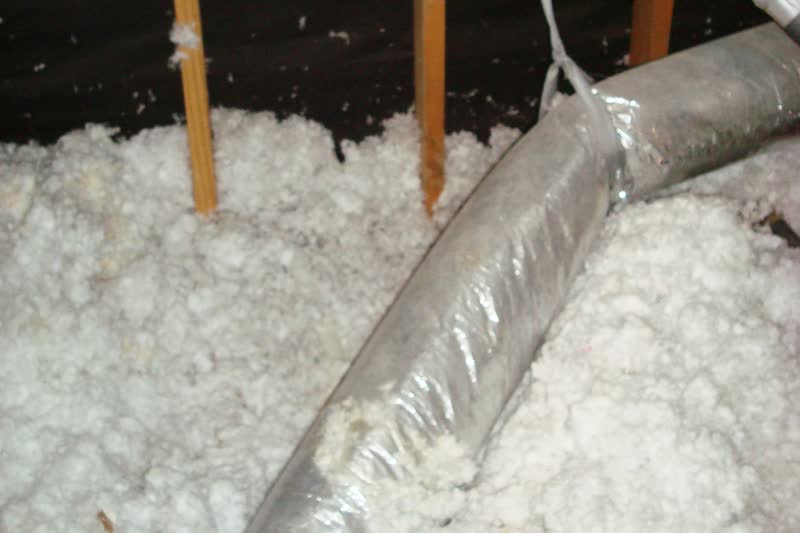
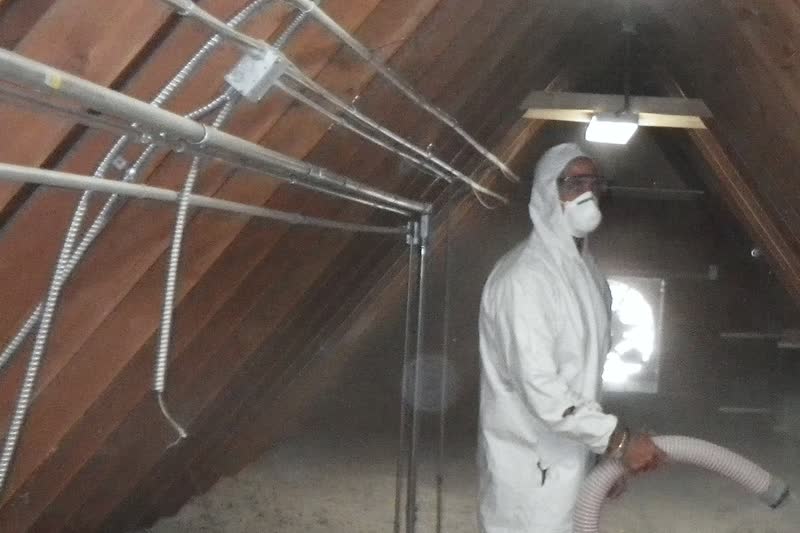
Blown-in fiberglass attic insulation, added to the depth your home needs, to even out hot and cold rooms and cut wasted heating and cooling.
A lot of Hickory houses are forty years old or more, and so is the insulation over their ceilings. We're an insulation contractor serving Hickory: blown-in attic insulation, old insulation vacuumed out and replaced, and air sealing, for houses from the early 1900s streets north of downtown to the ranches and split-levels that came after. The estimate is free, and the square footage is usually enough to price it.
Hickory is the largest city in Catawba County, with about 46,000 people in the Census Bureau's 2025 estimate. Its housing's median year built is 1982 in the bureau's 2020 to 2024 survey. That means a typical Hickory attic was insulated more than forty years ago, and plenty of the city is older still. Insulation that old may have settled, been pushed aside for cable and ductwork, or never made it to the eaves to begin with.
If you're looking for an insulation company in Hickory, here's what we do. We air seal the ceiling from the attic side, blow loose-fill over the attic floor until it's deep enough for the house, and vacuum out old insulation that's gone bad. We also handle insulation for walls, garages and crawl space floors, commercial buildings and paid home energy audits.
Insulation Pros is family owned and operated, and we try to make getting a price easy. For most Hickory attics we only need the square footage. You can tell us, or we'll size it up from the outline of the house. If something about the attic needs a look in person, we'll make a special visit for it. You won't get a sales pitch, and you won't pay for work your attic doesn't need.

Monday to Friday 8:00 am to 5:00 pm. Saturday by appointment. Sunday closed.
Hickory was incorporated as Hickory Tavern in 1863, took its short name in 1873 and absorbed its neighbors West Hickory and Highland in 1931. Its houses run from the Queen Anne homes of Oakwood to small mill-village houses near the Highland mills and the postwar houses of Forest Hills.
Hickory apparently had less company housing than other Piedmont textile cities, the city's 2015 survey update found, but two mill villages stand out. Shuford mill workers in Highland lived across the railroad tracks in houses built in the 1910s and 1920s. The Highland Cordage village beside its own mill was begun in the 1920s. The survey describes most of these as one-story frame houses with a side-gable roof and a front-gable wing, an L-shaped plan. Under an L-shaped roof the attic runs two ways, and the arm over the wing is easy to miss. We measure both arms and spread the insulation evenly across the whole ceiling, with no low spots.
When soldiers came home after World War II, Hickory had more families than houses. Forest Hills was platted in 1946 and enlarged in 1948 to ease that shortage, paid for in part with federal housing money and developed by the Hickory Housing Commission. The survey update describes modest six-room houses, most of them Minimal Traditional, with larger ranch and split-level houses on small subdivisions to the north. A split-level can have more than one attic, at different heights over its different levels, and sometimes each has its own access. Each one gets its own look and its own measurement, so the upper attic is not done while the lower one is forgotten.
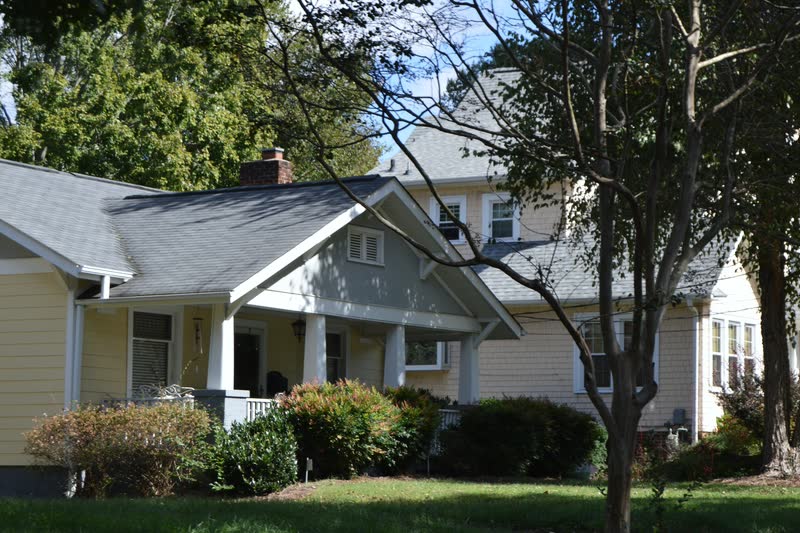
Kenworth filled in almost all at once, from about 1920 to 1926, and its 1985 nomination counts bungalows as about seven in ten of its buildings. They rise one or one and a half stories, with gable dormers. In the taller ones, short knee walls fence off a slice of attic on each side of the upstairs rooms. Iowa's guide to building problem areas calls those wedge-shaped spaces a frequent leak. ENERGY STAR also names the open framing under knee walls. So the slices behind the knee walls get air sealed and insulated, not only the attic above the bedroom ceilings.
Attic insulation, removal, air sealing and more. Open one to see how the work goes.
Blown-in fiberglass attic insulation, added to the depth your home needs, to even out hot and cold rooms and cut wasted heating and cooling.
Old, wet, matted or animal-soiled attic insulation vacuumed out, so new insulation can go in on a clean, sealed attic floor.
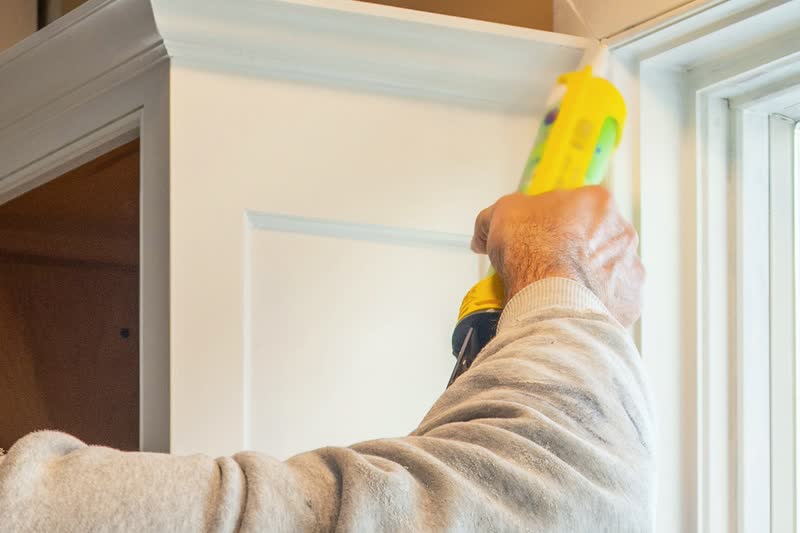
Sealing the gaps between your rooms and the attic, and leaky ductwork, so the air you pay to heat and cool stays inside.
Insulation blown into the closed walls of an existing house, batts in open walls for additions, remodels and new builds, and garage walls and ceilings.
Insulation for the garage ceiling under a bonus room, the wall shared with the house and the garage attic, with air leaks sealed first.
Floor insulation under the house: wet or fallen insulation pulled out, new batts between the floor joists, plastic over the dirt and the floor leaks sealed.
Most Hickory attic jobs are a top-up. The ceiling gaps get sealed, baffles go in at the eaves, and loose-fill gets blown over the layer that's there until the whole floor reaches its target. Catawba County is zone 4 in North Carolina's energy code and zone 3 on the newer national map. ENERGY STAR's figures are R-60 for a bare attic floor in zone 4 and R-49 in zone 3, or R-49 and R-38 where there's already 3 to 4 inches.
Hickory winters are a good reason to look at the upper end of that range. By NOAA's 1991 to 2020 normals for the Hickory Airport station, January's average low is near 30 degrees, with about 69 nights a year at freezing or below, and July's average high is about 87. On a cold night, heat from the rooms rises against the ceiling and gets out through every gap and thin spot. Sealing and depth both count.
Blown insulation is sold by R-value, not by inches, and the depth depends on the material. Our R-value guide gives the inches for each target, and your written price names the R-value we'd aim for in your attic.
Hickory's center sits about 1,140 feet above sea level, 2 miles from NOAA's Hickory Airport station, the best match for Hickory. The station's 1991 to 2020 normals average about 3,550 heating and 1,400 cooling degree days a year, so at Hickory's station, heating needs outweigh cooling.
Readings change over short distances around Hickory: NOAA's Lenoir station, 17 miles away, averages about 3,850 heating degree days.
Old insulation only has to come out when water, mold, odor or animal waste has ruined it. Those are ENERGY STAR's exceptions to its rule that new insulation can go right over old. The cause gets fixed first. A leaking roof goes to a roofer, and squirrels or mice that are still getting in go to a wildlife control company.
Storms are one way water reaches an attic. When Helene came through in September 2024, the National Weather Service's impact summary for Catawba County reported numerous trees down across the county and a 52 mph gust at the Hickory airport. Hugo hit harder in 1989: the State Climate Office reports an 81 mph gust in Hickory. Insulation that soaks up water through a damaged roof can stay matted, stained or musty after it dries. Once the roof is sound, we vacuum it out, seal the bare ceiling and, in most homes, blow in a fresh layer. Dry insulation away from the damage can stay.
Hickory has plenty of houses old enough to hold vermiculite, a pebble-like fill that's usually gray-brown or silver-gold. The EPA says a mine near Libby, Montana, supplied over 70 percent of the vermiculite sold in the United States from 1919 to 1990, and that homeowners should assume vermiculite insulation contains asbestos and leave it undisturbed. If you think you've got it, tell us before we price anything. We won't vacuum it out, and we'll refer you to a professional asbestos contractor.
Oakwood, north of downtown, was first listed on the National Register in 1986 for its grander houses from about 1880 to 1940. A 2019 boundary increase added 183 primary resources and about 80 acres around it. Its nomination says those blocks run later and smaller: Craftsman bungalows, Period Cottages, Minimal Traditional houses and one-story ranches, built from about 1905 to 1966, most of them frame houses under gabled or hipped roofs.
The same nomination lists dormers and rear wings or additions among the common features, and both matter in the attic. A rear wing or a later addition usually sits under a lower roof with an attic of its own, sometimes with no hatch, so it's easy to miss. Mention it when you ask for a price so it gets counted. Where an addition meets the original house, the old wall top and the new framing can leave a gap open between the two attics, and that seam gets sealed with the rest of the ceiling. A small Period Cottage or Minimal Traditional house may have one low attic, reached through a closet ceiling and tight at the edges.
Some 55 percent of Hickory housing units are detached single-family houses.
From 1990 to 2009, 29 percent of Hickory homes were built to codes below ENERGY STAR's target; check their eaves, where ENERGY STAR says insulation is often thinnest.
About 47 percent of Hickory's housing units predate 1980; nearly all predate the state's 1978 insulation rule too. Some 38 percent of Hickory units sit in buildings of two or more homes, where the attic is often shared.
By the year-built figures above, the 1980s built more of Hickory's housing than any other decade, with the 1970s, 1990s and 2000s close behind. Those years straddle the state's 1978 rule. North Carolina law says a single-family house begun on or after January 1, 1978 may not be occupied until it meets the minimum insulation standards. A house from the early 1970s may have started out with very little overhead. One from the 1980s probably got a modest layer that's packed down since.
Either way, the fix is usually the same. The ceiling gets sealed, and loose-fill goes over the old layer to bring the whole floor up to target. ENERGY STAR's quick check tells you where you stand: if you can easily see the tops of the floor joists because the insulation is level with them or below, you should add more. If they're buried, you may be fine, and we'll tell you that.
Air sealing closes the paths between the rooms and the attic before new insulation covers them up. ENERGY STAR's list of usual attic leaks takes in holes for wiring and plumbing, dropped soffits open to the attic, the chase around a flue or ductwork, recessed lights and the attic hatch. Its list of problems to fix before insulating adds kitchen, bath and dryer vents that blow moist air into the attic instead of outdoors. If one of yours does, the crew points it out on install day.
Ducts in a Hickory attic get the same attention. Loose joints up there leak heated air on winter nights and cooled air in July. The joints, seams and register boots within reach get mastic or foil tape, never cloth duct tape. If a run is flattened or has come apart, we'll show you the spot, and that repair goes to a heating and cooling company.
Duke Energy Carolinas supplies Hickory's electricity. For gas, Hickory is in the Catawba County franchise of Piedmont Natural Gas, and 35 percent of Hickory homes heat with piped gas. Duke's free House Call fits many Hickory homes: 61 percent heat with electricity.
Rebate to check in Hickory: Smart $aver Insulate and Seal (Duke Energy; Insulation Pros is an approved trade ally). Before a Hickory job, check its current terms; the Catawba County page lists every program.
Whoever you call, get the price in writing and read what's on it. ENERGY STAR advises getting estimates from several contractors and making sure the one you choose will seal attic holes and gaps before adding insulation. An estimate worth comparing names the R-value, the air sealing, any removal, the baffles at the eaves, and how the hatch and the ducts are handled. Anything on it you didn't ask about deserves a question. Ours only lists what your attic needs.
When a blown-in job is finished, the Federal Trade Commission's R-value Rule requires a signed receipt listing how much area was covered, how thick it went in and how thick it should settle, the R-value and how many bags were used, so you can check what went in.
Each page has local notes on the homes and attics in that town.
Catawba County, 4 miles west
Median home built 1970 (Hickory: 1982)
Attic insulation in Long ViewCatawba County, 6 miles east
Median home built 1991 (Hickory: 1982)
Attic insulation in ConoverCatawba County, 7 miles southeast
Median home built 1977 (Hickory: 1982)
Attic insulation in NewtonCaldwell County, 16 miles northwest
Median home built 1972 (Hickory: 1982)
Attic insulation in LenoirIredell County, 25 miles east
Median home built 1982, as in Hickory
Insulation contractor serving StatesvilleAlso in Catawba County: Brookford, Catawba, Claremont, and Maiden. Every town in Catawba County. See all service areas.
Local service pages: Attic Insulation in Asheville, Attic Insulation in Charlotte, Attic Insulation in Durham, Attic Insulation in Fayetteville, Attic Insulation in Greensboro, Attic Insulation in Greenville, Attic Insulation in High Point, Attic Insulation in Lexington, Attic Insulation in Raleigh, Attic Insulation in Thomasville, Attic Insulation in Wilmington, Attic Insulation in Winston-Salem.
Yes. We serve homes across North Carolina, so Hickory and its neighbors, among them Conover, Newton and Long View, are all in the area we cover. Pricing works the same anywhere: most attics from the square footage, and a special visit only when one needs it.
The city's Permit Center notes that Catawba County enforces the state building code within Hickory's jurisdiction, so building code questions go to Catawba County Building Services. Whether an attic job needs a permit depends on what it includes, especially if it touches ductwork, wiring or the roof, so ask before the work starts.
We don't publish a price, because each attic sets its own. Mostly it comes down to the size of the attic floor, so a Hickory attic can usually be priced from its square footage, or from your home's footprint. How far your insulation is from the target R-value, how much air sealing comes first and whether ruined insulation has to come out move it too. The written price is free.
Often less than in hotter parts of the state. The Building America Solution Center says a radiant barrier's advantages shrink where the attic takes in little summer heat, and that over an attic already at R-30 or better there's very little heat flow left for one to cut. Ducts in the attic are its clear exception. Bringing the insulation up to depth comes first, and that's the work we do.
Usually. ENERGY STAR says the new insulation doesn't have to be the same type as the old, so loose-fill over dry, clean batts is fine once the gaps under them are sealed. Batts that are stained or moldy from a leak, or full of droppings, are the exception, and those come out first.
A written price for the work your attic needs, usually figured from the square footage, with the target R-value, the air sealing and any removal spelled out. It costs nothing. If something sounds off, like a roof leak or signs of animals, we'll make a special visit before we price it. When the crew arrives on install day, they go through the attic with you before starting.
Not for the insulation itself. Hickory has three local historic districts, Oakwood, Kenworth and Claremont, all set up around 1985, plus a number of individual landmarks. In them, the city's Historic Preservation Commission must sign off on exterior changes through a certificate of appropriateness. Under state law it has no say over a building's interior arrangement. Blowing insulation onto the attic floor and sealing gaps from above is work done indoors. Adding roof or soffit vents alters the exterior, though, so talk to the city's planning staff before that step.
The wiring and the chimneys. Oakwood's oldest house dates from 1882, and its nomination describes Queen Anne homes followed by Colonial Revival houses built between 1907 and 1913, often with paired interior chimneys. Houses wired before 1930 may still have knob-and-tube circuits, which ENERGY STAR calls a fire risk when insulation covers them. An electrician clears that first. Each chimney opening in the attic floor is then capped with aluminum flashing bedded in heat-resistant caulk, and a metal collar keeps loose insulation off the brick.
No. The city describes the National Register as mainly an honorary listing and says its commission reviews only locally designated districts and landmarks. The State Historic Preservation Office makes the same point from its side: an owner paying for work on a listed house is free of any register rules. Hickory has many more National Register listings than local districts, including later boundary increases to Claremont and Oakwood, so the two maps differ. The city publishes maps of its local districts if you are not sure which side of the line you are on.
Attic Insulation
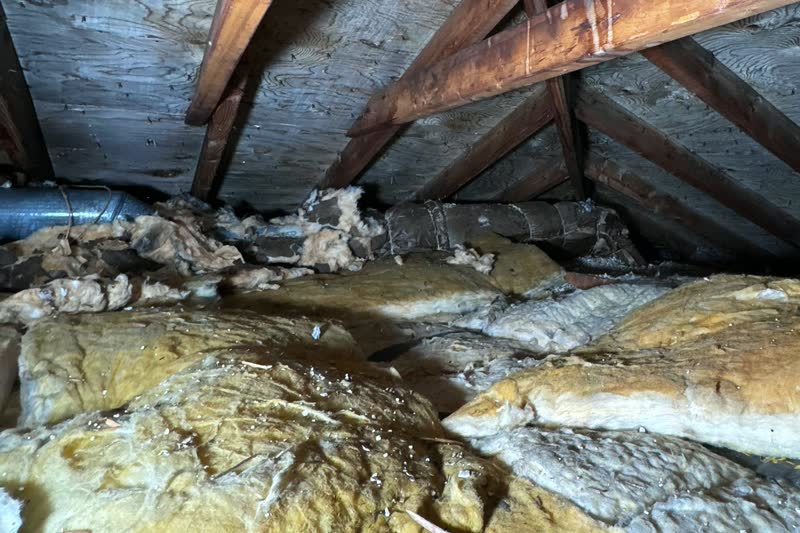
Uneven rooms, creeping energy bills and insulation you can barely see are all clues. These are the safe checks any homeowner can do from the attic hatch, and how to decide between topping off and starting over.
Attic Insulation
Houses built before the state's 1978 energy rules often have little in the attic and nothing in the walls. Learn the safety checks to make first, the leaks old framing hides and the order to do the work in.
Census Bureau figures for Hickory, NOAA normals for the Hickory Airport station, NOAA monthly normals for the Hickory Airport station, Duke Energy Carolinas, Oakwood Historic District boundary increase nomination (NC HPO), National Weather Service Helene impact summary (Greenville-Spartanburg), NC State Climate Office on Hurricane Hugo, N.C. Gen. Stat. 143-139.2, ENERGY STAR recommended insulation R-values, ENERGY STAR attic insulation project, ENERGY STAR Well-Insulated and Sealed Attic page, ENERGY STAR attic air sealing project, Building America Solution Center on attic radiant barriers, EPA on vermiculite insulation, FTC R-value Rule (16 CFR 460.17), City of Hickory Permit Center (October 2026). Compiled by Insulation Pros. How the town pages are made.
Sources for the Hickory notes and questions (read October 20, 2026):
Hickory, NC
Open in Google Maps (opens in a new tab)Insulation Pros is an insulation contractor serving North Carolina, with Hickory and the rest of Catawba County in the area we cover. Most Hickory attics can be priced from their size alone, free of charge.
Wondering how your Hickory attic is holding up? Call or text us, or fill in the contact form with the attic's size. We'll tell you what it needs, if anything, and put the price in writing at no cost.
What You Can Count On
We serve homes across North Carolina. These are the largest towns we work in.
Alamance County
Buncombe County
Cabarrus County
Cumberland County
Durham County
Forsyth County
Gaston County
Guilford County
Mecklenburg County
New Hanover County
Onslow County
Orange County
Pitt County
Wake County