Attic Insulation
Blown-in fiberglass attic insulation, added to the depth your home needs, to even out hot and cold rooms and cut wasted heating and cooling.
In a Burlington attic, insulation comes out when a roof leak, mice or smoke has spoiled it. Once a roofer or a wildlife control company stops the cause, we vacuum it out, seal the bare ceiling and lay new fiberglass. Estimates are free.
A little over half of Burlington's homes went up before 1980, yet more of them date from the 2000s than from any other decade, by the Census Bureau's 2020-2024 survey. Age alone doesn't decide removal. ENERGY STAR's guidance lets an old layer remain beneath new insulation except where it's wet, moldy, smelly or full of animal waste, and if yours is only thin, or packed down but dry and clean, the work can be a top-up, explained under attic insulation in Burlington.
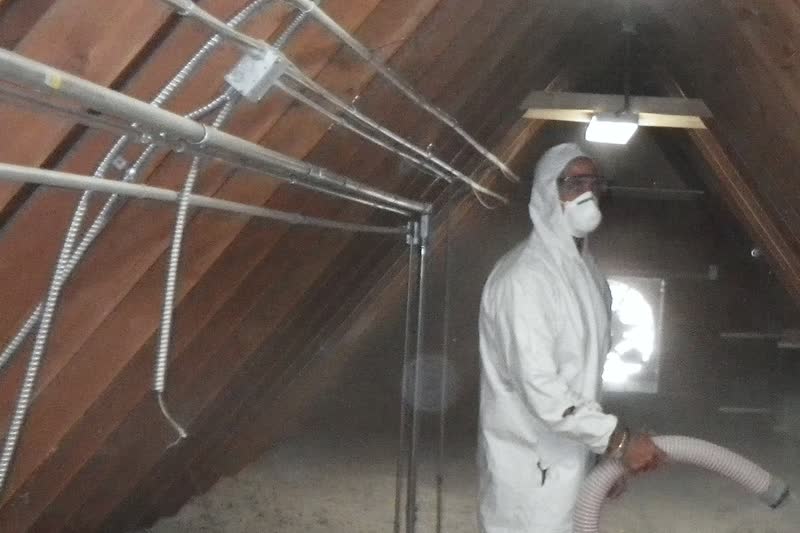
Removal is the answer for the rest. Attic insulation removal takes the spoiled layer out by vacuum, and an attic mice have lived in is sanitized and deodorized next. Then the open ceiling's gaps are sealed, baffles are fitted at the eaves, and new blown-in fiberglass is laid to the depth on your estimate.
See all of our insulation services in Burlington.

Monday to Sunday 8:00 am to 5:00 pm.
Attic insulation, removal, air sealing and more. Open one to see how the work goes.
Blown-in fiberglass attic insulation, added to the depth your home needs, to even out hot and cold rooms and cut wasted heating and cooling.
Old, wet, matted or animal-soiled attic insulation vacuumed out, so new insulation can go in on a clean, sealed attic floor.
Sealing the gaps between your rooms and the attic, and leaky ductwork, so the air you pay to heat and cool stays inside.
Insulation blown into the closed walls of an existing house, batts in open walls for additions, remodels and new builds, and garage walls and ceilings.
Insulation for the garage ceiling under a bonus room, the wall shared with the house and the garage attic, with air leaks sealed first.
Floor insulation under the house: wet or fallen insulation pulled out, new batts between the floor joists, plastic over the dirt and the floor leaks sealed.
Savings vary. Find out why in the seller's fact sheet on R-values. Higher R-values mean greater insulating power. In blown-in fiberglass, the attic insulation we install, ENERGY STAR's estimating figure puts R-49 at about 20 inches and R-60 at about 24; the coverage chart of the product used gives the exact installed thickness for each R-value.
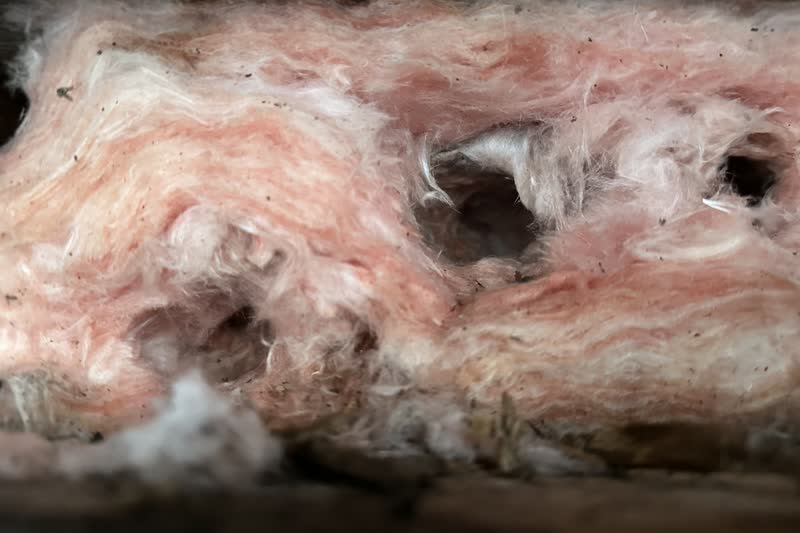
Roof water is one cause. A leak around a chimney, along a valley or at a vent pipe can soak the same patch of insulation through many storms before a stain reaches the ceiling. ENERGY STAR reads damp insulation as evidence of a roof leak to correct before any insulation work, so a roofer comes first. A bath fan whose duct stops in the attic can do similar damage from below, with every shower, so we carry that duct outside before the new layer goes in.
Then come animals. Trapping mice or squirrels and closing the gaps they squeeze through is a wildlife control company's work, and neither that nor roofing is something we do. Once the mice are gone, the fouled layer goes out by vacuum, and the attic is sanitized and deodorized before new insulation is laid. After a house fire, insulation that held on to soot or a smoky smell is vacuumed out too, rather than covered.
Every textile company in Burlington put up a mill village for its workers, and the city's 1984 National Register survey describes the typical mill house as a gable-roofed frame house of one or two stories, with a single-story ell at the back. Lakeside Mills' houses date from 1892 and 1893; all but three are a story and a half, each with a central chimney. A plan like that leaves the main block and the ell under separate roofs, so one house can have two attics.
For removal, that split can help. A leak over the ell, or mice that came in at its eaves, may have ruined the insulation back there and left the front attic sound. Then only the ell's layer is vacuumed out, and the front gets a top-up or nothing. A central chimney rises through the front attic; once the old layer around it is gone, the open ring at the brick gets aluminum flashing sealed with high-temperature caulk, and a sheet-metal dam keeps the fiberglass 2 inches off the masonry, the clearance codes usually ask for, ENERGY STAR notes.
Two finds stop the work. ENERGY STAR lists knob-and-tube wiring, used in houses wired before about 1930, as a possible fire hazard where it touches insulation, so an electrician sees it before any new fiberglass goes near it. Gray-brown or silver-gold granules may be vermiculite, and the EPA says to treat it as asbestos-bearing and leave it alone. We don't vacuum it; the job waits for an asbestos professional.
The South Broad-East Fifth Streets Historic District gained a group of 1920s bungalows, several faced in stone, and its 2001 nomination lists story-and-a-half, side-gabled bungalows with dormers among them. The upstairs rooms are tucked under the roof slopes, with wedge-shaped attics behind their short knee walls. Clearing a spoiled layer out of those wedges is slow, hands-and-knees work, and parts may be too tight to reach at all. The open framing under the knee walls gets sealed while it's bare.
Beverly Hills, northeast of downtown, was built up mostly between the late 1920s and the 1950s; the Minimal Traditional and Ranch houses of the 1940s and 1950s appear in its 2009 nomination, and the 1984 survey adds that houses of those decades were often brick-veneered. A ranch roof is pitched low, so the edge of the attic over the outside walls has very little height, and soiled insulation there is the hardest to get at. Once that edge is clear, baffles are set at the eaves to keep the soffit vents breathing above the new layer.
Not every removal empties the attic. When the damage sits in one place, such as under a leak or in the bays by the eaves where mice nested, only that section is vacuumed out, the good insulation beside it is left alone, and one new layer over the whole floor levels it. When droppings or smoke run through the whole attic, all of it comes out.
With the floor bare, the leaks are closed first: holes for wiring and pipes, ceiling fixtures, the attic hatch and interior wall tops, the leaks ENERGY STAR expects sealed before insulation. About half of Burlington's occupied homes heat with gas, the Census survey estimates, so a furnace or water-heater flue may cross the attic; its gap gets sheet metal and high-temperature caulk, not insulation, and the fiberglass stops short of the pipe. A dam frames the hatch so the loose-fill stays put.
Then the new layer. North Carolina's energy code puts Alamance County in climate zone 4, but the national map of 2021, which ENERGY STAR's chart follows, has it in zone 3. For a floor with nothing left on it, the chart gives R-60 for zone 4 and R-49 for zone 3, and your estimate names the target. Removal and refill appear as separate lines. Under the FTC's R-value Rule, the paperwork you get afterward must show the square footage covered, the installed thickness, the R-value and the bag count.
Each page has local notes on the homes and attics in that town.
Alamance County, about 3 miles to the northwest
About 8 percent of homes built before 1960; Burlington: about 28 percent
Attic insulation in ElonAlamance County, about 5 miles to the east
About 24 percent of homes built before 1960; Burlington: about 28 percent
Attic insulation in GrahamGuilford County, about 5 miles to the northwest
About 9 percent of homes built before 1960; Burlington: about 28 percent
Insulation contractor in GibsonvilleGuilford County, about 20 miles to the west
About 19 percent of homes built before 1960; Burlington: about 28 percent
Insulation contractor in GreensboroAlso in Alamance County: Alamance, Green Level, Haw River, Mebane, Ossipee, and Swepsonville. Every town in Alamance County. See all service areas.
Local service pages near Burlington: Attic Insulation Removal in Greensboro, Attic Insulation Removal in Summerfield, Attic Insulation in Jamestown, Attic Insulation Removal in High Point, Attic Insulation Removal in Archdale, Attic Insulation Removal in Asheboro, Attic Insulation in Durham, Attic Insulation in Trinity, Attic Insulation Removal in Kernersville, Attic Insulation in Greensboro, Attic Insulation in Summerfield, Attic Insulation in High Point, Attic Insulation in Archdale, Attic Insulation in Asheboro, Attic Insulation in Kernersville.
By the attic, so there's no figure on this page. The amount coming out sets the removal: floor area times depth. Batts and loose-fill are handled differently, a soiled layer takes more care, and a mill house's second attic or a bungalow's knee-wall wedges add time. A partial removal is measured on the section that comes out. The sealing, baffles and new fiberglass are the other half, or none of it if you only want the removal. The estimate costs nothing.
A wildlife control company goes first, to trap them and close the gaps they use; that isn't our work. Leave the fouled insulation alone until then. Once the mice are gone, we vacuum it out and the attic is sanitized and deodorized. Then fresh fiberglass goes onto a sealed ceiling. New insulation laid while mice can still get in just becomes their next nest.
Not on its own. A flattened layer that is dry and clean can stay under a top-up and counts toward the new depth. It comes out when it's too flat or too dirty to move aside for sealing and put back, or when it's wet, moldy, smelly or soiled by animals. Photos from the hatch help us tell which, and the estimate says plainly whether anything has to come out.
Not for the attic itself. A National Register listing, such as West Davis Street-Fountain Place or Beverly Hills, puts no limits on an owner spending private money, by the State Historic Preservation Office's account, and under state law a local historic district's commission reviews outside changes only. Taking insulation out and putting new in happens indoors. A new roof or soffit vent changes the outside, so check with the city before a roofer adds one.
Call or text 8 to 5, any day, or fill in the contact form. Give us the square footage, or just the address and we'll take the footprint from it, plus roughly when the house was built and what you've seen: a ceiling stain, droppings, a musty or smoky smell. Say if there's a back ell or upstairs knee walls, and send hatch photos if you can. That covers most attics; one that can't be judged that way gets a special visit before we price it.
Attic Insulation
Sound old attic insulation can stay under a fresh top-up. Wet, moldy, animal-soiled or smoke-damaged material cannot. Learn how to tell the difference, what removal involves and what to do about vermiculite.
Attic Insulation
There is no price list here, on purpose. See the seven things that move attic insulation cost up or down, why a per-square-foot number misleads and how to compare two written estimates line by line.
Census survey for Burlington, 2020 to 2024, Historic Resources of Burlington, National Register multiple resource nomination, 1984, Lakeside Mills District, National Register nomination, South Broad-East Fifth Streets Historic District, National Register nomination, Beverly Hills Historic District, National Register nomination, What is the National Register of Historic Places?, NC HPO, N.C. Gen. Stat. 160D-947, certificate of appropriateness, ENERGY STAR on hiring an attic insulation contractor, ENERGY STAR attic insulation project, ENERGY STAR attic air sealing project, ENERGY STAR on sealing furnace flues and chimneys, ENERGY STAR recommended insulation R-values, EPA on vermiculite insulation, FTC R-value Rule, 16 CFR 460.17 (October 2026). Compiled by Insulation Pros. How the town pages are made.
Burlington, NC
Open in Google Maps (opens in a new tab)Insulation Pros is an insulation contractor serving North Carolina, Burlington included. Most removals here can be priced from the house's square footage and a few photos.
Droppings at the eaves, a stain under the roof valley or a smoky smell upstairs in your Burlington house? Call, or send the square footage with a few hatch photos, and you'll hear how much has to come out. The estimate is free.
What You Can Count On
Insulation Pros just finished sealing and insulating the attic in our 4,500-square-foot home, and they did a really solid job. They were here for two full days and were careful about every detail—installing the insulation properly and sealing everything up tight. They also gave us the best price by a long shot. Nobody else came close. The whole time they made us feel like we were their only customer, which was nice. When they wrapped up, they cleaned everything so thoroughly it looked like they had never even been here. I could tell right away that the new insulation is helping keep the house cooler. … I'd recommend them 100% to anyone in the Lexington, NC area.
Jeremy S.
Attic Air Sealing & InsulationLexington area
… Needed insulation added and received Quick service, a friendly demeanor, and great prices! … They did great work and left things clean after work was done. Would recommend to anyone needing insulation services.
Ellen N.
Insulation Added
For some time I had issues with my home staying cool/heated. Insulation Pros came out and insulated my attic and crawl space. The guys were so polite and worked in a timely manner. Satisfied customer!
Daisy D.
Attic & Floor Insulation
Very impressed with the work they did. They came out to quote the job, and had the job completed within the week! Great turn around time and we did not have to wait. Very professional. Would recommend them to anyone!
Landon R.
Great job, very fast follow up, and scheduling. Good pricing…. Totally recommend this company for your insulation needs.
Bobby W.
Great job for a great price!
Dale B.
We serve homes across North Carolina. Listed here: the Triad area first, then the big cities.
Davidson County
Guilford County
Forsyth County
Rowan County
Across the State