Attic Insulation
Blown-in fiberglass attic insulation, added to the depth your home needs, to even out hot and cold rooms and cut wasted heating and cooling.
The Concord weather station logs about 61 days a year at 90 degrees or hotter, and a thin attic passes that heat to the rooms below. We seal the ceiling and attic ducts, then blow in fiberglass to an even depth. Free estimates.
NOAA's normals for 1991 to 2020 at the Concord station, less than half a mile from the city center, put the average summer high at about 90 degrees. Winter still has its turn: the station averages about 74 nights a year at or below freezing, and about 3,290 heating degree days against about 1,755 cooling degree days. For comparison, the cooling figure at the Statesville 2 NNE station, just outside Statesville, is about 1,260.
On a summer afternoon the air under a Concord roof runs far hotter than the air outside, and attic insulation doesn't cool it. What it does is slow how much of that heat comes down through the ceiling. Our blown-in insulation is loose-fill fiberglass, spread over the attic floor once the ceiling's air leaks are closed. Insulation Pros is an insulation company serving homes throughout North Carolina, Concord's among them.
See all of our insulation services in Concord.

Monday to Sunday 8:00 am to 5:00 pm.
Attic insulation, removal, air sealing and more. Open one to see how the work goes.
Blown-in fiberglass attic insulation, added to the depth your home needs, to even out hot and cold rooms and cut wasted heating and cooling.
Old, wet, matted or animal-soiled attic insulation vacuumed out, so new insulation can go in on a clean, sealed attic floor.
Sealing the gaps between your rooms and the attic, and leaky ductwork, so the air you pay to heat and cool stays inside.
Insulation blown into the closed walls of an existing house, batts in open walls for additions, remodels and new builds, and garage walls and ceilings.
Insulation for the garage ceiling under a bonus room, the wall shared with the house and the garage attic, with air leaks sealed first.
Floor insulation under the house: wet or fallen insulation pulled out, new batts between the floor joists, plastic over the dirt and the floor leaks sealed.
Savings vary. Find out why in the seller's fact sheet on R-values. Higher R-values mean greater insulating power. In blown-in fiberglass, the attic insulation we install, ENERGY STAR's estimating figure puts R-38 at about 15 inches and R-49 at about 20; the coverage chart of the product used gives the exact installed thickness for each R-value.
North Carolina's energy code places Cabarrus County in climate zone 3, and the Department of Energy's Building America guide to climate zones by county keeps it there on the 2021 national map. That leaves one row of ENERGY STAR's chart to read. For an existing house it's R-49 where the attic floor has no insulation, and R-38 added on top where 3 to 4 inches are already in place.
A new Concord house has to have R-38 over its ceilings under the state code, or R-30 when that thickness reaches all the way over the outside wall plates. Insulation already up there, if it's dry, is part of the total, so the fiberglass only has to make up the gap. Your estimate names the R-value and the settled depth it takes, and our R-value guide shows how inches and R-values line up.
Electricity heats about 52 percent of occupied Concord homes and piped gas about 46 percent, in the Census Bureau's 2020 to 2024 figures. Where the ductwork runs through the attic, it carries cooled air through the hottest space in the house all summer and heated air through one of the coldest all winter. A leak in a supply run spills that air into the attic. A leak in a return run does the reverse, pulling hot, dusty attic air into the system, which then blows it out through every register.
Duct sealing closes the joints, seams and register boots we can reach, with mastic or foil tape rated for ducts, before new fiberglass covers the attic floor. A run that's crushed or pulled loose needs repair by an HVAC contractor, and we flag it rather than tape over it. The joints are easiest to get at before the new layer goes in.
Close to two-thirds of Concord's housing went up in 1990 or later. The 2000s were the biggest decade, at about 22 percent of today's housing units, and the 2010s close behind at about 21 percent. Each of those attics got insulation when the house was built. What's worth knowing is how much of that layer is left, and whether it still reaches the edges.
A top-up starts with the openings the builder left in the ceiling: wiring and plumbing holes, the tops of interior walls, chases and the hatch. Baffles go in at the soffits so the vents keep breathing, and fiberglass is blown over the old layer until the depth matches from wall to wall. If the attic already meets its target, the estimate tells you that.
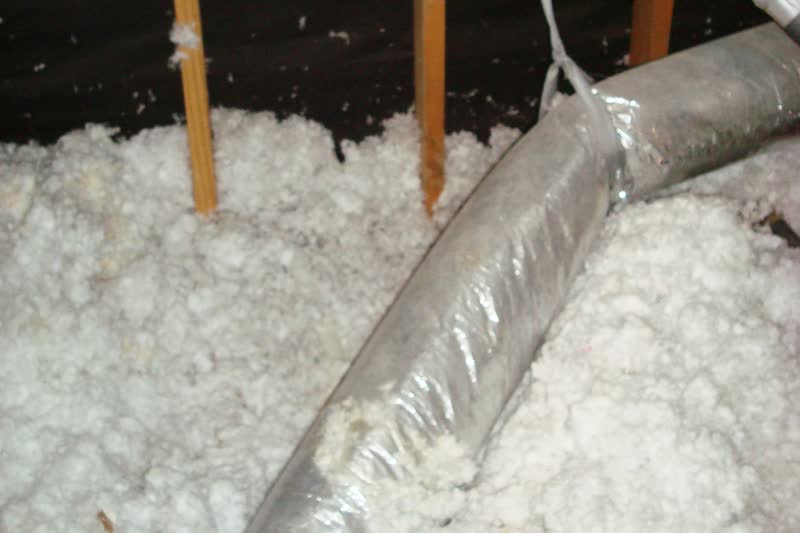
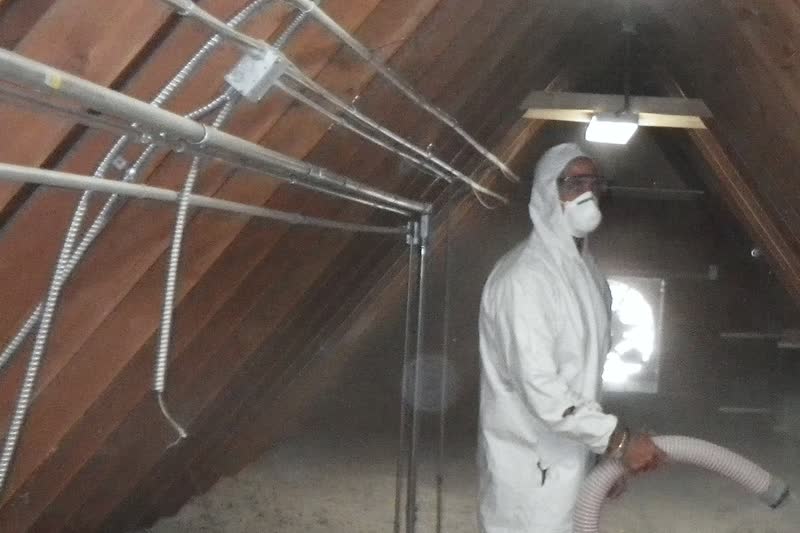
New insulation can go over old, ENERGY STAR advises, unless what's there is wet, moldy, smelly or fouled with animal waste. Those are the cases for attic insulation removal in Concord. A roofer repairs the leak behind a soaked layer, and a wildlife control company traps the animals and shuts their way in. Once the mice are gone, the ruined insulation is vacuumed out, the attic is sanitized and deodorized, and the bare ceiling gets sealed before the new fiberglass is blown in. If you want the old layer out and the attic left empty for now, that's a job we do as well.
Phone or text any day between 8 and 5, or use the contact form. The square footage of the house or the attic is what we price from, and if you only have the address, we figure the attic's size from the footprint. A few photos from the hatch and a line about the problem, such as an upstairs that runs hot by mid-afternoon, help too. Most Concord homes get their price with no appointment; the odd attic that can't be priced fairly unseen gets a special visit.
Your estimate lists the target R-value and the settled depth, with air sealing, duct sealing and any removal on separate lines, and ends with the total. Nothing on this page is a price, because each attic sets its own: the floor area, the depth there now, the leaks to close and any insulation that must be removed. Our cost guide covers each factor.
Each page has local notes on the homes and attics in that town.
6 miles north, in Cabarrus County
About 44 percent of homes built before 1980; Concord: about 28 percent
Insulation contractor in Kannapolis17 miles northwest, in Iredell County
About 14 percent of homes built before 1980; Concord: about 28 percent
Insulation company serving Mooresville21 miles northeast, in Rowan County
About 55 percent of homes built before 1980; Concord: about 28 percent
Insulation company serving Salisbury30 miles northwest, in Iredell County
About 48 percent of homes built before 1980; Concord: about 28 percent
Insulation contractor in StatesvilleAlso in Cabarrus County: Harrisburg, Midland, and Mount Pleasant. Every town in Cabarrus County. See all service areas.
Local service pages near Concord: Attic Insulation in Kannapolis, Attic Insulation in Charlotte, Attic Insulation in Mooresville, Attic Insulation in Salisbury, Attic Insulation in Albemarle, Attic Insulation in Statesville, Attic Insulation in Lexington, Attic Insulation Removal in Kannapolis, Attic Insulation Removal in Mooresville, Attic Insulation Removal in Salisbury, Attic Insulation Removal in Statesville, Attic Insulation Removal in Lexington.
That depends on who sends your power bill. Most of Concord is served by the city's own electric system, an ElectriCities member, and ElectriCities offers home energy audits to customers of its member towns; ask the city's utility office. Homes nearby and in other parts of Cabarrus County may be on Duke Energy Carolinas or Union Power Cooperative instead. Union Power has a free in-home energy audit for its members, and for Duke Energy's rebate the contractor must be in Duke's network. Each program has its own rules.
Start with Cabarrus County Property, Building and Development, the county's building office, or with the City of Concord. Either can tell you which office handles your address and whether insulation work alone needs a permit. Raise it before the work is booked, and mention any electrical, duct or roof work planned at the same time.
Two things. ENERGY STAR cautions that knob-and-tube wiring, in use until about 1930, can be a fire hazard when insulation covers it, so it waits for an electrician. Pebble-like granules that may be vermiculite aren't touched; the EPA's advice is to treat them as asbestos-bearing and leave them alone, so that's a job for an asbestos professional. About 6 percent of Concord's housing predates 1940, by the Census estimate. If either one might be in your attic, tell us when you call, since it may mean a special visit before pricing.
It can, as long as the batts are dry and clean. Mixing types is fine by ENERGY STAR, whose attic insulation guide says loose fill may be added over fiberglass batts or blankets. The ceiling leaks under the batts get sealed before anything is added. Then the blown fiberglass settles into the seams and gaps between them and covers the lot to one depth. Soaked, moldy, smelly or animal-fouled batts don't stay; they come out first, and that's attic insulation removal.
It can cut how much heat comes down through the ceiling, but it won't fix everything. Upstairs rooms also take in heat through windows, walls and leaky ducts, and some hot rooms come down to how the system's air reaches them, which is a question for an HVAC contractor. We'll tell you how much of the problem looks like the attic. Our guide on why your upstairs is so hot covers the other causes.
Both, with winter still the larger share. NOAA's 1991 to 2020 normals for the Concord station count about 3,290 heating degree days a year against about 1,760 cooling degree days, so the cooling load is more than half the heating load. One even layer does both jobs: it holds heat in the rooms in January and slows the roof's heat coming down in July. Where ducts run through the attic, sealing their joints matters in both seasons, because they carry heated air in winter and cooled air in summer.
Attic Insulation
There is no price list here, on purpose. See the seven things that move attic insulation cost up or down, why a per-square-foot number misleads and how to compare two written estimates line by line.
Attic Insulation
Start with the free checks, then work up through the attic: insulation depth, air leaks, ducts and roof heat. Each step says plainly whether it is a job for an HVAC technician or an insulation contractor.
Census survey for Concord, 2020 to 2024, NOAA 1991 to 2020 normals, Concord station, NOAA 1991 to 2020 normals, Statesville 2 NNE, Guide to Determining Climate Zones by County, PNNL for the U.S. Department of Energy (2022), ENERGY STAR recommended insulation R-values, North Carolina energy code (NC Office of State Fire Marshal), ENERGY STAR attic insulation project, ENERGY STAR on hiring an attic insulation contractor, EPA on vermiculite insulation, ElectriCities residential services, Union Power Cooperative, Audit My Home, Cabarrus County Property, Building and Development (October 2026). Compiled by Insulation Pros. How the town pages are made.
Concord, NC
Open in Google Maps (opens in a new tab)Insulation Pros is an insulation contractor serving North Carolina, Concord's older streets and newer subdivisions included. For most Concord attics, the size of the house is enough for a price.
Upstairs too warm by July in your Concord house? Send the square footage for a free estimate that covers what the attic needs and nothing else.
What You Can Count On
We serve homes across North Carolina. Listed here: the Triad area first, then the big cities.
Davidson County
Guilford County
Forsyth County
Rowan County
Across the State