Blown-In vs. Batt Insulation: Which Belongs in Your Attic?
For an open attic floor the usual answer is blown-in. Loose fibers flow around every wire, brace and odd-sized bay without being cut, and they go straight over the insulation already up there. Batts are the better tool somewhere else: in open walls, under floors, in garage ceilings, and in a few attic spots where loose fibers have nothing to rest on.
Insulation Pros does both. We blow fiberglass on attic floors, and we install fiberglass batts in open walls, in floors over crawl spaces and in garage walls and ceilings. So this guide is not a case for one product. It covers where each one fits, why batts can underperform in an attic, and where the two work together.

Batts and Blown-In: Same Fibers, Different Form
The material can be the same. Batts are blankets of fiber, such as fiberglass, cut to length and made in standard widths to fit between framing; rolls are the same blanket in one long strip. Blown-in, or loose-fill, is fiber in small pieces, fiberglass, cellulose or mineral wool, that a machine blows through a hose. The difference is how each one meets the space it has to fill. Our guide to fiberglass vs cellulose attic insulation compares the two common loose-fill materials.

ENERGY STAR's chart of insulation types sorts them by where they fit best:
- Batts and rolls: unfinished walls, floors and ceilings. ENERGY STAR rates the skill level as basic.
- Loose-fill and blown-in: unfinished attic floors, closed walls in existing houses, open wall cavities in new ones, and other hard-to-reach places. ENERGY STAR rates the skill level as intermediate.
- Both: ENERGY STAR adds that how well insulation performs depends heavily on the quality of the installation.
Why Blown-In Usually Wins on an Open Attic Floor
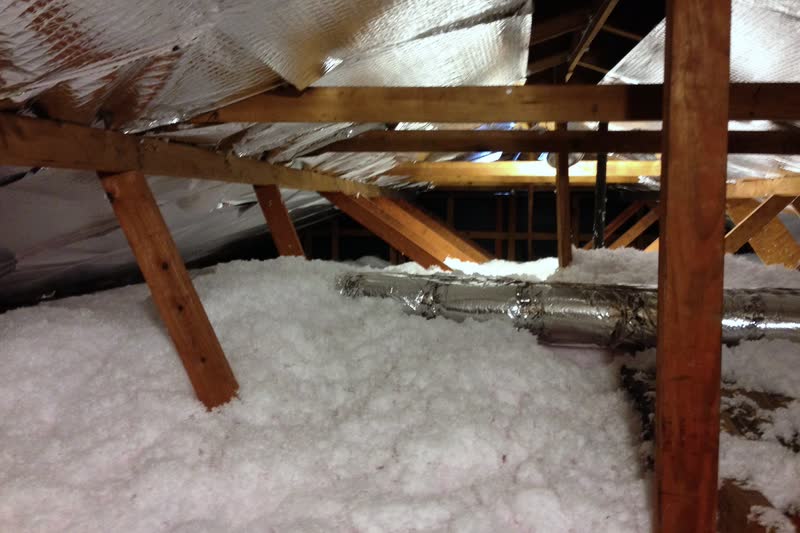
An attic floor is not always a neat row of empty bays. Wires run across the joists, junction boxes sit on the ceiling, braces and truss webs cut through, and in some older houses the joist bays are not the standard width a batt is made for. Every one of those spots has to be cut around by hand with batts, and every cut is a chance for a gap.

The Department of Energy's contractor guide puts the difference simply: the small particles of loose-fill fill the spaces behind and around obstacles such as electrical boxes, wiring and plumbing, where batts are hard to fit. Its section on vented attics adds that loose-fill usually gives better coverage than batts for that reason. For the steps of a blown-in job and the checks that go with it, see our guide to blown-in insulation.
Topping up over old batts
This is where blown-in is at its most useful. ENERGY STAR says new insulation does not have to match the old, and that loose-fill can go right on top of fiberglass batts. A blown layer also covers the tops of the joists, which batts laid between them leave bare. The Department of Energy recommends that covering layer to cut the heat that travels through the wood.
The old batts stay if they are dry and clean. The air leaks under them get sealed first. Batts lying with their paper facing up are the exception: the Department of Energy guide says not to put new insulation over them, because a facing between the layers can act as a vapor retarder and cause moisture and mold problems.
Rather Talk It Through Than Read?
Call (336) 780-7227Monday to Sunday 8:00 am to 5:00 pm.
Where Batts Go Wrong in an Attic: Gaps and Compression
A batt only performs at its label when it fills its space completely and keeps its full thickness. The Building America Solution Center's standard for a top-quality job, known as Grade I, is insulation installed without misalignment, compression, gaps or voids. It warns that gaps and squashed spots that pull the insulation away from the surface it is meant to cover can leave cold spots in ceilings, walls and floors, and that those cold spots can invite condensation.

The Department of Energy's contractor guide is blunter about attic floors. It says even small gaps between batts add up to a large drop in effective R-value, like holes in a blanket. Its rules for a batt job in an attic:
- Cut each batt to fit its bay exactly and run it out to the very edge of the attic floor.
- Keep each batt in full contact with the ceiling below and the framing on both sides.
- Cut or split batts around pipes, ducts and wires, never folding, tucking or pinching them.
- Lay a second layer across the tops of the joists, either batts running the other way or blown loose-fill.
Why squeezing a batt costs R-value
Fiber insulation works by holding still air, and a batt pressed flatter holds less of it. The Department of Energy's guide lists loss of R-value when compressed among the drawbacks of batts, and it also notes that air moves around and through batts that are not fitted carefully. In an attic the usual squeezers are boxes stored on top, foot traffic, a batt stuffed under a wire and a batt jammed into the tight wedge at the eaves. Our guide to attic storage over insulation covers how to keep the stored boxes and the R-value both.
What to look for in the batts you have
From the hatch, with a flashlight and without stepping off the framing, you can see the common faults:
- Gaps at the sides or ends of batts, or bays with no batt at all.
- Batts that stop short of the outside wall, leaving the edge of the ceiling bare.
- Batts riding up over wires and pipes instead of being split around them.
- Flattened areas under stored boxes or along a path people walk.
- Batts with the paper facing up, which should not be buried under new insulation.
Where Batts Belong in a House
Batts are at their best where the framing is open, regular and easy to reach, and where the insulation has to stay put on a wall or under a floor. Loose fibers cannot do that. Open garage walls are a good example, and our guide to insulating garage walls and ceilings covers them. These are the jobs where we install batts:
- Open walls. In an addition, a remodel or a new build, batts go into the bare studs before the drywall, each one cut to its cavity and around wires and boxes.
- Floors over a crawl space. Batts go up between the floor joists, held tight against the subfloor.
- Garage walls and ceilings. The wall the garage shares with the house and a garage ceiling under a room take batts while the framing is open.

The attic spots where batts fit
Even in an attic that gets blown-in, a few places call for a blanket or a board instead. The site's other guides cover each one:
- Knee walls. The short walls of a room under the roof are vertical, so loose fibers would slide off. Batts can fill them, but only with blocking at the top and bottom and a rigid air barrier over the attic side.
- The attic hatch. Loose fibers cannot stay on a lid that opens, so the hatch gets weatherstripped and a piece of rigid foam board, or fiberglass, is fastened to its back. Our attic hatch guide covers how.
- A small do-it-yourself top-up. ENERGY STAR says laying fiberglass rolls is the easiest choice for a do-it-yourself attic job. A second layer goes across the joists, unfaced, over a first layer that already fills the bays.
Using Blown-In and Batts Together
An attic can end up with both, and that is fine. ENERGY STAR says loose-fill can go over batts and batts over loose-fill, as long as any batt laid on top is unfaced, with no paper or foil backing. A finished attic over a bonus room might have batts in the knee walls, board on the attic hatch and blown fiberglass across the open floor.

Two rules keep a mixed attic working. The air leaks get sealed before either material covers them, because neither batts nor loose-fill stops air. And a heavier layer should not go over a lighter one that squashes easily, which the Department of Energy guide says lowers the lower layer's R-value. Blown fiberglass over old fiberglass batts is a light layer over a light one, which is why it makes an easy top-up.
What Insulation Pros Installs, and Where
In attics we blow loose-fill fiberglass, as a full new layer or as a top-up over sound insulation, with the air sealing, baffles and dams done first. When the old layer is wet, matted or soiled by animals, we vacuum it out before the new one goes in. We blow fiberglass, not cellulose; our guide to fiberglass vs. cellulose attic insulation explains the differences, including when cellulose is the better pick.

Outside the attic we install batts in open walls, floors over crawl spaces and garage walls and ceilings, and we blow fiberglass into the closed walls of existing houses. Our garage insulation and crawl space insulation pages cover those two jobs in detail.
We do not install spray foam; our guide comparing spray foam with blown-in insulation covers the jobs where it fits. Most attics are priced from the home's square footage, and the estimate is free.
Get a Free Estimate
Batts in the attic that never seem to work, or a wall that's open right now? Tell us which, plus the square footage, and we'll price blown fiberglass for the attic floor or batts for the open framing, whichever fits.

Prefer to talk? Call (336) 780-7227.