Fiberglass vs. Cellulose Attic Insulation: Which Fits Your Attic?
On an open attic floor, fiberglass and cellulose both work. Blown to the same R-value over a ceiling that has been sealed, either one will slow heat the way it should. The differences between them are real, but they are narrower than they can be made to sound, and they only start to matter in certain attics: one with a history of roof leaks, one under a low roof, one sitting on an old ceiling, or a house where someone is bothered by dust.
We should say where we stand before going further. At Insulation Pros we blow fiberglass, and we do not install cellulose, so we have a side in this question. That is why this guide sticks to what ENERGY STAR, the U.S. Department of Energy and building-science writers say about each one, and why it spells out the cases where cellulose is the better pick. It ends with a way to compare a fiberglass quote with a cellulose quote fairly.

What Fiberglass and Cellulose Are Made Of
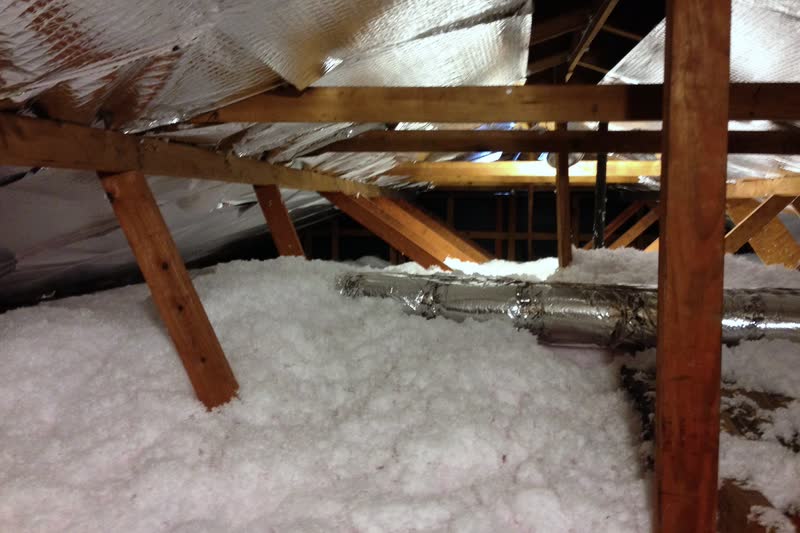
Both come as loose fibers packed in bags, and both go into an attic the same way: a machine fluffs them up and a hose carries them across the floor. ENERGY STAR's chart of insulation types lists cellulose, fiberglass and mineral wool as the loose-fill materials and names unfinished attic floors as one of the places they suit best. What sets the two apart is what the fibers are. Fiberglass also comes as batts, and our guide to blown-in vs batt attic insulation compares the two forms.

Loose-fill fiberglass is glass, melted and spun into fine strands. It is light and fluffy, white, pink or yellow, and a Department of Energy guide written for contractors says it can contain 30 percent or more recycled glass. Cellulose is paper. The same guide describes it as old newsprint shredded fine, with at least 70 percent recycled paper in it, and chemically treated so it holds up against fire, mold, corrosion and pests. It is gray, and denser than loose fiberglass.
The table below sets the main points side by side. Each one gets its own section further down.
| Point | Fiberglass | Cellulose |
|---|---|---|
| Made of | Spun glass fibers | Shredded paper, chemically treated |
| Weight | Light | Denser and heavier |
| Getting wet | Holds up better to moisture | Can soak up a lot of water |
| Fire | Glass does not burn | Treated with a fire retardant |
| Install day | Wear gear against fibers on skin, eyes and lungs | Blowing loose-fill of any kind is dusty |
| Settling | Bag lists its settled thickness | Bag lists its settled thickness |
| Who blows it here | Insulation Pros | Other contractors |
How Each One Is Installed in an Attic
The work around the material is the same for both. The ceiling leaks get sealed, baffles go in at the eaves, dams go around the hatch and the flues, depth rulers are fixed to the framing and the insulation is blown out to an even depth. Our guide to blown-in insulation walks through those steps one at a time. Where the two materials differ is in the warnings that come with each one.

The Department of Energy's contractor guide gives one for each:
- Fiberglass: a blowing machine can over-fluff it in an attic. Blown too airy, it ends up with less density and less R-value than the bag promises, so the installer has to put in the full number of bags the chart calls for.
- Cellulose: it has to be kept away from chimneys and metal flues, and it cannot go in until a contractor experienced in mold cleanup has cleared any mold problem.
- Both: the guide warns that loose-fill can have settling problems if it is not put in properly, which the next section covers.
Rather Talk It Through Than Read?
Call (336) 780-7227Monday to Sunday 8:00 am to 5:00 pm.
Settling: Read the Settled Depth on the Bag
Every loose-fill layer sinks a little after it is blown in. That is normal. The trouble is a layer that was blown too light to begin with: the Department of Energy guide says insulation installed below the maker's recommended density will settle excessively and end up with a lower R-value.

You will find plenty of claims online about which of the two settles more. The federal sources this guide relies on do not rank them, and you don't need them to, because the bag answers it for the product being quoted. The Federal Trade Commission's insulation rule makes every loose-fill label list, for a range of R-values, the thickness when first installed, the minimum thickness once it has settled, how many bags 1,000 square feet takes and the minimum weight per square foot. Two products can settle by different amounts, and each label already allows for its own.
So hold each quote to the settled depth on its own bag, not to the depth on install day. And watch the bag count: the label's weight per square foot is the density check, and a job that uses fewer bags than the chart lists for that area and R-value is short of material.
For a rough sense of the depths involved, ENERGY STAR's estimating figures put R-38 at about 15 inches of loose-fill fiberglass or about 10 inches of cellulose. The chart on the bag gives the exact figures for the product in your quote.
Savings vary. Find out why in the seller's fact sheet on R-values. Higher R-values mean greater insulating power. In blown-in fiberglass, the attic insulation we install, ENERGY STAR's estimating figure puts R-38 at about 15 inches; the coverage chart of the product used gives the exact installed thickness for each R-value.
Wet Insulation and Roof Leaks
This is the biggest practical difference between the two. The Department of Energy's contractor guide credits fiberglass batts with excellent moisture resistance, and loose-fill fiberglass is the same glass. Of cellulose it warns that a leak or high humidity can make it take up large amounts of water, which cuts its insulating value, can wash out its fire retardant and puts the wood around it at risk of mold and rot.

Neither one insulates well while it is soaked, and neither one fixes the leak. A roofer or a plumber fixes the roof or the plumbing first, and a bath fan that empties into the attic gets its duct run outdoors, whatever goes on top. Our guide to blown-in insulation covers when a wet patch can dry out and stay and when it has to come out. For choosing between the two, the takeaway is simple: in an attic that has leaked before, fiberglass is the more forgiving material once a roofer or a plumber has repaired the leak.
Weight on an Older Ceiling
Cellulose is the heavier of the two. The Department of Energy's table for identifying old insulation calls loose fiberglass lightweight. You don't have to guess at the difference: every bag label lists the minimum weight per square foot for each R-value, so the two products can be compared directly.

On a sound drywall ceiling this is rarely a problem. Drywall makers publish limits on how much insulation a new ceiling panel should carry, and Green Building Advisor, a building-science publication, looked at them for thick cellulose and concluded that even a deep layer should not make a drywall ceiling sag. Where to be careful is a ceiling that is already in poor shape: one that sags between joists, has cracked or loose plaster or shows old water stains. Have that looked at and repaired before any new layer goes on, light or heavy.
Weight also matters to the insulation underneath. The Department of Energy guide says a denser material should not go on top of a lighter one that squashes easily, because pressing it down lowers its R-value. Blowing fiberglass over old cellulose is fine. Blowing cellulose over old, fluffy fiberglass squeezes it, and the new layer has to make up the difference.
Dust and Itch on Install Day
The Department of Energy guide lists dust among the drawbacks of every blown-in loose-fill. For fiberglass it adds two points. Blown fiberglass makes little dust as it goes in, but the installer still needs protection against breathing the fibers and against fibers on the skin and in the eyes. And the insulation must be fully closed off from the house, so glass particles cannot find their way into the rooms below.

ENERGY STAR's attic insulation project lists the gear for anyone working up there: safety glasses, gloves, a dust mask, a cap, and a lightweight disposable coverall to keep itchy, irritating insulation off the skin. For a homeowner, the practical points are the same with either material:
- Stay out of the attic while the blowing is going on.
- Keep the hatch closed and the gaps around it sealed, so fibers stay on the attic side.
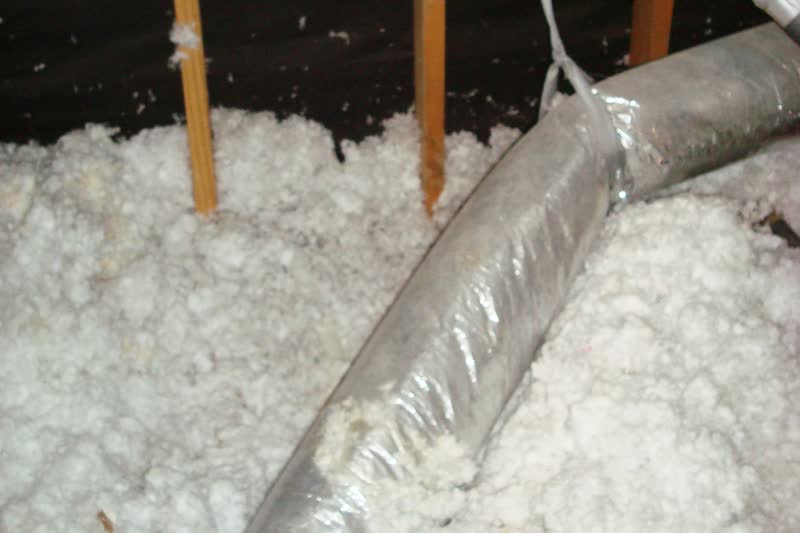
- Have the ducts in the attic sealed first. The Department of Energy guide asks for this before either material goes in, so fibers are not drawn into the system that blows air into your rooms.
- If someone in the house is sensitive to dust, say so before install day and ask how the work area will be closed off.
Fire Treatment and Clearances
Glass does not burn, and the Department of Energy's contractor guide calls blown fiberglass non-flammable. Cellulose starts out as paper, so it needs a chemical fire retardant. The same guide notes that treated cellulose can still smolder if it gets hot enough, and that water can drain the treatment out. Federal rules also give cellulose a flame-resistance standard and a warning label of its own, which our guide to blown-in insulation covers.

Non-flammable does not mean anything goes. With either material, the Department of Energy says to keep insulation away from chimneys and metal flues and not to bury recessed lights unless they are rated for it. ENERGY STAR's rule is at least 3 inches of clearance from can lights that are not IC rated. So the clearances, the dams and the light covers are part of the job whichever material is quoted.
Does Cellulose Stop Air Better Than Fiberglass?
You may hear that cellulose blocks air movement and fiberglass lets it through. On an open attic floor, the federal guidance does not back that up. The Department of Energy's contractor guide says plainly that most insulation does not stop airflow. It gives some air-sealing ability only to dense-pack: fibers of either kind, cellulose or fiberglass, blown tightly into a closed wall or ceiling cavity. A loose layer lying on an attic floor is not packed that way.

So the answer is the same with either one. Air leaks through the ceiling, around pipes and wires, along the tops of interior walls and at chases, get sealed before the insulation buries them. ENERGY STAR's attic air sealing project puts that step first, and our guide on why air sealing comes before insulation explains the reasons. A quote that leans on the material to do the air sealing is skipping that step.
When Cellulose Is the Better Pick
We blow fiberglass, but cellulose is a sound material, and in some attics it is the better fit. Cellulose makes sense when:
- The roof is low. Near the eaves or in a shallow attic, depth is tight, so compare the two bag charts at your target R-value. The product with the lower settled depth fits better, whichever one it turns out to be.
- Recycled paper matters to you. Both have recycled content, but the Department of Energy puts cellulose at 70 percent or more recycled paper.
- Your chosen contractor works in cellulose and the quote is complete. ENERGY STAR notes that insulation performance depends heavily on the quality of the installation. A careful cellulose job beats a careless fiberglass one.
When fiberglass is the safer bet
Fiberglass leans ahead when the attic has a leak history, when the ceiling below is old or weak, when the new layer goes over old fluffy fiberglass that a heavier layer would squash, and when the attic holds chimneys and flues, since glass does not burn and treated cellulose can still smolder. The clearances still apply to both. In an attic with none of these concerns, either material at the same R-value does the job, and the prep matters more than the choice.
Spray foam is not part of this choice
Spray foam is not a loose-fill material, so it does not belong in a fiberglass-or-cellulose comparison. The Department of Energy's contractor guide lists it for places such as the roof deck and the tight edges of a vented attic, where fiber insulation cannot reach full depth. Insulation Pros does not install spray foam; our guide comparing spray foam with blown-in insulation explains how the two differ.
How to Compare a Fiberglass Quote With a Cellulose Quote
Inches may not match between the two, and they are not supposed to. Each product's coverage chart sets its own depth for each R-value. To compare the quotes fairly, fix everything else and let the bag do the converting:
- Same R-value. Ask both companies to price the same finished R-value. The R-value guide listed below gives the targets for each North Carolina climate zone.
- Same area. Both should cover the same square footage, with any attic over a garage or porch named as in or out.
- Both depths. Ask for the installed depth and the settled depth, and check them against the bag chart for that R-value.
- Bag count. Ask how many bags the job takes. The chart gives bags per 1,000 square feet, so the count follows from the area.
- The prep. Air sealing, baffles, dams and the hatch should be named in both, or plainly left out of both.
What the receipt has to show
After a loose-fill job, the FTC's insulation rule requires the installer's receipt to state the area covered, the initial installed thickness, the minimum settled thickness, the R-value and the number of bags used. A good quote states ahead of time what that receipt will state afterward, so the two can be checked against each other. Our guide to attic insulation costs goes through the rest of a quote line by line.
Get a Free Estimate
Comparing materials, or holding a cellulose quote? Tell us the attic's square footage and the R-value you're after, and we'll price it in blown fiberglass, with the bags, the settled depth and the prep written out.

Prefer to talk? Call (336) 780-7227.