Why Is My Electric Bill So High in Winter? A North Carolina Checklist
Why is my electric bill so high in winter? In a North Carolina home it often comes down to three things at once: cold weather that keeps the heat running longer, backup heat that switches on when a heat pump falls behind, and a house that lets warm air escape through the attic. Electricity heats most homes here. In the U.S. Energy Information Administration's (EIA) 2020 survey of home energy use, 62 percent of North Carolina homes heated mainly with electricity, against 34 percent nationwide, and 38 percent heated with a central heat pump, against 13 percent nationwide. So when it turns cold in this state, it shows up on the electric bill.
Savings vary. Find out why in the seller's fact sheet on R-values. Higher R-values mean greater insulating power.
This checklist goes in the order that finds the cause fastest: the bill itself, the weather and the price, the heat pump, then the house. Insulation Pros works on the attic side of the problem: attic insulation, air sealing and duct sealing. We do not repair heat pumps or furnaces, and when the clues point to the equipment, this guide says so.

Start With the Bill: Compare Kilowatt-Hours With Last Winter
The dollar total mixes two things: how much electricity you used and what each unit cost. Find the kilowatt-hours, shown as kWh, and compare them with the same month last winter, not with October. A January bill in a house with electric heat can be far higher than an autumn bill and still be normal for that house.

Two adjustments make the comparison fair:
- Days in the billing period. A 33-day bill has four more days of heating in it than a 29-day bill. Divide the kWh by the days to get a daily figure.
- Actual or estimated reading. If the bill marks the meter reading as estimated, the next actual reading can catch up all at once, and one bill carries two months of cold.
Where do I find last winter's usage?
Look for a usage chart on the bill or a usage history in your online account, or ask the utility. A full year of history shows your normal winter peak, so you can tell an unusual January from an ordinary one.
Cold Snaps and Longer Heating Run Times
Heating follows the cold. EIA measures it with heating degree days: for each day, the number of degrees the average temperature falls below 65 degrees Fahrenheit. EIA says a heating degree day indicates a cold day and measures how much heating a building needs to stay warm. A week of nights in the teens piles up far more of them than a week of mild rain, and the heat runs more hours with the thermostat exactly where it was.

Duke Energy says January is historically the peak month for energy use, as heating systems work harder to keep homes comfortable. Its January 2026 tips for customers in the Carolinas put the reason plainly: as temperatures fall, heating systems must work longer.
Winter brings other loads too. Longer nights mean more hours of lighting, holiday lights add up, people spend more time at home, and a houseful of guests over the holidays shows on the meter. Write down anything new before you blame the house.
Do space heaters raise the electric bill?
They can. A plug-in electric space heater turns electricity straight into heat, the same way a heat pump's backup heat does. Its wattage is printed on the label: a 1,500-watt heater running for eight hours uses 12 kWh. Multiply that by your price per kWh and by the days it runs. And if one room needs a space heater all winter, that room is telling you something about the house.
Rather Talk It Through Than Read?
Call (336) 780-7227Monday to Sunday 8:00 am to 5:00 pm.
Electricity Prices: Compare Your Price With Last Winter
The price matters as much as the usage. EIA's Electric Power Monthly for March 2026 put the average price for North Carolina homes at 13.68 cents per kWh in January 2026, up from 12.51 cents in January 2025. That is about 9 percent more for every kWh, so a home that used exactly the same electricity in both Januaries still paid more. EIA marks its 2026 figures as preliminary.

Prices go up again in 2027. Duke Energy's 2027 rate increase, which the North Carolina Utilities Commission approved on November 16, 2026, takes effect on January 1, 2027, with a second step on January 1, 2028. It covers Duke customers only: homes that get their power bill from an electric co-op or a city system follow that utility's own rates.
Your own price will differ, because EIA's figure is an average across every utility in the state and who sets your rate depends on who serves your address. To find yours, divide the electricity charges on the bill by the kWh, and do the same for the same month last winter. Our guide to a high summer electric bill walks through the bill's line items and who regulates which rates.
The table shows EIA's averages, in cents per kWh, for North Carolina homes and for the country:
| Month | North Carolina | United States |
|---|---|---|
| January 2025 | 12.51 | 15.94 |
| January 2026 | 13.68 | 17.45 |
| February 2025 | 14.19 | 16.43 |
| February 2026 | 14.64 | 17.65 |
Heat Pumps, Backup Heat and Emergency Heat
A heat pump heats the house by moving heat from the outdoor air indoors. Most also have a backup. The Building America Solution Center, a U.S. Department of Energy resource, describes heat pump auxiliary heating as typically electric resistance heat and calls it costly. It comes on when the heat pump alone cannot keep up, and when it runs for long stretches, the bill shows it.

Three things commonly bring the backup on:
- A big jump on the thermostat. Raising the setting several degrees at once can call the backup to close the gap. Carolina Country, the magazine of North Carolina's electric cooperatives, advises raising a heat pump's setting one degree at a time.
- A deep setback with the wrong thermostat. The Building America Solution Center says a programmable thermostat for a heat pump should have adaptive recovery, which warms the house back up gradually with the heat pump alone. Duke Energy's advice for heat pumps is a moderate setting, or a programmable thermostat made for heat pumps.
- The Emergency Heat setting. Emergency heat runs the backup on its own. Carolina Country says to leave the thermostat in Heat mode and to select Emergency Heat only when heat is needed in an emergency.
How do I know if the backup heat is running?
Many heat pump thermostats show a word such as Aux or Em Heat on the screen while the backup is on. Some backup on the coldest nights is part of how the system was built to work. If you see it on mild days, or the system runs for hours without catching up, have an HVAC technician check the heat pump and its controls. That is their work, not ours.
Frost on the outdoor unit
Carolina Country says a small amount of frost on the outside of a heat pump is normal at or around freezing, and that the unit defrosts itself a few times an hour in cold weather, sometimes with odd noises. Visible ice on the copper lines between the outdoor unit and the house is not normal, and it says to call an HVAC company if you see it.
The House: Warm Air Escaping Through the Attic
If your daily kWh rose more than the cold and the price can explain, look at the house, beginning with the attic. ENERGY STAR's guide to sealing and insulating describes what happens in cold weather: warm air rises in the house the way it does in a chimney, escapes into the attic and pulls cold air in all around the house, around windows and doors and through holes lower down. The heat you paid for leaves through the ceiling, and the system runs longer to replace it. If the second floor also runs colder than the first, our guide on why the upstairs is so cold in winter covers that side.

With a heat pump, that matters twice. The faster the house loses heat, the sooner the heat pump falls behind on a cold night and the backup takes over. Three things in the attic decide how fast that happens.
Air leaks in the attic floor
Gaps around ceiling lights, wire and pipe holes, the attic hatch or pull-down stairs, and the chases around flues and ducts all let heated air up into the attic. A Department of Energy guide to air sealing puts the payoff from sealing uncontrolled air leaks at 10 to 20 percent of heating and cooling bills. Sealing comes before new insulation, because the holes are hard to reach once they are buried. Our guide on why air sealing comes before insulation explains the order of work.
Thin or uneven insulation
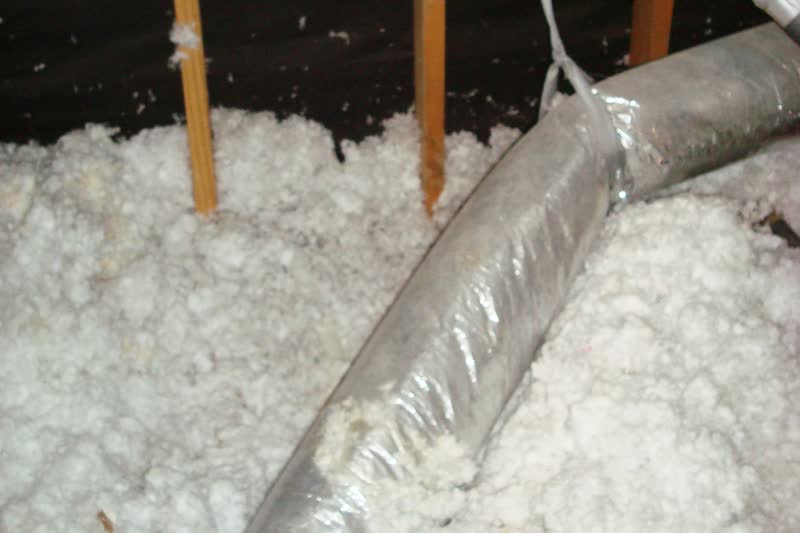
Insulation slows the heat moving up through the ceiling into the cold attic. ENERGY STAR's quick test: if the insulation is level with or below the attic floor joists, so you can easily see the joists, you should add more. Our guide on how to tell if your attic needs more insulation shows how to check the depth safely, and the R-value guide lists the target for every North Carolina county.
Leaky ducts in a cold attic
If your air handler or ducts are in the attic, your heated air travels through it. ENERGY STAR says that in a typical house about 20 to 30 percent of the air that moves through the duct system is lost to leaks and poorly connected ducts, and it lists high summer and winter utility bills and ducts located in an attic among the signs of a duct problem. In January, that lost air is heated air spilling into a cold attic. A Department of Energy guide adds that return ducts with holes can draw in cold outside air.
Duct sealing on the runs you can reach is attic work we do. Resizing or replacing a duct system is a job for an HVAC contractor. Heat also leaves through the floor of a house over a crawl space, and our guide to insulating floors over a crawl space covers that side.
A 20-Minute Checklist for a High Winter Bill
Work through this with this winter's bill and last winter's in hand. Each step either explains the bill or narrows down where to look next:
- 1. Compare daily kWh. Divide the kWh by the days in the billing period, for this bill and for the same month last winter.
- 2. Work out your price. Divide the electricity charges by the kWh on each bill. A higher price explains a higher bill at the same usage.
- 3. Note the weather. Was this month colder than the same month last year, or did it include a hard cold snap?
- 4. List anything new. A space heater, holiday lights, more people at home, a new appliance or an electric car.
- 5. Check the filter. Duke Energy says a dirty filter makes a heating system work harder. Replace it if it looks gray or clogged.
- 6. Check the thermostat. Heat mode, not Emergency Heat, and with a heat pump, no deep setbacks unless the thermostat is made for it.
- 7. Look at the outdoor unit. A little frost near freezing is normal. Ice on the copper lines, or a unit that never stops, is a call for an HVAC technician.
- 8. Feel for drafts. Around the attic hatch, ceiling lights, outlets on outside walls, windows and doors, on a cold, windy day.
- 9. Look from the attic hatch. Can you see the joist tops? Are there bare spots, dark dirty patches in the insulation or loose ducts? Take photos and stay on the joists. If you see loose gray-brown or silver-gold granules, back out and leave them alone, since that can be vermiculite.

Finding the drafts
Drafts are easiest to find on exactly the kind of day that runs up the bill. Our guide to finding drafts room by room covers a simple smoke test from the Department of Energy and what each leak usually means.
Still Cannot Explain the Bill? Have the House Tested
If the cold and the price do not explain the bill, and you cannot tell whether the cause is the house or the heat pump, a home energy audit is the next step. The Department of Energy's consumer guide names the blower door test, which measures how leaky a house is, and the infrared scan, which shows differences in temperature along walls and roofs and around windows and doors, as the two most common techniques.

Look for a free option first. Duke Energy's Home Energy House Call is a free in-home energy assessment for qualified customers that comes with free energy-saving products, and Duke's page says eligibility depends on the type of assessment. Co-ops and town utilities may have programs of their own. Our rebate and utility finder shows which utility serves your town and what each one offers.
Our audits are a paid service, so ask what one would include for your house. If a look from the hatch already shows bare joists and open holes, you probably don't need an audit to know where to start. Tell us the attic's square footage and we'll price the attic work instead. That estimate is free.
Which Fixes Make Sense First
Start with what is free, fix the attic next, and replace equipment last:
- 1. Free changes. Heat mode instead of Emergency Heat, small thermostat changes, a fresh filter, blinds and curtains open on sunny days and closed at night, and ceiling fans run clockwise to push warm air down, as Duke Energy suggests.
- 2. A heat pump check if one is due. An HVAC technician can check the backup heat controls, the defrost and the refrigerant.
- 3. Seal the attic floor and the ducts. Close the holes between the attic and the rooms, and seal the duct joints you can reach.
- 4. Bring the insulation up to depth. An even layer over the sealed floor, with the soffit vents kept clear.
- 5. Replace equipment last. Sized for the house as it is after the attic work.
How much difference will the attic work make?
Nobody can promise a number for your house. It depends on how thin and leaky the attic is now, whether the ducts run through it, what you pay per kWh and how often the backup heat runs. Rebates can help with the cost, and our guide to insulation rebates in North Carolina covers Duke Energy's program and the state's. The attic work does not have to wait for spring, either. Our guide on whether you can install attic insulation in winter explains how a cold-weather job goes.
Get a Free Estimate
Heat running all day and the bill still climbing? Tell us the attic's square footage, or let us work it out from your home's footprint, and we'll price the sealing and insulation. If it sounds like the heat pump itself, we'll say so.

Prefer to talk? Call (336) 780-7227.