Duke Energy's 2027 Rate Increase in North Carolina: What Changes and Who It Affects
Duke Energy's North Carolina electric rates go up on Jan. 1, 2027. The North Carolina Utilities Commission approved the increase on Monday, Nov. 16, 2026, for both of Duke's North Carolina utilities, Duke Energy Carolinas and Duke Energy Progress, and its orders add a second step on Jan. 1, 2028. Duke puts the average yearly increase for residential customers over the two years at 4.8 percent for Duke Energy Carolinas and 4.7 percent for Duke Energy Progress. For a typical residential customer using 1,000 kilowatt-hours a month, Duke projects an increase of $6.53 on Jan. 1, 2027 for Duke Energy Carolinas customers and $9.62 for Duke Energy Progress customers.
This guide sets out what was approved, which homes it reaches and which it doesn't, how to read your own change off your bill, and the attic checks that cut the kilowatt-hours a house uses at any price. Insulation Pros is an insulation company, not a utility, and has no part in setting rates. Every figure here comes from Duke's announcement, the Commission or the U.S. Energy Information Administration (EIA), and each one is linked under Sources at the end.

What the Utilities Commission Approved
The Commission ruled in Duke's two North Carolina rate cases: docket E-7, Sub 1329 for Duke Energy Carolinas and docket E-2, Sub 1380 for Duke Energy Progress. Duke announced the outcome on Nov. 17, 2026 and linked both orders. The table gives Duke's summary of them.

Duke's announcement also gives its own figures for a typical residential customer using 1,000 kilowatt-hours a month: "a projected increase of $6.53 on Jan. 1, 2027, and $4.66 on Jan. 1, 2028, for Duke Energy Carolinas customers and a projected increase of $9.62 on Jan. 1, 2027, and $5.89 on Jan. 1, 2028, for Duke Energy Progress customers." These are Duke's projections for its example home, not our prices and not a forecast for your house: what you pay depends on how much electricity you use and on your rate schedule, and the 2028 step comes on top of the 2027 one. A few news reports printed the two utilities' figures the other way round; the figures here are copied from Duke's announcement, linked under Sources.
The orders also set a new rate schedule for data centers with loads above 50 megawatts, with upfront payments and other terms that Duke says are meant to insulate existing customers from the cost and financial risks of new data centers. And they approve new funding from Duke Energy shareholders to help customers in need.
| Duke Energy Carolinas | Duke Energy Progress | |
|---|---|---|
| Average yearly increase over two years, all customers | 3.7% | 3.4% |
| Average yearly increase over two years, residential customers | 4.8% | 4.7% |
| First step | Jan. 1, 2027 | Jan. 1, 2027 |
| Second step | Jan. 1, 2028 | Jan. 1, 2028 |
| Duke's projected increase for a typical home using 1,000 kWh a month, Jan. 1, 2027 | $6.53 | $9.62 |
| Duke's projected increase for the same home, Jan. 1, 2028 | $4.66 | $5.89 |
| Who it serves, per Duke | About 2.3 million households and businesses in Central and Western North Carolina | About 1.6 million customers in Central and Eastern North Carolina and the Asheville region |
Why are there two sets of figures?
Duke runs two utilities in North Carolina, Duke Energy Carolinas and Duke Energy Progress, each with its own rates and its own rate case. Duke says Duke Energy Carolinas' area includes Charlotte and Durham.
The two become a single utility on Jan. 1, 2027, but Duke says their rates stay separate for now and will blend gradually, at a pace the Commission sets in later rate cases and rider filings. Duke's page on the combination says your bill will still come from Duke Energy and that you don't need to switch rates or do anything because of it. If you aren't sure which of the two serves your address, your online account or Duke's customer service can tell you.
Will my own change be bigger or smaller than the average?
It follows your use. A month with more kilowatt-hours carries more of the increase and a lighter month less, depending on how the new rates split between the fixed monthly charge and the price per kilowatt-hour. A house with electric heat can use far more electricity in January than in a mild month, which is why the sections below matter.
Is Your Home on Duke? City Power and Co-ops Are Not Part of This
These orders set Duke's rates and no one else's. The Utilities Commission says it regulates all aspects of service from the investor-owned utilities, such as Duke Energy and Dominion Energy North Carolina, but does not regulate the retail rates of electric membership corporations or municipally owned electric systems. If a co-op or a city sends your power bill, this increase is not yours; watch that utility's own notices.

Lexington and High Point, for example, run their own electric systems and are members of ElectriCities, the group that serves North Carolina's public power cities. A home that pays its power bill to one of those cities is not a Duke customer.
Utility lines don't follow town limits, so the name on your bill is the only sure answer. For some of the towns we serve, this is who supplies most homes, from the utility territory maps and the ElectriCities member list we use for our town pages:
| Town | Electric utility for most homes | Does Duke's 2027 increase apply? |
|---|---|---|
| Thomasville | Duke Energy Carolinas | Yes |
| Lexington | City of Lexington (ElectriCities member); some homes around the city are on Duke or EnergyUnited | Not for city customers |
| High Point | City of High Point (ElectriCities member); some homes around the city are on Duke | Not for city customers |
| Greensboro | Duke Energy (Carolinas or Progress; see your bill) | Yes |
| Winston-Salem | Duke Energy Carolinas; some homes are on Surry-Yadkin EMC | Yes, for Duke customers |
| Kernersville | Duke Energy Carolinas; some homes are on EnergyUnited | Yes, for Duke customers |
| Archdale | Duke Energy (Carolinas or Progress; see your bill) | Yes |
| Asheboro | Duke Energy; some homes are on Randolph EMC | Yes, for Duke customers |
| Salisbury | Duke Energy Carolinas | Yes |
What if a co-op serves my home?
Then Duke's orders don't change your rates. The Commission doesn't set co-op retail rates, so each electric cooperative sets its own. EnergyUnited, Randolph EMC and Surry-Yadkin EMC all serve homes in parts of the towns above. Watch your co-op's own notices for any change.
Rather Talk It Through Than Read?
Call (336) 780-7227Monday to Sunday 8:00 am to 5:00 pm.
How to Find Your Own Change on the Bill
The quickest check needs two bills: one from 2026 and one from after Jan. 1, 2027, ideally for months with similar weather. Divide the electricity charges by the kilowatt-hours on each, and you have what you paid per kWh before and after. Our checklist for a high winter electric bill walks through the same steps, along with the weather and the heat pump.

For the exact numbers, Duke publishes its rate schedules on its website. The residential schedule for your utility, Carolinas or Progress, lists the fixed basic customer charge and the price per kilowatt-hour; look for the version that takes effect Jan. 1, 2027.
For context, EIA's Electric Power Monthly put the average price for North Carolina homes at 14.95 cents per kWh in August 2026, against 14.59 cents in August 2025 and 18.16 cents for the country in August 2026. EIA marks its 2026 figures as preliminary, and its average covers every utility in the state, co-ops and city systems included, so your own price will differ.
Why January Bills Will Show It Most
Duke says January is historically the peak month for energy use, as heating systems work harder to keep homes comfortable. The new rates start on the first day of that month, so the first full month at the new rates is the one Duke says is historically its peak. Electricity heats most homes in this state: in EIA's 2020 Residential Energy Consumption Survey, 62 percent of North Carolina homes heated mainly with electricity.

In a house with a heat pump, the cold nights matter twice. The Building America Solution Center, a U.S. Department of Energy resource, describes heat pump backup heat as typically electric resistance heat and calls it costly, and it runs more as the house loses heat faster. Settings that keep the backup off, and how to tell when it is running, are in our winter bill checklist.
Attic Checks That Cut the Kilowatt-Hours, Whatever the Rate
A higher rate raises the price of every kilowatt-hour the house wastes. In winter, heat moves up through the ceiling into the cold attic and warm air escapes through gaps in the attic floor, and the heating system has to replace both. These are the attic checks we would make first. Each is a separate fix, and how much any of them changes your bill depends on the house; no one can promise a figure.

Can you see the tops of the joists?
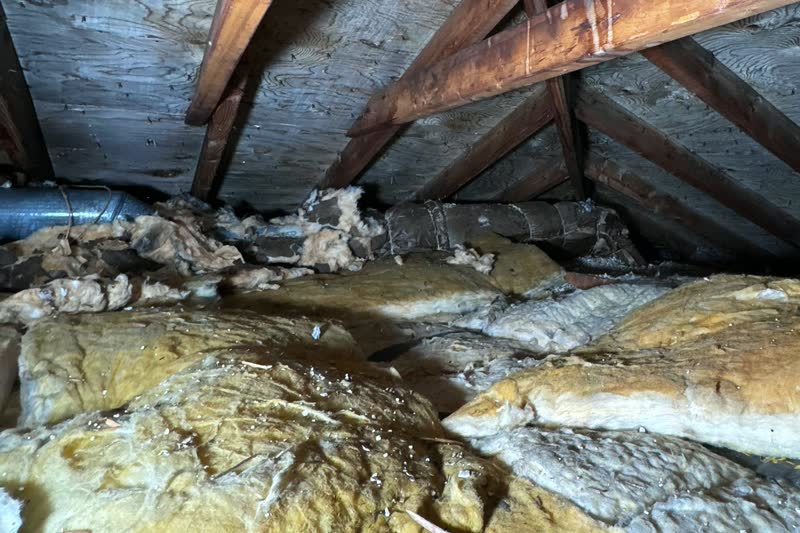
ENERGY STAR's quick test: if the insulation is level with or below the attic floor joists, so you can easily see the joists, you should add more. Our guide on how to tell if your attic needs more insulation shows how to check the depth safely from the hatch.
The hatch or pull-down stairs
The panel or stairs into the attic is part of the ceiling too. If you can see light around it, feel air moving past it, or find no insulation on its back, warm air is getting out there. Our guide to attic stairs and hatch insulation explains the weatherstripping, insulated covers and dams that fix it.
Air leaks in the attic floor
Gaps around ceiling lights, wire and pipe holes and the chases around flues and ducts let heated air up into the attic. A Department of Energy guide to air sealing puts the payoff from sealing uncontrolled air leaks at 10 to 20 percent of heating and cooling bills. Our guide on why air sealing comes before insulation explains the order of work.
Savings vary. Find out why in the seller's fact sheet on R-values. Higher R-values mean greater insulating power.
Ducts that run through the attic
ENERGY STAR says that in a typical house about 20 to 30 percent of the air that moves through the duct system is lost to leaks and poorly connected ducts. In January, leaky attic ducts spill heated air into a cold attic. Sealing the runs that can be reached is attic work we do; resizing or replacing a duct system is a job for an HVAC contractor.
Does the work have to wait for spring?
No. Our guide on installing attic insulation in winter explains how a cold-weather job goes and what to do before the crew arrives.
Help That Is Already Out There
Duke's Home Energy House Call is a free in-home energy assessment that comes with free energy-saving products; Duke's page says you must have a heat pump, electric heat or central air to qualify. Duke also pays rebates for attic insulation done with air sealing, and for duct sealing, when the work is done by a contractor in its Smart $aver network.

Our guide to insulation rebates in North Carolina covers Duke's rebate rules, the state's Energy Saver North Carolina program and free weatherization for income-qualified households, and says where co-op and city-power customers should look instead. To see the programs for your own town or county, use our rebate and utility finder.
Get a Free Estimate
Want to know whether the attic is costing you before the new rates start? Tell us the attic's square footage, or let us work it out from your home's footprint, and we'll price the sealing and insulation. If the attic is already in good shape, we'll say so.

Prefer to talk? Call (336) 780-7227.