Where Heat Leaves a North Carolina House in Winter: A Part-by-Part Map
Where does the heat go in winter? In a typical North Carolina house, it leaves in a handful of predictable places: up through the attic floor, out of ductwork running through the attic, down through the floor over a vented crawl space, and out through walls, windows and the wall shared with a garage. Some of it leaks out as warm air. Some of it moves straight through materials that are thin on insulation.
This matters more here than in many states. In the U.S. Energy Information Administration's 2020 survey of home energy use, 62 percent of North Carolina homes heated mainly with electricity, so the heat a house loses shows up on the December and January electric bills. If you want the bill checklist first, our guide to a high winter electric bill starts there. This post is the map of the house itself.
Savings vary. Find out why in the seller's fact sheet on R-values. Higher R-values mean greater insulating power. In blown-in fiberglass, the attic insulation we install, ENERGY STAR's estimating figure puts R-38 at about 15 inches and R-49 at about 20; the coverage chart of the product used gives the exact installed thickness for each R-value.

How Heat Leaves a House
Heat moves from warm to cold. In winter it leaves a house two ways. It passes through the ceiling, walls and floor, faster where there is little insulation. And it rides out with warm air that escapes through gaps, while cold air comes in lower down to replace it.

ENERGY STAR's guide to sealing and insulating explains the pattern: in cold weather, warm air rises like it does in a chimney, escapes into the attic, and pulls cold air in around windows, doors and holes lower in the house. So the place you feel a draft is often not the place the heat is leaving.
1. The Attic Floor
The attic floor is the top of that chimney, so it is usually the first place to look. Two things go wrong there. The insulation is thin or uneven, and the gaps under it let warm air through.

North Carolina's energy code calls for R-38 in the ceiling of a new house. ENERGY STAR recommends adding R-38 to R-49 over an attic that already has 3 to 4 inches. Many older North Carolina houses have far less than that, packed down over the decades and by boxes stored on top.
- Low or uneven depth. If you can see the tops of the ceiling joists, there is not much insulation over them.
- Dark or dirty patches. ENERGY STAR notes that dark spots in insulation come from filtering dusty house air, a sign of a leak below.
- Open holes and chases. Wire and pipe holes, the tops of interior walls, dropped soffits and the gap around a flue all open into the attic.
- The hatch or pull-down stairs. A thin lid with no weatherstripping is a hole in the ceiling you can see from the hallway.
Fixing the attic floor
The holes are sealed first, while they can still be reached, then insulation is blown in to an even depth. Our guide on why air sealing comes before insulation explains the order.
Rather Talk It Through Than Read?
Call (336) 780-7227Monday to Sunday 8:00 am to 5:00 pm.
2. Ducts in the Attic
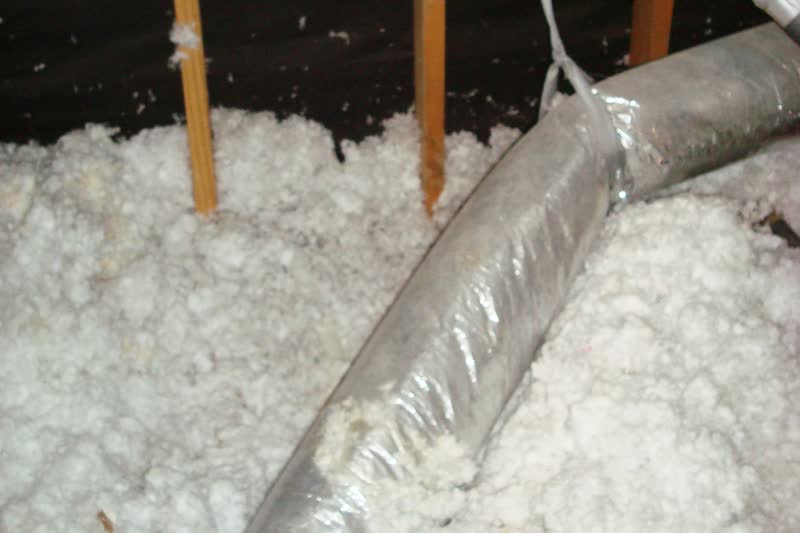
In many North Carolina houses the heat pump's ductwork runs through the attic. That puts the warmest air in the house inside the coldest space of the house.

ENERGY STAR says that in a typical house about 20 to 30 percent of the air moving through the duct system is lost to leaks, holes and poorly connected ducts. In winter, a leaking supply duct heats the attic instead of the bedroom. A leaking return duct pulls cold attic air into the system.
- Loose joints and boots. Look where ducts meet the ceiling vents and where sections join.
- Crushed or sagging flex duct. Kinks slow the air, and a torn outer jacket leaves the duct bare.
- Rooms at the end of a long run. A bedroom that never warms up is often at the far end of a leaky duct.
Fixing the attic ducts
The joints we can reach in the attic are sealed with mastic or foil tape, not cloth duct tape. Our attic duct sealing guide covers what that work includes. Duct repairs inside walls, and the heat pump itself, are jobs for an HVAC contractor.
3. The Floor Over the Crawl Space
A lot of North Carolina houses sit on a vented crawl space. In December that crawl space runs close to the outdoor temperature, and the floor above it is a large cold surface.

North Carolina's energy code lists R-19 for floors over unheated space in a new house in climate zones 3 and 4, and R-30 in the mountain counties of zone 5. In older homes, the batts under the floor have often fallen down or were never installed. You feel it as cold floors and cold air along the baseboards, coming up through holes around pipes, drains and wires.
Fixing the floor over the crawl space
The holes through the floor are sealed from below, then batts are fitted tight to the underside of the subfloor and held in place. Our crawl space floor insulation guide walks through it.
4. Walls, Outlets and the Garage Wall
Exterior walls lose heat through the studs and through any cavity with little or no insulation. Outlets and switches on outside walls leak air too. The Department of Energy's building science guidance says any penetration into the walls can let air flow in and out of the house.

If several outlets on one wall feel cold, or the wall itself feels cold to the touch, the cavity may be empty. A closed wall can be insulated without tearing it out, which our drill-and-fill guide explains.
Watch the wall and ceiling shared with an attached garage. An unheated garage is a cold room on the other side of that wall, and a bonus room over a garage often has the coldest floor in the house. Our garage insulation guide covers both.
5. Windows and Doors
Windows matter, but they are rarely the cheapest place to start.

Before replacing anything, check the easy fixes. Worn weatherstripping, gaps behind the trim and a door that does not close tight are hardware store jobs. Replacing windows and doors is work for a window contractor, and we do not do it.
Which Place to Fix First
Start at the top. The attic floor and the ducts above it are often the largest losses in a North Carolina house, and they are usually the easiest to reach. Then the floor over the crawl space, then the walls.

How much difference any of this makes depends on how the house starts, and nobody can promise a number.
If you want the losses measured instead of guessed, a home energy audit with a blower door test shows how leaky the house is and where. Audits are a paid service with us. For attic, duct and floor work, the estimate is free and lists what will be sealed and insulated. Call (336) 780-7227.
Get a Free Estimate
Cold floors, a cold bedroom at the end of the hall, or a bill that climbs every December? Tell us what you notice and roughly how big the house is, and we'll price sealing and insulating the attic and the floor over the crawl space, and sealing the attic ducts we can reach.

Prefer to talk? Call (336) 780-7227.