What Happens on Attic Insulation Install Day
By the time install day comes, the price is settled. Most attics are priced from the home's square footage, with a special visit only when an attic needs a closer look first, and once you say yes, we set the day with you. What is left is the work itself, and most of it happens before a single bag of insulation is opened.
This guide follows an attic insulation job in the order the work runs: getting the house ready, the crew going over the attic with you, sealing the ceiling, baffles and dams, blowing the new layer, and the last look and the receipt at the end. How long it takes depends on the attic, so there are no clock times here. Insulation Pros blows in loose-fill fiberglass, so that is the material described. If your date falls in winter, our guide to installing attic insulation in winter covers what changes on a cold day.

Before the Crew Arrives: Getting the House Ready
A few small things help, and none of them is a big job. You don't need to clean or clear out the attic itself. What matters is the way in:
- Clear a path to the attic hatch or pull-down stairs.
- Move anything stored right by the hatch, and anything near knee wall doors or closets that open into the attic.
- If we're also working in the garage or the crawl space, clear the way to that door as well.
- Keep pets away from the work area, behind a closed door or outside.
- Mention a hatch you've never opened, or a part of the attic you can't reach, when you book.
- Take a few photos of the attic floor from the hatch. ENERGY STAR suggests this before any work begins, so you have something to compare against afterward.

Do you need to be home?
It helps. The first thing the crew does is go over the attic with you, so you see what they see and hear about anything that changes the job before it's done. If you can't be there, tell us before booking and we'll work out another way.
First, the Crew Goes Over the Attic With You
Nothing gets sealed or blown until the crew has looked the attic over, with you if you're there. The crew goes over the depth of the insulation you have now, the air leaks, any moisture, any sign of pests and the ducts where they run up there. The depth is measured, because the new layer only has to close the gap between what's there and the R-value in your estimate.

If something changes the job, you hear it before work starts. These are the usual ones:
- Wet, moldy or animal-soiled insulation. It comes out rather than getting buried; a wildlife control company removes any mice, and once the mice are gone, a mouse-soiled attic is sanitized and deodorized before anything new goes in.
- Signs of a roof leak, or a bath fan that ends in the attic. First a roofer fixes the leak or we run the fan's duct outdoors, so the new layer isn't headed for the same fate.
- Recessed lights not rated for contact with insulation, and flues. They need clearance, which the dams in the next steps provide.
- Loose, pebble-like fill. That may be vermiculite, and the crew stops and tells you. Our guide to vermiculite attic insulation explains why and what happens next.
Rather Talk It Through Than Read?
Call (336) 780-7227Monday to Sunday 8:00 am to 5:00 pm.
Sealing the Air Leaks in the Ceiling
Insulation slows heat. It doesn't stop air, and air passes straight through loose-fill. So before new material goes down, the gaps in the attic floor are closed, while they can still be reached:
- Gaps around pipes and wiring that come up through the ceiling.
- The tops of interior walls, open chases and dropped soffits.
- Around flues, with metal flashing and high-temperature sealant rather than ordinary caulk.
- Around the hatch itself.

Ducts and fuel-burning equipment
Leaky ducts in the attic are pointed out for sealing, which is a separate job from the insulation. If a furnace, water heater or other equipment in the attic burns a fuel, such as gas, ENERGY STAR passes on the EPA's recommendation to have a professional HVAC contractor test combustion safety after any air sealing. That test is a heating contractor's work, not ours. Our guide on why air sealing comes before insulation explains the order of the work.
Baffles at the Eaves, Dams at the Hatch
Next comes the prep that keeps the new layer where it belongs. Vent baffles go in between the rafters at the eaves, so the insulation stops short of the soffit vents and outside air can still get into the attic. ENERGY STAR says any attic insulation estimate should include them.

Dams go up around the hatch, so loose-fill doesn't spill out every time it's opened, and around flues and any recessed lights not rated for insulation contact, so the material keeps its distance. Our guide to attic ventilation, soffit vents and baffles explains why the airflow matters.
Blowing the Insulation to an Even Depth
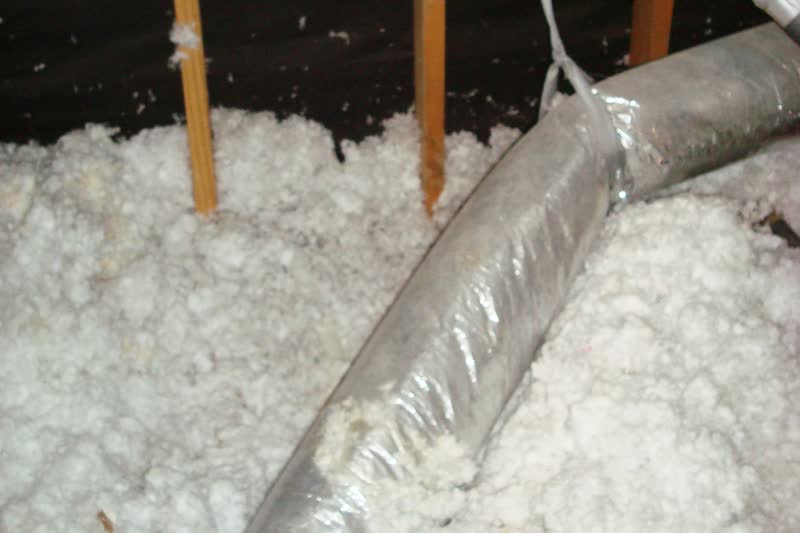
Only now does the hose come out. Before the blowing starts, depth rulers are fastened to the framing in several places, so the depth can be read as the material goes in. The fiberglass is then blown from the far edges of the attic back toward the hatch, so nobody has to walk across fresh insulation to get out.

The goal is one even layer across the whole floor, corners and eaves included, at the depth that reaches the R-value in your estimate. Loose-fill settles a little after it's blown in, so the depth that counts is the settled one, and the bag chart for the product gives both. Last, the hatch itself is insulated and weatherstripped, so the opening isn't the weak spot in a deep new floor.
At the End: a Look From the Hatch and the Receipt
When the work is done, take a look from the hatch yourself. You should see the tops of the joists gone under one even layer that runs out to the eaves, with baffles at the soffits and a dam at the hatch. Hold it up against the photos you took before the work began, and ask the crew about anything you're not sure of.

Then there is the paperwork. Under the FTC's R-value Rule, the installer has to give you a contract or receipt, and for loose-fill it must show:
- The area covered.
- The thickness as first installed.
- The minimum settled thickness.
- The R-value.
- The number of bags used.
Checking it later
The depth rulers stay in place, so you can read the depth from the hatch in a year or five. Keep the receipt with your house papers: it is the record of what went in. If you have a question about the work or the paperwork later, call or email us.
Get a Free Estimate
Ready to set a date, or still deciding? Tell us your attic's square footage, or your address so we can work it out, and we'll send a free written estimate with the R-value the attic will reach.

Prefer to talk? Call (336) 780-7227.