Attic Condensation and Mold: What Causes It and How to Stop It
Attic condensation happens when warm, moist air reaches a surface in the attic that is colder than the air's dew point: the roof deck and its nails in winter, the air conditioning ducts and lines in summer. The moisture nearly always has a source you can fix. It is house air leaking up through the ceiling, a bath, kitchen or dryer vent that empties into the attic, soffit vents buried under insulation, or ductwork that sweats. Mold on the roof deck is what grows when that wetting keeps coming back. Stop the source and the condensation stops.
This guide takes the causes one at a time, then shows how to tell condensation from a roof leak, what the EPA says about growth already there, and the order of repairs that keeps it away. Two of the fixes are our work: air sealing the ceiling, and new attic insulation once the attic is dry. The rest belong to a roofer, an HVAC contractor or a mold remediation contractor, and we say which as we go.
What Attic Condensation Looks Like on the Roof Deck and Nails
Attic condensation is the same thing you see on a glass of iced tea on a July porch. The Building America Solution Center, run by the Pacific Northwest National Laboratory, describes moist air in the attic condensing on cold rafters, trusses and sheathing, producing water droplets that damage the wood and encourage mold. A home inspection note about staining or suspected growth on the roof sheathing is usually describing the result.
Look from the hatch with a strong flashlight first. If you go in, step only on the joists or on boards laid across them. These are the signs:
- Water droplets, frost or rust on the tips of the roofing nails that poke through the roof deck.
- Dark staining or black spotting on the underside of the roof sheathing and on the rafters.
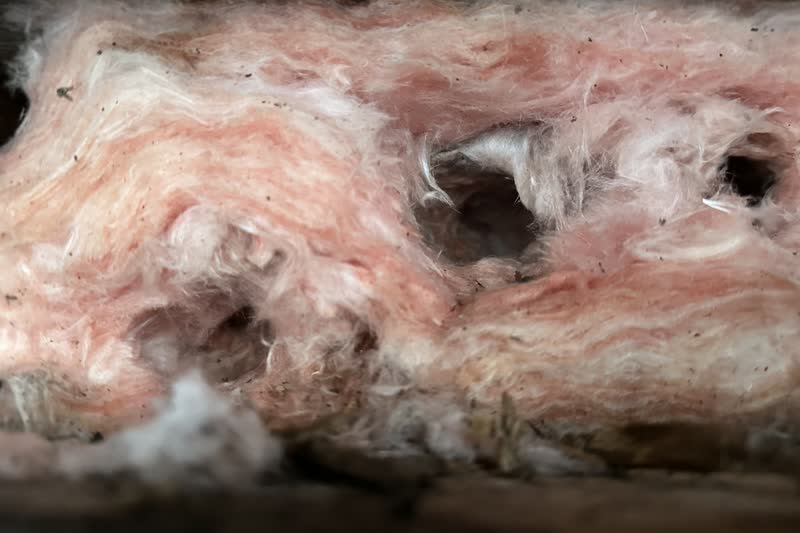
- Damp, matted or stained insulation. ENERGY STAR notes that in cold weather you may see frosty patches where warm, moist house air has condensed and frozen.
- Dark, dirty patches in the insulation, which ENERGY STAR reads as air moving up through a gap in the ceiling.
- Stains or drips on the ceiling below, often near a bath fan or a supply register.
- A musty smell when you open the hatch.
Is attic condensation worse in winter or in summer?
North Carolina gets both kinds. In winter the roof deck is the cold surface and the moisture usually comes from inside the house. The six high mountain counties that the state energy code places in climate zone 5, Alleghany, Ashe, Avery, Mitchell, Watauga and Yancey, have the longest cold spells, but a cold snap farther east does the same for a few days.
In summer the cold surfaces belong to the cooling system, and the moisture is in the outdoor air. The North Carolina Energy Conservation Code puts every county in the moist climate regime, the A in zones 3A, 4A and 5A. So a wet attic in August and a wet attic in January often have different causes.
Cause 1: Warm, Humid House Air Leaking Into the Attic
The most common source of winter attic moisture is the house itself. Showers, cooking, laundry and the people living there all add water vapor to indoor air. Warm air rises, and in a typical older home it finds plenty of gaps in the top-floor ceiling. In the attic it meets the cold roof deck and gives up its water. ENERGY STAR's attic air sealing guide describes exactly this: frost in the insulation in cold weather, and water staining in the same spots when it is warmer.
ENERGY STAR sends you to the big openings first, because that is where most of the air goes: dropped soffits over kitchen cabinets and bath vanities, the open tops of interior walls, the cavities behind knee walls, and the chases around flues and ducts. Then come the wiring and plumbing holes, the recessed lights and the hatch.
Closing those gaps is air sealing. It stops the moisture before it reaches the attic instead of trying to air it out afterwards. It is also why we seal before adding insulation: a deep new layer over open gaps keeps feeding the roof deck, just out of sight. Our guide on why air sealing comes before insulation covers that order of work.
How do you find the ceiling leaks that feed attic moisture?
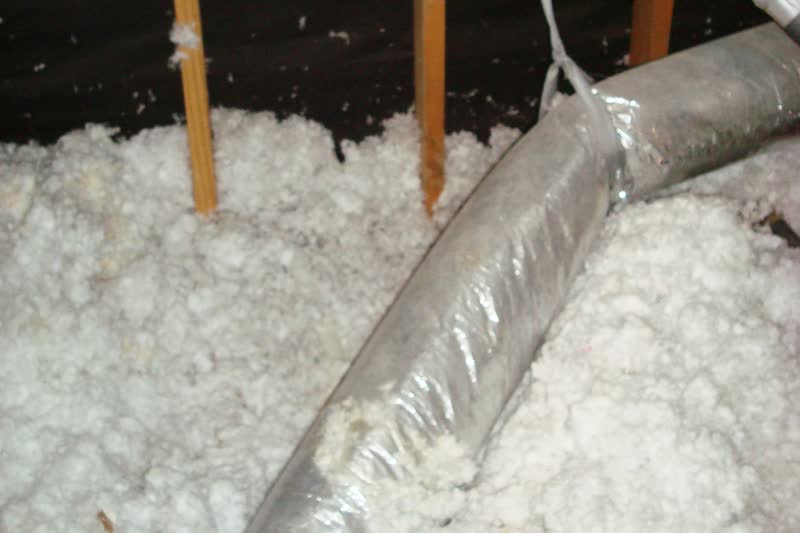
Start with the clues in the attic. Insulation that has turned gray over a wall top or a light fixture has been filtering house air, and the gap is under it. Frost or stains on the roof deck right above a bathroom point the same way. For a whole-house picture, a blower door test measures how much air the house leaks and helps find where. That test is part of our home energy audit, which is a paid service.
Lowering indoor moisture helps too. The EPA recommends keeping indoor relative humidity below 60 percent, ideally between 30 and 50 percent, and a small humidity meter from a hardware store tells you where your house sits.
Rather Talk It Through Than Read?
Call (336) 870-3893Monday to Friday 8:00 am to 5:00 pm. Saturday by appointment. Sunday closed.
Cause 2: Bath, Kitchen and Dryer Vents That Empty Into the Attic
A bath fan that blows into the attic takes the steam from every shower and delivers it to the coldest wood in the house. The Building America Solution Center's guide to checking exhaust fans says that in many older homes the duct never reaches the outside. It stops near a ridge, gable or soffit vent, or lies loose on the attic floor, and the moist air condenses on the rafters and sheathing around it. One of its photographs shows mold on the roof sheathing right above a bath fan duct that ends in the attic.
North Carolina's residential code is clear on this. Section M1501.1 requires the air removed by every mechanical exhaust system to be discharged to the outdoors, and it does not allow exhaust into an attic, a soffit or a ridge vent. Section M1507.2 adds that bathroom exhaust must go directly outdoors and must not discharge into an attic. A duct that ends a few inches short of a vent meets neither.
Checking takes one trip into the attic. Find each fan from below first: bathrooms, kitchen and laundry. In the attic, each exhaust fan has its own duct, separate from the heating and cooling ducts. Follow it to the end:
- It should end at a dampered cap through the roof or an outside wall, with an air-tight connection.
- It should be insulated where it crosses the attic, or it sweats inside. A Department of Energy job checklist calls for at least R-8 on bath fan ducts in unconditioned space, where the local code requires it.
- Smooth metal duct on the shortest, straightest path works best. Long runs, sharp bends and crushed or corrugated plastic duct choke the airflow.
Who reroutes a bath fan duct that ends in the attic?
The same guide says a roofer is typically the best trade to install a vent through the roof or a gable wall, and that an HVAC technician or a skilled handyman can route the insulated duct to it. That part is not our work. We point it out when we see it, seal the fan housing to the ceiling, and keep the duct clear when new insulation goes in. Once it vents outside, the guide recommends running the fan for about an hour after a shower, on a timer switch.
Do dryer vents and range hoods count too?
Yes. ENERGY STAR lists kitchen, bathroom and clothes dryer vents that exhaust into the attic among the problems a professional should correct before attic work, and the EPA says to vent dryers and stoves outside. The code does let a listed ductless range hood recirculate when installed to the maker's instructions, but a ducted hood has to reach the outdoors.
Cause 3: Blocked Soffit Vents and Too Little Attic Ventilation
A vented attic is meant to breathe: outside air comes in low through the soffit vents at the eaves and leaves high through ridge or gable vents, carrying some moisture with it. When insulation is blown over the soffits, or the vents were painted or covered during a siding job, that flow stops and the moisture stays. ENERGY STAR lists little or no attic ventilation among the conditions to correct before attic work begins.
Keeping the soffits open is part of every insulation job we do. Baffles go in at the eaves first, so the new layer cannot choke the intake. Adding roof or ridge vents is a roofer's job.
Ventilation helps, but it cannot make up for the first two causes. More vents will not dry an attic that a bath fan wets every morning, and in a North Carolina summer the air coming in is humid itself. Our guide to attic ventilation covers how much vent area an attic needs.
Cause 4: Sweating Ducts and AC Lines in a Humid NC Summer
In summer the cold surfaces in the attic belong to the air conditioning. Chilled air runs through ducts surrounded by hot, humid attic air. Wherever the duct insulation is torn, squashed or missing, or its outer jacket is split, that air reaches the cold duct and it sweats. A 2024 Building Science Corporation report in its Building America series puts it directly: in hot, humid climates the particular concern is dripping condensation on cold air-conditioning ductwork in summer, which threatens the attic floor with conditions for mold and rot.
The drips land on the insulation and the ceiling below, so summer stains often show up around supply registers rather than on the roof deck. Look at these on a hot afternoon with the system running:
- Supply ducts and the boots at the ceiling registers. A Department of Energy job checklist calls for duct insulation with an attached, continuous vapor retarder, every seam sealed and no bare metal showing.
- The larger copper refrigerant line to the outdoor unit. The EPA's advice for cold surfaces that sweat is to cover them with insulation.
- The air handler's drain pan and condensate line. The EPA says to keep drip pans clean and drain lines unobstructed and flowing.
Why is water dripping from a ceiling vent in summer?
Usually it is condensation, not a roof leak: the boot or duct above that register, where the insulation has slipped or split, or an overflowing drain pan. Look in the attic with the system running.
Duct sealing is part of our air sealing work. Rewrapping ducts and refrigerant lines and clearing a drain are jobs for an HVAC contractor. If there is growth near the return or on the air handler, the EPA's advice is not to run a system you suspect is contaminated, because it can spread mold through the house. Our guide on whether duct sealing is worth it goes deeper on sweating ducts.
Roof Leak or Condensation? How to Tell the Difference
Ask when it got wet and where. A roof leak follows the rain and traces back to one spot. Condensation shows up without rain, spreads over a wide area, and comes and goes with the weather outside and the habits inside. These clues usually settle it:
| Clue | Points to a roof leak | Points to condensation |
|---|---|---|
| When it is wet | During or after rain | Cold snaps, or humid days with the AC on |
| Where it is wet | One area near a chimney, pipe boot, valley or flashing | Wide areas of the deck, or near a fan duct or AC duct |
| What the stain does | Runs down a rafter in a single track | Many small spots, rust on nail tips |
| Insulation below | One soaked patch | Frost or damp patches over ceiling gaps, or under ducts |
What if both are going on?
The roofer still goes first. ENERGY STAR reads wet or damp insulation as a sign of a leaky roof, to be corrected before any insulation work. Photograph the wet areas on a dry day and again after the next rain: a spot that stays wet through a dry week is fed from inside.
Black Spots Already on the Roof Deck: What the EPA Advises
Fix the moisture first, then clean, and never cover it up. The EPA's guide to mold and moisture is blunt about the order: "If you clean up the mold, but don't fix the water problem, then, most likely, the mold problem will come back." It also says not to paint or caulk over moldy surfaces, and the same logic applies to sealing or insulating over them.
Size decides who cleans up. The EPA says that if the moldy area is less than about 10 square feet, roughly 3 feet by 3 feet, most people can handle it themselves. Where growth covers more than that, or there has been a lot of water damage, it points to its more detailed remediation guidance, and says that anyone you hire should have experience cleaning up mold and references you can check.
We do not do mold remediation. When we find growth on the roof deck or framing, we show you photos and suggest an experienced mold remediation contractor before any insulation work. Once the attic is clean and dry, the sealing and insulation are ours. For a small patch you clean yourself, the EPA's guidance comes down to this:
- Wear an N-95 respirator that fits properly, long gloves and goggles without vent holes.
- Scrub hard surfaces with detergent and water, then dry them completely.
- Porous materials such as ceiling tiles may have to be thrown away, because mold works into them. Insulation is porous too.
- Bleach is not recommended as routine cleanup, and it must never be mixed with ammonia cleaners.
- Killing mold is not enough. Dead mold can still cause allergic reactions, so it has to be removed.
- Testing is usually unnecessary when the growth is visible, and no federal limits have been set for mold.
How do you know the cleanup is finished?
The EPA gives a short test. The water or moisture problem is completely fixed. Visible mold and moldy odors are gone, though some staining may remain. A check shortly afterwards shows no new water damage or growth. And people can use the space without health complaints. When all four hold, the attic is ready for sealing and insulation. A stained deck is not necessarily a weak one, but wood that is soft or coming apart in layers is a question for a roofer.
Fixing the Cause: Seal, Vent, Then Insulate
Every attic moisture problem is fixed in the same order: stop the water, clean up, dry out, then seal and insulate. ENERGY STAR lists wet insulation, moldy or rotted framing and fans venting into the attic as problems to correct before any insulation project, and it recommends sealing the attic's air leaks before the insulation goes in. Insulation laid over a damp attic soaks up the same water and hides the evidence.
Insulation that got soaked, grew mold or matted down usually comes out rather than staying under a new layer. Our attic insulation removal service handles that: we vacuum out the old insulation, seal the bare ceiling while every gap is in reach, and blow in the new layer. Our guide on when to replace old attic insulation explains how to tell a top-up from a tear-out. The full sequence usually runs like this:
- Roof repairs. A roofer fixes any leak at flashing, a pipe boot, a chimney or a valley.
- Exhaust ducts outdoors. Every bath, kitchen and dryer duct ends at a dampered cap outside.
- Cooling system. An HVAC contractor puts right sweating ducts, bare refrigerant lines and a blocked drain.
- Cleanup. Growth on the wood is cleaned, by you if it is small or by a remediation contractor, and the attic dries.
- Removal. Wet, moldy or matted insulation comes out.
- Sealing. Wall tops, chases, soffits, wiring and pipe holes, lights, the hatch and leaky duct joints are sealed.
- Clear intake. Baffles go in at the eaves so the soffit vents stay open.
- New insulation. The attic floor is insulated to an even depth at the level recommended for your climate zone.
Who Fixes Attic Condensation: Roofer, HVAC or Insulation Contractor?
Call for help when the growth covers more than about 10 square feet, when you cannot find the source, when the attic is hard to get into, or when the insulation is wet and you do not know why. Moisture problems often involve more than one trade, so it helps to know who does what:
| Problem | Who usually fixes it |
|---|---|
| Roof leak or soft roof deck | A roofer |
| Fan duct ending in the attic | A roofer for the cap; an HVAC technician or handyman for the duct |
| Sweating ducts, lines or drain pan | An HVAC contractor |
| Growth over about 10 square feet | A mold remediation contractor with references |
| Leaky ceiling and duct joints | Air sealing and duct sealing: our work |
| Wet, moldy or matted insulation | Removal and new insulation: our work |
| Insulation blocking soffit vents | Baffles: part of our insulation work |
What happens when you call us about attic moisture
A wet attic is the kind that needs a closer look, so this is one of the times we make a special visit. We look at the roof deck, the insulation, the fan ducts and the ductwork, show you photos, and tell you which causes are ours and which belong to another trade. Then you get a written estimate for our part only: the sealing, any removal and the new insulation. The roofer, HVAC contractor or remediator goes first, and we follow once the attic is dry.
Get a Free Estimate
Wet nails, a musty smell at the hatch or a ruined layer of insulation? Tell us what you're seeing and how big the attic is. Once the cause is fixed and the attic is dry, we price the sealing, the removal and the new layer, and nothing the attic doesn't need.

Prefer to talk? Call (336) 870-3893.