DIY Blown-In Attic Insulation: Machine Rental, Bags and When to Hire
Yes, you can blow insulation into your own attic. Know what the sources say first: the insulation fact sheet from the U.S. Department of Energy advises hiring a contractor for loose-fill, and ENERGY STAR rates the project moderate to difficult. Both still explain the work. This guide to DIY blown-in attic insulation follows them through the safety checks, the machine rental, the bag count, the parts no bag includes and the steps.
We blow in attic insulation, and vacuum out old attic insulation, in homes across North Carolina, so we also say when the honest advice is to stop. There are no prices and no product picks here. A store is named only for what its own pages said on the day we read them.
Is Attic Insulation a DIY Job? Can You Insulate an Attic Yourself?
It can be, when the attic is an open floor with room to move and nothing wrong in it. ENERGY STAR's test: if the attic is easy to reach and to move around in, and you like bigger projects, it may be a good do-it-yourself job, one that takes a homeowner one to three days.
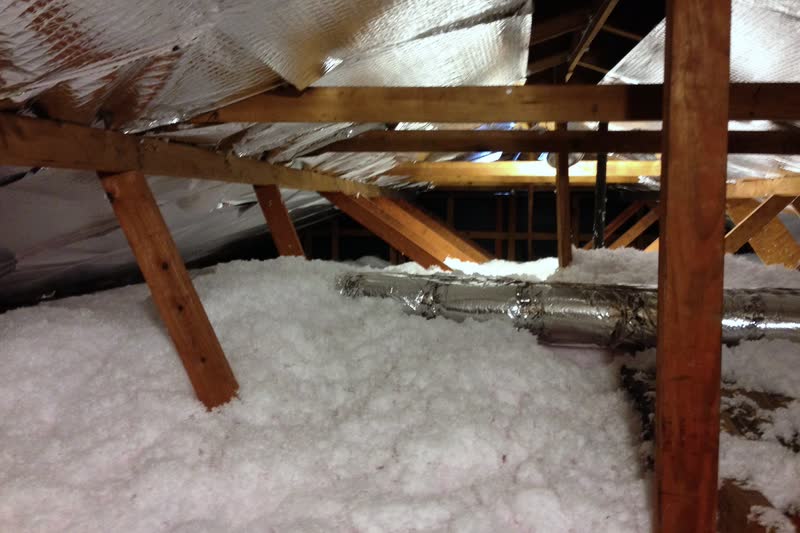
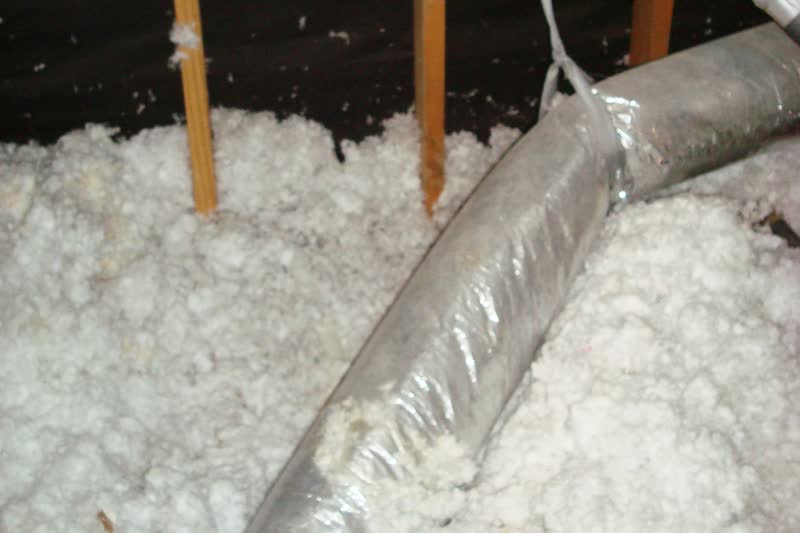
You have two ways to go. Rolls laid across the joists need no machine, and ENERGY STAR calls them the easiest for a do-it-yourself job. Loose-fill flows around wires and framing where a roll has to be cut. The trade-off is a blowing machine, a helper and a lot of dust.
Attic insulation safety: what to check before you start
Look before you buy anything. Each item below is a reason ENERGY STAR, the EPA or OSHA gives for caution, and some of them end the do-it-yourself plan.
- Vermiculite. Loose, pebble-like fill in gray-brown or silver-gold may contain asbestos. Treat it as if it does, the EPA says: leave it alone and never remove it yourself.
- Old wiring. ENERGY STAR puts knob-and-tube wiring, a method from before 1930, on its list as a fire hazard when insulation lies against it. Have an electrician look first.
- Recessed lights. Keep insulation 3 inches from any can light not marked IC, for insulation contact. With loose-fill, ENERGY STAR says to ring the fixture with sheet metal or wire mesh.
- Flues and chimneys. ENERGY STAR says building codes generally want a 1 inch gap at a metal flue and 2 inches at a masonry chimney, kept open by a sheet-metal dam.
- Moisture. Wet insulation, moldy or rotted framing, and a bath, kitchen or dryer vent that empties into the attic all have to be put right first, by ENERGY STAR's list.
- Heat and footing. Go up early, drink water and step only on joists or on boards laid across them. OSHA treats extreme attic heat as a serious hazard for the people who do this work.
- Protective gear. ENERGY STAR's list: safety glasses, gloves, a dust mask, a disposable coverall, kneepads and a hat or hard hat. OSHA's advice to insulation crews adds long sleeves and long pants for fiberglass and a dust respirator for cellulose.
Blown-In Insulation Machine Rental: How an Attic Insulation Blower Rental Works
Some home improvement stores rent the blowing machine, as ENERGY STAR points out. It stays on the ground, outside or in the garage, and a helper feeds it bags while you work the hose in the attic. Before you take one home, ask the store:
- Which insulation it is for. A rental blower may be made for one product only.
- The terms: minimum purchase, deposit, hours allowed and what a late return does.
- The hose length, and whether it reaches the far end of the attic.
- The power it needs and what it weighs, so you know it suits your circuit and your vehicle.
- Whether one is available on your day. Reserve it before you buy the bags.
Blown-in insulation machine rental at Home Depot
We read Home Depot's rental pages on October 13, 2026. They list two insulation blowers, one for cellulose and one for fiberglass. Each page offers the first day free when you buy 10 bags of that insulation, and each machine has 100 feet of hose and is listed at 165 pounds. The cellulose blower works with one maker's cellulose only. The fiberglass one uses a 15 amp circuit, and its model and availability vary by location. Both pages mention a deposit, payment by credit card and a valid ID. Terms change, so read the page for your own store.
Buying blown-in attic insulation at Home Depot, Lowe's or another home center: what to read on the bag
Home centers sell loose-fill by the bag, as cellulose or fiberglass. The Home Depot listing we read carried a bag calculator, labeled an estimate only. Lowe's website has a blown-in insulation department and a blown-in insulation calculator too. We could not open its pages when we wrote this, so we cannot report its machine terms. Ask at the store.
At any store the facts are on the bag. A Federal Trade Commission rule requires a coverage chart on every package of loose-fill, and it requires stores that sell to do-it-yourself customers to make the maker's fact sheet available, in the store or beside the online listing. Read these before you pay:
- The material and the net weight of the bag.
- The chart row for the R-value you plan to add: bags per 1,000 square feet, thickness to blow and settled thickness.
- The blowing machine and setting behind the chart, which the label must name.
- On cellulose, the fire caution the Consumer Product Safety Commission requires about recessed lights and flues.
Rather Talk It Through Than Read?
Call (336) 870-3893Monday to Friday 8:00 am to 5:00 pm. Saturday by appointment. Sunday closed.
Blown-In Insulation: How Many Bags Do You Need?
Count from the chart on the bag, not from a rule of thumb. The Federal Trade Commission's rule makes the chart show, for R-13 through R-49, the bags per 1,000 square feet and the thickness. For the targets in your county's climate zone, see our guide to attic insulation R-value in North Carolina. The method:
- Measure the attic floor: the length times the width of the ceiling below.
- Work out what is there. ENERGY STAR's figures are depth in inches times 2.5 for loose fiberglass, 3.7 for cellulose and 3.2 for fiberglass batts.
- Set the amount to add. In North Carolina's three climate zones, ENERGY STAR's chart adds R-38 to R-49 over 3 or 4 inches of old insulation and R-49 to R-60 in an empty attic, depending on your county's zone.
- Read the bags per 1,000 square feet from the chart row at or just above that number, multiply by your square feet and divide by 1,000. A 1,400 square foot attic and a row of 20 bags comes to 28.
- Over old fiberglass, allow about one extra inch. The U.S. Department of Energy's fact sheet says the new layer presses the old one down.
- Blow to the chart's installed thickness and use at least its bag count. The right depth with too few bags is a fluffed layer, which a Department of Energy guide for contractors says settles too far and loses R-value.
- 1Ceiling joists. Insulation level with or below the tops of the joists usually means the attic needs more.
- 2Existing insulation. Many older attics have only 3 or 4 inches.
- 3Loose-fill on top. R-values add up: new insulation over a sound older layer counts on top of it.
- 4R-38. About 15 inches of loose-fill fiberglass or 10 inches of cellulose. North Carolina's code minimum for the ceiling of a new home.
- 5R-49. About 20 inches of loose-fill fiberglass or 13 inches of cellulose.
- 6R-60. About 24 inches of loose-fill fiberglass or 16 inches of cellulose.
The marker shows depths for loose-fill fiberglass. Every depth is a rough guide: blown-in insulation settles and products differ, so the coverage chart on the bag has the real numbers.
Is There a Blown-In Insulation Kit?
Not one box that holds the whole job. Stores sell the bags and supply the machine, and the rest is bought piece by piece. Three of those pieces have their own sections below. The others:
- A barrier for each recessed light that is not IC rated: sheet metal or wire mesh, or a ready-made cover. The Department of Energy's job aid keeps 3 inches clear on all sides and the top free of insulation.
- Aluminum flashing and high-temperature caulk for the flue dam.
- Caulk and cans of expanding sealant for leaks in the attic floor.
- Flags for junction boxes, so covered wiring can be found again.
- Boards to kneel on, a work light and the protective gear above.
Attic insulation baffles
Baffles, which ENERGY STAR calls rafter vents, keep an air channel open above the insulation at each soffit vent. Buy one for every rafter bay that has a vent. ENERGY STAR describes them as 4 feet long and 14 1/2 or 22 1/2 inches wide, to match the rafter spacing, stapled to the roof deck. The Department of Energy's job aid wants 1 to 2 inches of air space between the baffle and the roof deck, and North Carolina's energy code allows any solid material that rises above the insulation. Loose-fill needs one more piece, a block at the outer edge of the wall plate such as rigid foam board, to keep it out of the soffit.
Attic insulation depth markers
Depth markers are rulers fastened to the trusses or joists. You read them while you blow, and anyone can check the depth years later. The Department of Energy's job aid installs one for every 300 square feet. North Carolina's energy code asks the same in a new house, with numbers at least an inch tall and each marker facing the hatch. Mark every ruler at the installed thickness from the bag chart before you start.
Attic insulation door cover, hatch cover and dam
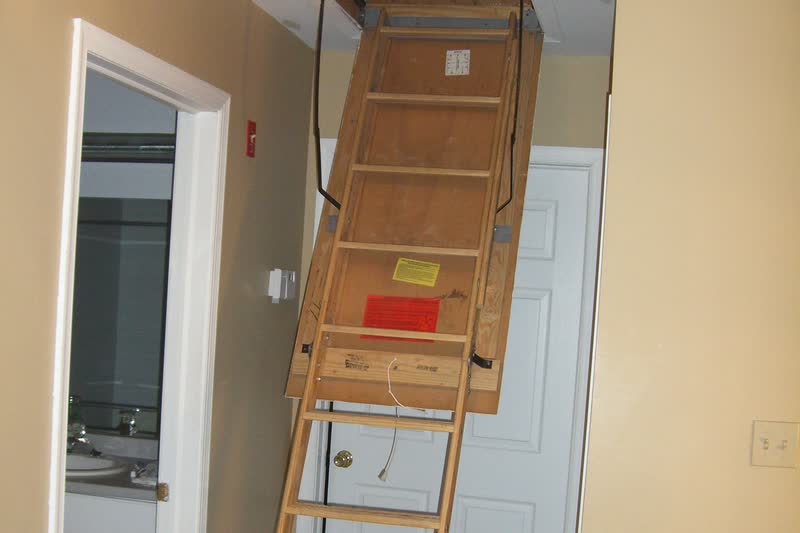
An attic door is a hole in the insulation until you treat it, and it takes two parts. The dam is a rigid frame around the opening that keeps loose-fill from spilling into the house, and the Department of Energy's job aid makes it at least 2 inches taller than the finished insulation. The cover is insulation on the door itself, plus weatherstripping. ENERGY STAR says to treat the opening like a door to the outside: foam board on the back of a hatch, or a ready-made insulated cover over pull-down stairs. North Carolina's energy code asks R-10 of a hatch and R-5 of pull-down stairs in a new home.
DIY Blown-In Insulation: How to Install Attic Insulation Yourself, Step by Step
Blowing is the short part, and the preparation decides how the job turns out. The Department of Energy's job aids for weatherization crews and ENERGY STAR's guide put the work in this order:
- Clear the attic floor, and run any bath fan duct to the outdoors.
- Close the leaks in the attic floor while you can still reach them. The details follow this list.
- Guard recessed lights that are not IC rated, build the flue dam, and cover and flag junction boxes.
- Fit a baffle and a wall-plate block at each vented rafter bay.
- Fasten and mark the depth markers, and build the hatch dam.
- Set up the machine, lay boards to work from and put on your gear.
- Start at the eaves farthest from the hatch and work back to it, reading the markers as you go. Keep material out of the baffles and the dammed-off spaces.
- Count the empty bags against the chart, then insulate and weatherstrip the hatch.
- Write down the date, product, square feet, depth, bag count and R-value, and keep the note by the hatch. An installer would owe you the same record under the Federal Trade Commission's rule.
How to air seal an attic before you insulate
Seal first, because the new layer buries every leak. ENERGY STAR's order is the big holes, then the small ones. The usual hiding places are laid out in our guide on why air sealing comes before insulation.
- Open stud cavities and the boxed-in soffits above kitchen cabinets or a bathroom vanity: plug them, then cover them with rigid board or foil sealed at the edges.
- Wire and pipe holes: caulk for gaps up to 1/4 inch, expanding sealant from a can for gaps up to 3 inches.
- Flues and chimneys: metal flashing and high-temperature caulk only, never the canned sealant.
- The hatch: weatherstripping, and insulation on its back.
- Gas or oil appliances: ENERGY STAR suggests having their venting tested before and after the sealing.
How to install blown-in insulation without a blower: can you spread it by hand?
For a patch, yes. The Consumer Product Safety Commission defines cellulose insulation as loose-fill suited to blowing or pouring, so a low spot or the corner by the hatch can be topped up from an open bag and raked level. A whole attic is another matter. The Federal Trade Commission's rule has the bag name the blowing machine and setting behind its coverage chart, so the installed thickness printed there describes machine-blown material, not material spread by hand. With no machine, ENERGY STAR's easier route is unfaced rolls laid across the joists.
DIY attic insulation mistakes that cost money
- Blocking the eaves. ENERGY STAR calls covering the soffit vents the most common mistake homeowners make.
- Insulating over leaks that are easy to reach today and buried tomorrow.
- Fluffing: the right depth with too few bags settles below the R-value you paid for.
- Burying heat. Insulation against a flue, or over a can light that is not IC rated, is the fire hazard the caution label on cellulose warns about.
- Covering wet, moldy or animal-soiled material, which hides the damage and fixes nothing.
- Storing boxes on top. Squeezed loose-fill is thinner and has a lower R-value.
When Hiring an Attic Insulation Contractor Is the Better Call
Hire it out when the attic fails the safety check. ENERGY STAR's list of reasons to call a professional first is cramped or hard access, wet insulation, moldy or rotted framing, fans venting into the attic, poor ventilation and knob-and-tube wiring. Vermiculite stops the job outright, and the next call is to a professional asbestos contractor.
Hire it out, too, when old insulation has to come out first, or when you cannot give the job a helper and a few free days. Taking out wet, moldy or animal-soiled insulation is dirtier work than blowing in new, and ENERGY STAR itself says most people prefer to have someone else crawl around a dusty attic.
That is our work. Insulation Pros blows in loose-fill fiberglass, vacuums out old attic insulation when it has to go, and seals the attic floor first. In most homes the new insulation goes in right after the old comes out, and if you only want the removal, we take on that job by itself as well. Wiring, roof leaks, animals and asbestos are jobs for other trades, and we tell you when one of them must be handled first. Tell us the attic's square footage and we'll price the job, free and in writing, so you can hold it up against the rental, the bags and your weekend.
Get a Free Estimate
Weighing a rental blower against hiring it out? Tell us the attic's square footage and we'll give you a price to compare. If your attic is a fair DIY job, we'll say so.

Prefer to talk? Call (336) 870-3893.